Archive for the ‘Aging’ Category
The Cost of Living . . .
. . . keeps on increasing,

but it’s still high on everyone’s list.
= = = = =
Aging Politicians
Ignore Aging Population
While there have been loud voices bemoaning the fact that we’re not paying enough attention to climate change, there isn’t even a whimper about what’s happening to our population change.
It’s paradoxical that the greying heads in government are paying little attention to the graying of their constituents.
The voters’ rolls are adding 10,000 over-65ers every day. You’d think that all those silver-haired politicians would be looking hard at how to accommodate the needs of folks who are growing old just as they are. Even the aging talking heads on television seem ignorant of what’s concerning a growing segment of their viewers.
The apparent reasoning for this blindness to a massive problem is the mantra that 70 is the new 50. And the spreading myth that age is simply a state of mind. Several studies topple this trend in thinking by supporting what we’ve always known – ailing and aching increase as you get older.
No matter how Pollyannaish we may feel, our odds of falling victim to such widespread debilitations as Alzheimer’s disease increase the longer we live.
As the aging population grows, the birth-rate is diminishing as women are having fewer children.
While health-care is high on the list of promises by those seeking votes, the focus usually is on the young who have inadequate coverage rather than the elderly who cannot care for themselves.
Another major concern is the strength and stability of Social Security. Predictors tell us there will be about two workers supporting each recipient by the early 2030s. This was not in any forecasts when there were more than 45 workers for each recipient of benefits when the program was instituted back in the 1930s.
Meanwhile, aging and aged politicians seeking election and re-election to Congress and Senate in Washington, DC, suggest it might be a good idea to push back the age for receiving Social Security benefits that seniors have paid into all their working lives.
A sign of the widening awareness that aging has its problems, not only for the aging but for those around them who care, are recent reports that three-quarters of respondents to a survey indicated doctors should be allowed to help a patient die peacefully and painlessly if there is no possible cure.
Medically assisted deaths are legal in 10 states — Maine, New Jersey, Vermont, New Mexico, Montana, Colorado, Oregon, Washington, Calfornia and Hawaii.
Canada’s medical assistance in dying (MAID) program adopted in 2016 was aimed at individuals with terminal illness. It was changed in 2021 to include anyone with a serious or chronic condition that isn’t life-threatening.
I Didn’t Realize . . .
. . . how many dear old gals
knew the F word

until I heard on of them yell
“Bingo!”
= = = = =
Another busy Friday with
bocce, billiards, bridge & bingo.
= = = = =
Get Busy to Do Nothing
Most people have figured out what they’re going to do when they retire.
Travel, visit the kids, play golf, grab some coffee with old friends, and go fishing are high on the list of plans.
But most people haven’t figured out what their going to do when there’s nothing left they want to do.
There’s an art to doing nothing when you know you can do anything you want to do whenever you want to do for as long as you want to do it.
So you might want to start practicing.
Recent studies indicate doing nothing – giving your brain a rest — can actually stimulate your mind. Researchers report that sitting back and doing nothing for a spell can refresh your brain and enhance your creative abilities.
Studies have revealed that, when boredom sets in, your brain is actually daydreaming – and those dreams can be productive.
However, doing nothing all the time can calcify your thinking.
To start doing nothing, get away from your television set, mobile phone, book, jigsaw puzzle or whatever else around you that can command your attention.
Some experts suggest you start doing something boring, like counting cars streaming by your window or stroll down to the nearby park to stretch out on a bench and stare into the pond or at the overhead clouds.
Killing time by wandering through the internet, meditating or checking messages doesn’t work because they don’t allow your mind to wander, to daydream. The idea is to eliminate all stimulation and activity so your body and your mind and emotions can do nothing.
Even listening to music can be a distraction when you’re trying to do nothing.
If you have to be doing something, try coloring in a coloring book – something that keeps our hands busy but doesn’t require any brain work.
These do-nothing periods can not only boost your awareness as you proceed through the day, they can help develop more creative pastimes to help you enjoy the times when you’re not doing nothing.
Don’t Know How . . .
. . . anyone else feels,
but I’ve found that
growing old

has come at a very inconvenient time.
= = = = =
Taos Pueblo Houses Magic, Mysticism
By Silvia Shepard-Lobanov
Hi ne ya
Dal tso hozho ni
All is beautiful, beautiful
Dal tso hozho ka
All is beautiful
Pueblo Indians carry a certain magic about life. They know about p’o (the moon), sip’ophe (the underworld) and ‘opa (everything). And, that song and the universe are one. They always have been one with the land, sensitive to its beauty. Their whole being is open to the glory of life in their valley. Indeed, the word “taos” means “place of red willows” in their native Tiwa tongue.
They believe all nature’s elements — the snow, the land, the sharp mountains, life itself — flow into their essence and make them look vibrant and purposeful, but act shy.
Silence is an important element in their nature. Solitude often is their way of communicating. To the stranger, they may not utter a word, yet one can feel a new force passing between you. Through hundreds of years, when bitter cold embraced the harsh landscape and there was almost no food to eat, Pueblo chiefs would go to the kivas, below-ground centers of religious ceremonies. The drums would start the chanting and accompany a dance whose steady cadence transported those present to the future when corn, wheat, and beans would once again be plentiful. Each generation learns that winter is only part of a cycle: that it will go away. The cold will go because the people in the pueblo command it to go, they say. They concentrate. Be the summer.
Be the warmth.
Author D.H. Lawrence sensed the area’s powerful natural force. “The moment I saw the brilliant, proud morning sunshine high over the deserts of Santa Fe, something stood still in my soul and I started to attend.”
For Pueblo Indians, the stillness helps them hear the energy of the universe. They see themselves as eternally knowing, part of the creation of the cosmos — secret knowledge given by their ancestors that should remain theirs alone. But it is their eyes that reveal the great sweep of life within them: the invisible fire.
A Friend Recently .. .
. . .mulled replacing some of her furniture

but she gave it up because she said
she and her recliner go way back.
= = = = =
Caregivers Pay Economic, Emotional Prices
Besides the shoulder-stooping emotional cost of caring for ill and ailing loved ones, there is can be an enormous economic price to pay by the more than 22 million U.S. families who provide such care.
Caregiving costs individuals some $660,000 over their lifetimes in lost wages, and lost pension contributions and Social Security because they take time off, leave their jobs or miss out on opportunities for training, promotions, and plum assignments.
Almost 85 percent of employees reportedly make adjustments to their work schedules by taking sick leave or vacation time, decreasing work hours, taking a leave of absence, switching to part-time employment from full-time, resigning, or retiring.
Elder care has more negative impacts on workers than does child care, particularly for those who are the primary caretakers for an older adult. Taking care of an aging parent is always difficult, but it is even more difficult for employees who have to care for their parent in their own home. It essentially means employees have a second shift of work when they get home.
As the population ages, the number of caregivers grows and the personal and corporate costs rise. Employees who care for elderly or sick relatives with long-term-care insurance are twice as likely to stay in the workforce as are workers who care for relatives without coverage, according to data from three MetLife institute surveys.
In addition, working caregivers of loved ones with long-term-care insurance coverage are less likely to experience such types of stress as having to provide constant attention to the care recipient or having to offer caregiving while ailing themselves.
Attention All Bocce . . .
. . .aficionados ! ! !

It’s Friday again
so dive into your playing gear
and climb aboard the team bus
at the Verena front door at 11 a.m.
= = = = =
Mental Exercise Sharpens Seniors’ Mind
A few mental push-ups here and there can help keep an older adult’s mind just about as sharp as ever — much the same way physical exercise can help maintain physical fitness, according to the Pennsylvania State University’s Gerontology Center. Researchers worked with 5,000 men and women for more than three decades and found less than half showed a decline in mental ability, even those aged 74 to 81.
Does mental ability start to decline in middle age? Ridiculous, not even at age 60, they report. Just as you can maintain physical well-being as you age by exercising and eating properly, you can maintain mental well-being by engaging in stimulating activities, continuing to make decisions and leading an active life.
Mind-sharpening exercises include watching television informational programs rather than soap operas, playing bridge instead of bingo, playing blackjack instead of slot machines, and taking up word games like Scrabble or anagrams. They even recommend square-dancing because not only is it good for you physically, it’s also mentally challenging because you have to follow intricate patterns chanted by the caller.
OK, We’re In . . .
. . . what used to be called a “rest home.”
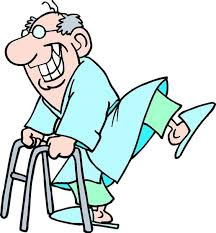
Sunday is a day of rest,
so what the heck do we do
the rest of the week?

If You Haven’t . . .
. . . gotten out of the house for a bit,
just pin a $1 bill to your collar

for The Wearin’ o’ the Green on St. Paddy’s Day.
As for me,
I’m gonna pour a wee dram o’ good ol’ Paddy Irish whiskey.
= = = = =
Cut Through Long-Term-Care Costs
It may turn out that you need long-term care for only a short time, but it’s a critical health-care term in all our lives. It normally deals with the last months of your life and those around you.
Researchers agree on one thing: most people are not well-informed about long-term care and its implications for both their physical and fiscal health.
The problem grows larger as our population ages — current 65-year-olds are expected to live another quarter century — and as myths and misconceptions about this misunderstood matter grow more widespread.
Almost 70 percent of Americans are worried about paying for long-term care, according to a National Council of Aging report, compared with some 55 percent who are concerned about paying for their retirement. Four out of 10 people 65 years of age or older believe Medicare or Medigap (Medicare supplemental insurance) pays for long-term nursing-home stays, according to a Financial Planning Association study.
The reality is that Medicare will pay for a limited number of days for “short term” nursing-home care under certain circumstances. It does not pay for long-term custodial care.
Another popular myth is that Medicaid picks up the tab for long-term care. It does pick up 50 percent of the tab if you’re poor enough to qualify. In addition, your income from Social Security and any other pension must go toward the bill.
Adding more pain to the process is the confusion within the long-term-care-insurance industry. Premiums veer drunkenly in all directions.
For example, a 70-year-old person buying a comprehensive policy with a four-year benefit period, 60-day elimination period, $100 daily benefits and inflation protection can pay between $2,700 and $4,000 a year, depending on what company is chosen. The annual cost of a similar policy in another state with a lifetime-benefit term and 20-day elimination period can range from $4,600 and $5,500.
The National Council on the Aging has some tips to help you shop for long-term-health-care insurance.
The first thing to do is take your time and find a reputable independent sales person who can sell policies for several companies. Check the stability of the companies whose policies you’re considering. Then read a specimen policy contract thoroughly and make sure you understand what you’re buying. You don’t need multiple policies. One good policy is enough.
= = = = =
I’ve Never Told . . .
. . .this to anyone before but,
when I found out
what electricity could do,

I was shocked.
= = = = =
Mature Motorists Slowing Down
The “get ’em off the road” gang is after aging drivers again. This happens every time a silver-haired motor-vehicle operator gets into an accident.
Take away their license. Test them every year. Let them walk. They bring out the statistics that senior drivers are the second-most accident-prone segment of American’s motoring public. However, the single-most road-risky group are teen-aged drivers. But no one suggests taking away their licenses.
Detractors of senior drivers suggest taking driving licenses away at a certain age. How about holding back drivers’ licenses to young people until they reach a certain age? Neither of these suggestions make sense.
Age is not the problem. The problem is common sense and competence behind the wheel.
It is estimated that one out of every five of the nation’s drivers will be older than 65 by 2030. A Massachusetts Institute of Technology study indicates that most older drivers limit or stop driving on their own as they perceive their capabilities diminishing.
About 70 percent of more than 3,800 drivers 50-years-and-older queried said they restricted their driving under a variety of conditions. These included bad weather, heavy traffic, rush hour, night time, long distances, and freeways.
Older drivers apparently develop strategies to compensate for failing vision, slower reflexes, stiffer joints, and medication, according to researchers. They can help their cause by supporting physical improvements such as signs that are larger and less complex, improved lighting and enhanced visibility at intersections, and remedial-driving programs.
= = = = =
 Mature Life Features