Archive for the ‘Health’ Category
While Tomatoes and Avocados . . .
. . . are fruits,

it’s not a good idea to put them in a fruit salad.
And did you know that avocado peel
is extremely healthy but,
because it’s so bitter and chewy,
few people eat it.
= = = = =
Follow The Doctor’s Orders
Taking medications correctly at the right time and in the right way as prescribed by your doctor can help control any medical issues. While not doing so can some grim consequences, not everyone follows those rules because they’re too busy, feel good without the medications, have pills too big to swallow or any number of other excuses.
About 30 percent of medication prescriptions are never filled, according to the Centers for Disease Control and Prevention (CDC). In 50 percent of cases studied, patients don’t continue medication as prescribed. This non-adherence to doctor’s orders causes as much as 50 percent of chronic disease treatment failures and 125,000 deaths per year.
One of the two most-common reasons medications are not taken as prescribed is, “I’m feeling better. I can stop taking medication.” Not taking medications as prescribed by your doctor can result in several negative outcomes.
If, for example, you’ve started on a new blood-pressure medication but you’re not taking it regularly, it may not properly control your blood pressure. If your doctor thinks you’re taking the medication as prescribed, they may look at high blood-pressure readings as a sign that you need additional medication.
The other most common reason for not following the prescribed medical course is, “My medication is too expensive. Missing one dose or taking a half-dose here and there to save a little shouldn’t be a big deal.” Your doctor may not notice you’ve missed a few doses here and there. But medications like those for your thyroid or blood thinners may have a huge impact if only one dose is missed.
To help you stick to a required regimen, don’t skip doses or take half doses to save money. If money is a problem, tell you doctor so the problem can be addressed and solved.
Keep taking the prescribed medicine until it’s completed or until your doctor tells you no longer need it. The reason you may be feeling is good is because the medication is working, so keep on taking it.
If you have any questions about the medication you’re taking, talk to your doctor and pharmacist.
Something . . .
. . .I never do:
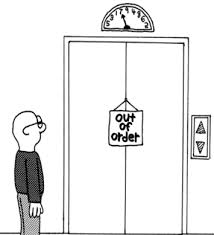
I don’t stand
in front of elevator doors
= = = = =
Alzheimer’s Toll Also Economic
Call it what you will: senior moments, Alzheimer’s disease, dementia, or any of several other descriptions of mental and memory meltdown. It still boils down to the emotionally loaded tearing down of a connection with a loved one. And it can take with it a sizeable economic loss that overwrought and overworked caregivers can easily overlook.
Adults who have paid their bills regularly as they matured will become addled by arithmetic if they fall victim to Alzheimer’s so it’s up to the family or friends near him or her to be alert to signs of faltering financial know-how. If a parent, sibling or spouse who’s handled household expenses or investment portfolios over the years begins showing signs of senior slippage, it’s time to move quickly to save the savings accumulated over the years.
Mail and bills piling up is an immediate signal of trouble.
You can conduct a simple test on your own. Go to lunch with the person and suggest you each pay for your own meal. Then observe how much difficulty he or she has figuring out what each owes, how to make change, and how much to leave as a tip. Another warning sign is the inability to recognize and address basic economic terms, such as interest, the difference between checking and savings accounts, and minimum credit-card payments.
Any of these can be signs of diminishing capabilities that can lead to increased dangers, such as a loss of credit standing and being victimized by scam artists by mail, phone, the Internet, or a knock at the door. Whether you’re in the will or not, you should take steps, or alert family members empowered to so do, to protect the slipping senior’s assets.
Recommendations should be discussed with the individual showing signs of shortcomings. He or she can be part of the process during lucid moments and outline his or her wants and likes. One simple step to take is to maintain a small checking account in his or her name so checks can be written on it to purchase Christmas gifts for the grandchildren or pay a bill. This protects the bulk of the assets while giving the person a feeling that he or she still has some financial control.
A team that includes members of the family and an attorney and financial advisor can protect both the economic and emotional, as well as the medical, needs of the person whose memory is being addled by the aging process.
The Follow-up . . .
. . . to Monday’s introductory session
with the pharmacists from Val Vista Pharmacy across the street
that was planned for later this week
has been cancelled.
Keep your eyes open for the flier announcing its new date.
= = = = =
Doug and Elie have asked that

anyone wishing to have their Sunday meat grilled
should sign in with the concierge
by the previous Wednesday.
= = = = =
Check Over-The-Counter Medication
Some over-the-counter medications can make the summer heat more dangerous. Antihistamines, found in cold and allergy medicines, can make the body sweat less, potentially accelerating heat-related illnesses. These medications cause the mucus membranes in the body to dry up. Since sweat is one of the body’s first defenses against heat, this could be serious.
Diuretics and some diet pills can also be potential problems. These drugs make you shed water faster than normal, either by increased urination or sweating. On hot days, this makes the body more prone to dehydration.
Experts recommend people taking these medications be extra cautious during the summer by avoiding strenuous exercise in the heat of the day, drinking plenty of water, and watching for the danger signs of heat-related injuries.
= = = = =
Our Neighborhood Druggists. . .
. . . from Val Vista Pharmacy across the road
will be in the 2nd floor theater at 2 p.m. Monday
to answer any and all questions
about your prescription and over-the-counter drugs,
how they interact and
how you can make life easier.
= = = = =
Don’t Drink and Dive
Medical experts are the first to warn that alcohol and recreational activities on the water don’t mix. Ten people drown on an average day. Alcohol combined with water recreation is a factor in about one third of the adult drownings.
That’s why it’s important to understand the dangers alcohol consumption can pose, especially near the water. When people drink alcohol, their judgment and inhibitions are impaired. That is a dangerous situation, especially near water. Medical experts recommend you never drink alcohol before or while swimming or boating, so sipping spirits between laps and dips in the pool is not a good idea.
= = = = =
Why Is it . . .
. . . that the most boring conversations begin with,

“I don’t want to bore you with my problems,
but . . .”
= = = = =
Everyone seemed to enjoy St. Paddy’s Day doings
so don’t forget the Irish spirits-and-beer-tasting at
5 p.m. Sunday in the bistro.
= = = = =
3 Little Questions Can Improve Health
If you can read and understand this clearly, you’re already a step ahead of many adults in the battle to stay healthy. Health literacy, which refers to the ability to read, understand, and act upon health information, has been identified as a hidden health crisis that affects all ages, races, and income levels.
This often-overlooked area of the health-care field puts one out of three people at risk for poor health outcomes. Health-care costs for individuals with low literacy skills have been estimated to be four times higher than for those with higher literacy skills. And patients with low literacy skills face a 50 percent higher risk of hospitalization compared with patients with adequate literacy skills.
Research suggests that people with low reading levels make more medication and treatment errors and lack the skills needed to successfully negotiate the health-care system. This affects the elderly because two-thirds of adults 60 years of age and older reportedly have either inadequate or marginal literacy skills.
The literacy problem can stem from poor reading comprehension, the complexity of medical information, the format in which it is delivered, or any combination of these. Studies show that anyone can have difficulty understanding health-care information. Even college-educated people who can understand complicated verbiage prefer to have medical information stated simply.
Medical terms often come across to patients as if the doctor is speaking another language. A sampling of some used by doctors and health-care providers include:
–dysfunction, a medical term that can replace problem;
–landmark, a conceptual term for turning point;
–cognitive, a term that can replace learning, and
–progressive, a value-judgment description that can mean getting worse or getting better._
A tool has been developed to make clear communication easier. It’s available on line at http://www.AskMe3.org. This program promotes three simple, but essential, questions patients should ask their doctor, nurse, pharmacist or other health-care provider in every health-care situation.
1. What is my main problem?
2. What do I need to do?
3. Why is it important for me to do this?
= = = = =
For Those Who Keep Asking . . .
. . . there is a Roman Catholic Mass

scheduled for the 2nd floor theater
at 10 a.m. Friday.
= = = = =
If at first you don’t succeed,
just remember that
you’re like the rest of us.
= = = = =
Let’s Drink to Our Health
Results of several studies and surveys in various parts of the globe support the view that the moderate use of alcohol actually is good for your health and longevity. We’re talking about moderate drinking, which translates into an average of one or two drinks a day.
One drink is defined as an ounce of liquor, four ounces of wine, or 12 ounces of beer. This is not to be mistaken as a promotion for the use of alcohol. If you don’t drink, don’t start. If you do drink, keep it minimal.
Studies have revealed that women who drink an average of half a drink a day have a 14 percent lower risk of developing high blood pressure than non-drinkers. Those who average one drink a day lower their risk of hypertension by 20 percent compared with non-drinkers.
A study of more than 38,000 men over a dozen years indicated that those who have a drink three or more times a week reduce their risk of heart attack compared to those who drink less. Those who average one drink a day are more than 30 percent less likely to die after a heart attack than teetotalers.
People 65 and older who down more than 15 drinks a week are 40 percent less likely than abstainers to have silent strokes, but they are at greater risk for brain shrinkage. Harvard researchers even found a slight reduction in Parkinson’s disease rates among moderate beer drinkers.
Despite the data supporting the cardiovascular-health benefits of moderate drinking, physicians are loathe to prescribe a glass of wine after dinner to improve your well-being. There simply isn’t enough information to encourage patients who do not drink alcohol to start.
When discussing the benefit or bane of alcohol, medical experts argue that its use can lead to abuse, while exercise, proper diet, and cholesterol-controlling drugs can achieve and maintain a quality level of health. Supporters of the moderate use of alcohol suggest it dovetails smoothly into the litany of a health lifestyle: don’t smoke, be active, maintain a healthy weight, and eat a balanced diet — with a daily glass of wine.
= = = = =
Activity Review Meeting . . .
. . . sked for 4:30 p.m. Tuesday
is cancelled
because Mary Weaver took her family to Disneyland this week.
So enjoy the monthly party
that begins at 3:30 p.m. in the dining room
for folks with birthdays in March.
= = = = =
Exercise More Than Calorie Burner
As people age, the most significant benefits of regular exercise may have little to do with burning up calories. As you grow older, physical activity not only lowers body weight but it also cuts cardiovascular and blood-pressure perils, has positive effects on the immune system, and can reduce the risk of certain cancers, say medical experts.
Exercise also strengthens the heart, helps the lungs function better, enables the blood to carry more oxygen, makes muscles stronger, and improves motion in the joints. There is evidence that exercise also enhances your mood and counters mild to moderate depression. Active people also have a lower risk of stroke.
If physical activity hasn’t been part of your life for some time, don’t despair. Research has revealed that starting an exercise program at any point in life boosts health.
The Centers for Disease Control and Prevention and the American College of Sports Medicine set the standard for physical activity in 1995, recommending at least 30 minutes a day of moderate exercise on most or all days of the week in increments as short as 10 minutes.
A study of various combinations of high and moderate exercise intensity and duration combined with a 30 percent reduction in calories consumed revealed that the intensity level produced no significant differences in weight loss. What did make a difference was time.
Many older people who want to exercise are discouraged by poor health and the toll of aging.
This doesn’t have to be the case if the person’s physician has given the green light to exercise. Almost any form of physical activity can improve overall health and the cardiovascular system. This includes walking, gardening, pushing a stroller, swimming, jumping rope and riding a bike.
= = = = =
Keep In Mind . . .
. . . Mary is taking her family
on a Disneyland visit this week
and won’t be back until St. Patrick’s Day
= = = = =
You Can’t Hide From the Sun
A neighbor who passed by with a bandaged nose reminded me of a life-long friend who died recently.
The outsized bandage was a result of what was simple visit to their dermatologist too have a mole removed. As it turned out, the biopsy indicated there was cancer and it went deeper than everyone anticipated. As a result, the neighbor will require some facial reconstruction after the area heals.
That reminded me of a friend who underwent a series of sometimes painful removal of cancerous lesions, some of which required digging some serious holes in their arms, back, neck and cheeks.
This damage to both those people was caused by exposure to the sun.
Summer’s approach reminds members of mankind to acquire an attractive tan. As long as they don’t get sunburn, they feel all is well. What they’re doing is sauteing their skin.
Exposure to the sun’s ultra violet rays can do hidden damage that may take years to emerge. Medical experts expect more than 4 million cases of skins cancer to be diagnosed each year. One out of five adults will develop some form of skin cancer by the time they reach 70 years of age. As many as half of these cases can progress to melanoma, the most serious stage of skin cancer.
You can protect yourself by being sun smart.
You wouldn’t go out in the rain without an umbrella or raincoat to keep you from getting wet, so why do you head outdoors without any protection from the constant outpouring of ultra violet rays. A dermatologist told me long ago that she applies sun screen to her skin, just like lotion, after she takes her shower. She pointed out that those harmful rays pass through the windows of her house, her car, her office and the shops she visits.
A friend told me his dermatologist strongly recommended surgery, “To sew a cap on my head.”
Those skin-damaging rays also pour through the clouds when you think the sun don’t shine. They even sneak through clothing that isn’t sun-protection-factor (SPF) rated.
Sitting in the shade may not be all that safe either. Water, sand, pavement and any other smooth surface reflects those damaging UV rays.
It Was Just . . .
. . . the other day
that I mentioned I couldn’t remember
the last time I had a cold.

Now I remember.
I caught one yesterday and still have it.
= = = = =
All we hear about Humpty Dumpty is his great fall.

He musta had a lousy summer.
= = = = =
Fish Fight Arthritis
The omega-3 fatty acids in fish bolster your body’s ability to battle inflammation that autoimmune rheumatoid arthritis causes to its victims’ joints, heart and lungs.
A couple of fish servings a week can alleviate the pain and discomfort as can a daily dose of fish supplement.
Vitamin C-rich foods, such as citrus fruit, also can help. Two CCs – celery and cherries – can alleviate the pain caused by gout, a form of arthritis that flares up without warning to attack joints. Cherry juice also can help.
If you’re prone to gout attacks, you should avoid carbohydrates, such as white bread, and commercially prepared baked goods as well as processed foods.
Early Warning!!!
Folks relying on
Mary Weaver’s constant support
will have to make adjustments while she’s on
vacation March 13 – 16.
She’ll be back in time to lead our St. Patrick’s Day celebration.
= = = = =
Do it now.
Bookmark
maturelifefeaures.com
so you can give it a quick check every morning.
= = = = =
Snore No More
Snoring can ruin your sleep as well as those sharing your dwelling. Almost half the population snores some time. One out of four people snore regularly. Only half of the people who snore admit to snoring.
The sound of snoring has been reported to hit as high as a car horn or low-flying jet.
Folks who snore regularly are five times more likely to suffer heart disease than those who only snore now and then.
It’s the third major reason given for getting a divorce, following infidelity and financial issues.
A little exercise can help you avoid snoring or, if you’re already a snorer, cut down on its effect on you and those around you.
You don’t have to get any special equipment or join a gym. Developers of these exercises call them throat sit-ups. They report that patients who face surgery or have been wearing mouth guards to curb snoring have been able to discard the devices or avoid surgery after doing these exercises, which take about five minutes, three times a day for six weeks.
The first is a simple tongue press. Push the tip of your tongue firmly behind your upper teeth and drag it tightly back along the roof of your mouth as far as you can. Try saying the five vowels – a,e,i,o,u – at the same time.
While saying the vowel sounds again, suck your entire tongue up against the roof of your mouth. Now try raising it to the back of the roof of your mouth and, if you can’t get the vowel sounds, say aaah.
Repeat each of these throat sit-ups about 20 times.
You should also discuss your situation with your primary care physician, who can recommend therapies or specialists if these exercises don’t work.
= = = = =
 Mature Life Features