Archive for the ‘Travel’ Category
I Haven’t Slept . . .
for a week,

because
that would be too long.
= = = = =
Perry Mason Still Lives in Ventura
By Beverly Rahn, Mature Life Features
VENTURA, Calif. —- One of the biggest mysteries to locals is why the ghost of Erle Stanley Gardner hasn’t lured more visitors to his home town. Hundreds of thousands of tourists and travelers, most of them from the sprawling Los Angeles metropolis an hour away, visit Santa Barbara next door each year, said Paul Navratil as we watched traffic stream by on Highway 101, better known as the Ventura Freeway. “And they just drive right by us to get there.”
We were sitting in the Pierpont Inn, where the creator of Perry Mason went for victory dinners after his successes in the nearby Ventura County courthouse. Gardner began his 150-novel career, which he launched with a short story using the pseudonym Charles M. Green, in his second-floor law office at California and Main streets overlooking downtown’s commercial core. He didn’t have to turn to writing to achieve success, according to locals. Ventura’s most famous resident was a good lawyer and probably would have become a California Supreme Court judge, but he preferred to be like his well-known creation – Perry Mason. To keep from getting mixed up, Gardner used the local courtroom, his office and the views from each of them as models for his settings.
Visitors to the courtroom enter the City of Buenaventura — that’s the official name of the municipality popularly known as Ventura — city hall through its bronze sliding grilled entrance adorned with depictions of lima beans. Ventura was once billed the lima-bean capital of the world. Railway officials shortened the city’s name because it was too long for their schedules.
Keeping an eye on the comings and goings in front of City Hall is a bronze statue of Fr. Junipero Serra, the Franciscan friar who founded Mission San Buenaventura in 1782. The mission, a half-dozen blocks below the civic center, features a triangular buttress across its face — a support installed after an 1812 earthquake fractured its face. Also visible are two metal crosses imbedded on each side of the front door. These are assurances that the building will remain operating as a Roman Catholic church into perpetuity.
Visitors can circle these two complexes on a variety of walking and motor tours of such attractions as blocks of Victorian houses, oil-boom mansions from the 1920s, flower gardens, some three-dozen antique boutiques downtown alone, and a meandering string of art studios, galleries and workshops.
Ventura’s oceanfront harbor, which offers marine diversions to please visitors of all ages, is embraced by a 150-year-old pier and some 30 acres of galleries, cafes and restaurants to suit all tastes. Boats shuttle several times a day to and from the Channel Islands for hiking, picnicking, snorkeling and camping. The price of whatever vessel you choose is worth it just to watch the porpoise pods slip, slide, slap, soar, swoop and swish all around your boat as pelicans patrol overhead. You’re also likely to encounter orcas or gray, minke, humpback or blue whales.
Twenty minutes southeast of town, the Ronald Reagan presidential library is enshrined atop a Simi Valley hill.
Was Gonna Try Something . . .
. . . as soon as a I remembered

what it was I was gonna try.
But my son said
I should forget about it.
= = = = =
Walk in the Footsteps
of Nobel Winners
By Marlene Fanta Shyer, Mature Life Features
You can walk up the same marble stairs that Nobel Prize winners have climbed every Dec. 10, the anniversary of the death of the prize’s namesake, since 1901. It’s the City Hall in Stockholm and you’re in the Blue Hall gazing up at the granite pillars and exposed brick walls that stretch 75 feet from floor to ceiling.
It’s called the Blue Hall but there’s not a spot of blue anywhere. It was designed by Ragnar Östberg, a Swedish architect who was inspired by Italian design and envisioned a soaring ceiling-free space with a view of an azure sky. However, climate demanded a roof be added, but the name stuck.
As you stand on the spot where the most coveted award in the world is celebrated annually, Stockholm comes very much alive, but it’s just part of reason to visit the city. Built on 14 islands and called everything from “image-conscious” to “trend-hungry” to “tech-friendly,” it is richly historical with its Old Town of narrow cobblestone streets and clutter of shops, its Royal Palace, and National Museum.
A Viking ship that sank in the Baltic about three miles from the city in 1628 was discovered some 60 years ago. It was pulled out of the deep complete with 27 bodies, casks of spirits, and the bones of meat intended to feed the passengers. After being rebuilt, it draws more than 800,000 visitors to the museum every year.
Wherever you head in Stockholm, water views are always close by as are some of the finest
restaurants in Europe.
It’s Been Said . . .
. . . about what I’m about to say
so I won’t bother repeating it.
= = = = =
On a Mission to Sip and
Savor California Wines
SAN LUIS OBISPO — The “real California,” that land of myth and movies, does exist.
You’ll find it along the section of the California mission trail that connects Mission San Juan Bautista outside Salinas to the mission for which this city is named, mid-way between Los Angeles and San Francisco.
We started along the River Road that parallels the Salinas River and Highway 101 as far south as Mission Soledad. This quiet out-of-the-way mission was the 13th the Franciscan friars established in the chain that forms the spine of the Golden State. It sits on a site that was served by native-built redwood aqueducts from hot springs a few miles away on the flanks of the Coastal Range.
Within a couple of hours’ drive-time north of “Obispo” are several other missions — Carmel, Santa Cruz, San Juan Bautista, San Miguel, and San Antonio. The last is the next one down the road from Soledad. San Antonio, founded third after San Diego and Carmel, is on the Hunter Ligget Military Reservation, the only one on a military base. Besides providing settlement centers, the 21 California missions served as military complexes and were built roughly a day’s horse-ride apart.

Its southern neighbor is San Miguel that was established in 1797. It’s the 16th mission to be strung along El Camino Real (The King’s Highway). Window panes were made of stretched sheepskin as a substitute for hard-to-get glass.
We next ducked into Paso Robles, one of the best-kept secrets on this out-of-the-mainstream tourist trail. It anchors a rolling Tuscany-lookalike landscape that supports some 70 wineries.
Before taking the 30-minute drive to San Luis Obispo, we spent a couple of days in Paso Robles to soak in its restfulness and romance while stopping by several wineries for savory sampling. When we finally rolled up to Mission San Luis Obispo, we were welcomed by chants of Sunday Mass coming from the church as we strolled along the creek walk that proclaims the present and past of this historic town.
It Sounds Like . . .
. . . 100 percent of the people in this country

think at least 50 percent of the people in this country
have lost their minds.
= = = = =
Backyard Travel in Vogue
The coronavirus has dealt crippling blows to the travel industry, but folks hooked on or interested in tramping new ground can still get out and about.
They can explore their neighborhoods, cities and nearby countrysides without threatening their fellow man with contagion.
It’s still possible to take a bike ride along forest breaks that used to be railway lines to enjoy the quiet and comfort of the countryside.
And you can drive up to such major attractions as the Grand Canyon, South Dakota’s Mount Rushmore, and bluffs on the Atlantic or Pacific coast to watch sunrise and sunsets without having to get out of your car.
There‘s much to see, hear and taste in our environs.
While Baltimore lures you with the finest crab cakes in the galaxy, it’s difficult to match fresh-lobster dining offered on Canada’s Prince Edward Island.
The Monterey scenic drive still provides long-lasting memories for travelers.
Trains offer comfortable vistas of the Pacific Coast and the Prairies, to mention a couple of interesting travels that are handy.
Most RVers will tell you there are North American vistas that vie with the most picturesque parts of the world – the Rockies, Yosemite National Park, Mackinac Bridge, Toronto Skyline, the St. Lawrence Seaway’s Thousand Islands, Carlsbad Caverns, Niagara Falls, and Seattle Space Needle, to cite a few sights.
Many food venues are attractions, including Kansas City steaks, New Orleans jambalaya, ballpark hotdogs, and home-cooked Amish dishes in Pennsylvania-Dutch country.
If you haven’t dropped by your hometown for a few decades, a revisit can be a door to an entirely new world wrapped around your old memories.
Tuesday Opens August . . .
. . . with monthly
Food Service and Town Hall meetings
beginning at 3 p.m. in the 2nd floor theater.
= = = = =
Living in Santa Fe
is an Art Form
By Fyllis Hockman, Mature Life Features
SANTA FE, NM – This state capital with some 70,000 inhabitants that leans against the Sangre de Cristo mountains is a state of mind more than a city; a way of life more than a place to live.
With more than 250 galleries housing Santa Fe art ranging from Southwestern to Native American to contemporary, no one is surprised to learn this is the first city in the country to be designated a UNESCO Creative City for Craft and Folk Art.
Visitors can start with museums, picking from a list that includes the SITE Santa Fe Museum of Contemporary Art, Museum of International Folk Art, New Mexico History Museum, New Mexico Museum of Art, Museum of Indian Arts and Culture, Wheelwright Museum of the American Indian, and Georgia O’Keefe Museum.
Each one is an immersion into whatever and whoever it is celebrating. The same as the hundreds of galleries proffering paintings and pottery, artworks and art wear and artifacts, jewelry, ceramics, sculpture, photography – have I forgotten any form of artistic expression? And if by any stretch of the imagination you have not seen enough art, there are galleries on steroids and shopping opportunities galore at the Railyard Arts District, Canyon Road and, of course, all around the central plaza that forms the heart of the city.
But Santa Fe also offers some more leisurely sightseeing stereotypes.
Among these are three very old structures, each sporting its own history and appeal.
The Loretto Chapel was built in 1873 as the first Gothic (as opposed to adobe) structure west of the Mississippi. It is home to probably the most inspirational staircase anywhere.
The architect building the church died before access to the choir loft could be constructed. The chapel was too small to allow for a traditional staircase. So the nuns did what nuns do: they prayed to St. Joseph, the Patron Saint of Carpenters for nine days, at which time a carpenter appeared without any of the tools needed to build a staircase. And yet a spiral staircase, taking up little floor space, was built – at which point he disappeared without thanks or payment.
Mystery still shrouds the Miraculous Staircase, as it is known. Wooden pegs have been used instead of nails and the wood is not native to the American Southwest. It has two complete 360 degree turns with no center pole for structural support. The entire weight of the staircase rests on the bottom stair. And the identity of the builder is still unknown.
Then there’s the Oldest House. Its adobe foundation dates back to an ancient Indian Pueblo circa 1200. The museum itself is relatively new, as recent as 1646. Two rooms with even newer household artifacts from the 1800s to 1900s rest on part of the original foundation conveying a sense of the family life that thrived back then. Not surprisingly, a sheaf of dried red peppers so prevalent in modern-day Santa Fe also make their appearance here.
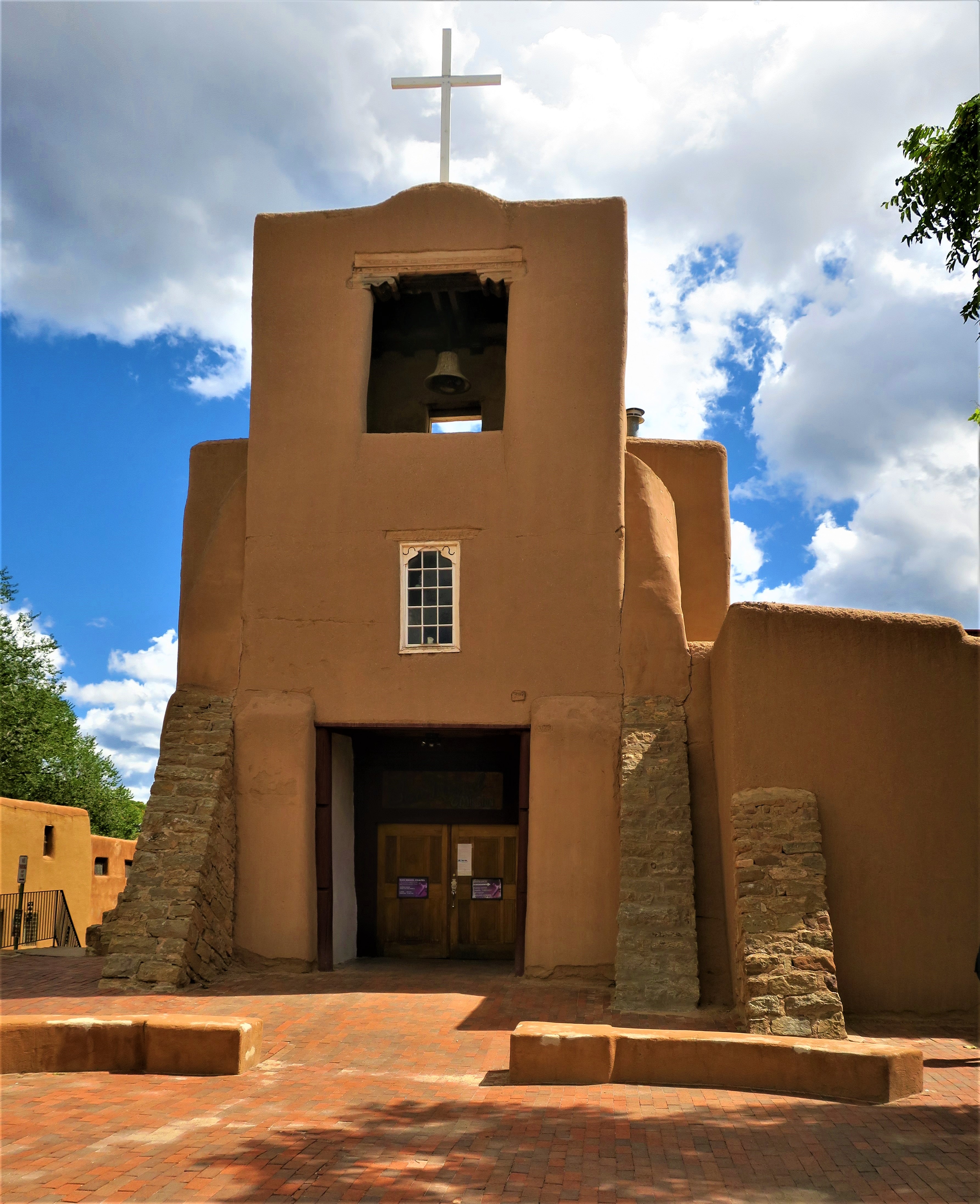
Nearby is San Miguel Mission, which stakes its claim as the nation’s oldest church that’s still operating today. Santa Fe and the church were pretty much born in the same year – 1610 – and once again, the original foundation is still evident. There are a number of very old paintings flanking the walls but the most intriguing feature is a large church bell perched behind the mission pews that dates back to 1356.
The chapel, the church and the house are all on the Santa Fe Trail, an historic landmark on its own, that connected Missouri and New Mexico in 1821, heralding a decades-long period of trade, adventure and western mobility unheard of before in the new nation. The historic trail ends in the Santa Fe Plaza, where many Native Americans, whose culture permeates every facet of the city, gather daily to sell their wares. As a Washington, DC, resident, I was amused to see a Redskins cap on the head of one of the vendors. When I mentioned the controversy surrounding the name (many claim it is culturally derogatory) he said, “I am a Redskin,” alluding to a lot more than the football team. As for those who object? “That’s only East Coast lawyers wanting to make money,” he asserted. We left with a hearty, “Go Redskins,” having brought all the history of Santa Fe into the modern era.
-30-
Think The Food’s Bad?
Find out what’s good for you

at the “Taking Care of Yourself Nutritionally”
presentation in the theater at 2 o’clock.
Then enjoy yourself an hour later during Thirsty Thursday in the bistro.
= = = = =
Evergreen Triangle Links U.S.-Canada
By Sandy Katz, Mature Life Features
You can sample two national cultures with plenty of time for sightseeing, dining, entertainment and outdoor recreation while traveling the “Evergreen Triangle,” formed by the three cities in the Northwest — Seattle in the state of Washington and Victoria and Vancouver in Canada’s province pf British Columbia.
I launched my trip aboard the Victoria Clipper, a high-speed ferry that connects Seattle to Victoria’s Inner Harbor. From there, I took a leisurely stroll along the winding pathways of the city’s celebrated Butchart Gardens — the century-old 50-acre plot of formal plantings that are always in bloom in this provincial capital.
By late afternoon, I was enjoying high tea in tje majestic Empress while planning my trip to Vancouver the next day.
On the BC Ferries craft that morning, I noticed a brochure describing a helicopter ride from atop Grouse Mountain, the peak I got to by bus and tram rides before stepping over a blanket of snow to board an open sleigh for a high-speed ride on the mountain to catch a helicopter at the peak for birds-eye swing over the countryside.
The day’s excitement still was not over. On the bus ride back to the city, I got off at Capilano Park to walk the Capilano Suspension Bridge, the 450-foot-long plank-and-hemp-rope span said to be the world’s longest pedestrian suspension bridge that swings and sways with pedestrians 25 stories above the Capilano River.
The third leg of the Evergreen Triangle took me back to Seattle. My first objective was the Space Needle, the city’s enduring symbol from the 1962 World’s Fair. The 518-foot elevator ride takes you to the observation deck for a panoramic view of the city, Puget Sound and the Cascade and Olympic Mountains. At the base of the needle is the 74-acre Seattle Center housing civic and cultural attractions in a garden setting with plazas and fountains.
The Monorail is the best mode of transportation between the Space Center and downtown, where you can watch fish fly. Just head the Pike Place Fish Market, fishmongers pluck seafood orders and hurls them down the counter to another worker, who catches it with a flourish, wraps it for the customer, and collects the money.
Got A Full Week . . .
. . . of fun and frolicking

as we climb toward another weekend.
Coming up quickly is Name That Tune with Dale at
4 p.m. tomorrow (Tuesday).
Get a seat early in the 2nd floor theater
for a session you can’t avoid enjoying.
= = = = =
Traveling Alone
Has its Own Allure
Travel can lose much of its attraction after losing your life-long partner that shared the sites and sights you encountered around the globe over the years.
There’s no longer someone to share views and viewpoints with, or to recall and recount the memories with when you return home. And many suddenly-singles don’t relish the thought of returning to a favorite voyage or villa without the person they enjoyed it with over the years.
As a result, many folks in this position simply tuck travel into the bag of things they no longer do.
This is at a time when, for the first time in their lives, they probably can travel to wherever they choose to and stay as long as they wish.
Most can recall chatting with a solo traveler or two over the years. One long-time friend has flown to several countries and cities without any reservations and rents a room or apartment for several weeks to soak in the culture and cuisine of the land.
Another acquaintance spends most of the year on freighters that take them anywhere at any time on comfortable cruises. All they have to do is make a few phone calls to find a ship and schedule that sounds interesting.
Both of these individuals are examples of how independent they can be in the type and time of travel they choose.
For the less independent or adventurous, there are tours designed to accommodate single people on the road.
If you don’t feel like going it alone, you can book tours for ski trips, museum visits, cooking schools, national parks and almost anything you can envision.
Some of the bumps on the traveling-alone road include finding time to go off on your own during the tour you’ve booked with a group, how to avoid paying the single supplement charged by hotels and cruise ships, as well as getting along with room-mates on the trip.
Some cruise lines have begun offering single-only rooms and salons where solo travelers can gather.
Solo travel takes a bit more planning and preparation, especially if it’s your first time. You might get a lot of helpful hints from other singles on the road.
The Neat Thing . . .
. . . about weekends

is that
they keep coming back
about every seven days or so.
= = = = =
Elegance Frames
Rockies Train Trip
By Pat Neisser
Mature Life Features
CALGARY, Alberta —- Smiling staff members greeted us with “Would you like some champagne or a lemonade, madam?” as we boarded what was to be our home-on-wheels for the next three days. Given the aura of elegance, I could have been on the Orient Express, but the atmosphere of this train was a bit more casual and friendlier.
We were aboard the Royal Canadian Rockies Experience round-trip out of Calgary, one of the several itineraries offered by Royal Canadian Pacific. The 32 passengers on the five refurbished
1930s executive cars relaxed quickly amid wood inlaid paneling in true luxury on rails.
My compartment had two beds and a desk, a complete bathroom with shower, and plenty of storage space. The large windows looked out onto the passing scenery of deep rivers, soaring glaciers, forests, small towns, and, of course, the majestic Rockies.
Squeezed in between excursions tailored for this train’s passengers were three gourmet meals and afternoon tea daily.
Our first stop was Banff and a visit to the historic Banff Springs Hotel. Then we were off to lovely Lake Louise, where a naturalist guide led us around the mirrored waters. Fond memories of skiing this site came rushing back. We reboarded and slid through the Spiral Tunnels along the Kicking Horse River to our overnight stop at Golden, British Columbia.
The next morning, we took a short motor coach ride up to Kicking Horse Resort, where a gondola carried us up to Eagle’s Eye Mountain for a view from the 7,700-foot level along breakfast in the Eagle’s Eye Restaurant.
Back on the train, we headed south in the Columbia River Valley to Cranbrook, British Columbia, where we stopped directly behind a museum and stepped down for a tour.
Lunch was served after reboarding, lunch was served. Our menus matched those of a four-star restaurant. Our dinner one night included sautéed shrimp with jalapeno chutney, orange and ginger glace, baby spinach salad, and crusted rack of lamb. Chocolate pate with spun-sugar crowned the banquet.
Next day, we visited Head-Smashed-in-Buffalo-Jump, a World Heritage site and explored the museum before peering over the cliffs where natives drove bison herds to their deaths for 10,000 years to provide food and clothing for a whole year.
The next morning, we visited Homeplace Ranch where we had lunch after riding horses and before boarding our rolling home for our ride back to Calgary.
As We Wind Down . . .
. . . this week,
we might keep in mind that
we’ll have a new bus driver

beginning next week.
And practice her name — Elizabeth.
= = = = =
Outer Banks Attract Interest
in Wright Stuff
NAG’S HEAD, N.C. —- It was the Wright place and the Wright time for the elderly North Carolina couple to learn how to fly. They snapped on helmets and hang-gliding harness, caught the wind and sailed off the largest living sand dune in America to emulate the historic moment that occurred more than a century earlier just up the road at Kill Devil Hills, where a memorial to Orville and Wilbur Wright’s famous flights is operated by the National Park Service.
It was the wide-open rolling dunes, privacy, and persistent wind at Kill Devil Hills, not Kitty Hawk farther up the road, that opened the skies for air travel. Any local will tell you bluntly – you don’t even have to ask – that Kitty Hawk gets all the glamor because the Kill Devil Hills telegraph station was closed that December day in 1903 when the brothers completed their four controlled flights. So they made their announcement to the world through the Kitty Hawk telegraph office.
The brisk breezes that lure hang gliders to this ring of barrier islands that shelter North Carolina are what give the place its spanking-clean look. Everything is scoured by sand. Cookie-cutter wooden houses on stilts and lattice-wrapped carports stretch along the 75-odd miles of beachfront. They come in all shades of gray – tan, white, ecru, taupe, azure, cream, yellow, and aqua, but still look gray – and straddle both sides of Highway 12, the asphalt spine that stretches south from just below the Virginia border to Ocracoke Island that’s monitored by that storied point of fact and fiction, Cape Hatteras.
It’s a 90-minute drive from Norfolk airport to the Currituck Lighthouse that warns ships away from the northern end of these Outer Banks. But you should stop along the way to study and sample local delicacies that range from sweetbreads to softshell crabs. The latter, which are called peelers here, are trapped in wire cages much like lobster. Because they molt under a full moon, light bulbs are placed over the traps to confuse the crustaceans into shedding their carapaces, at which time they are picked and prepared for sale.
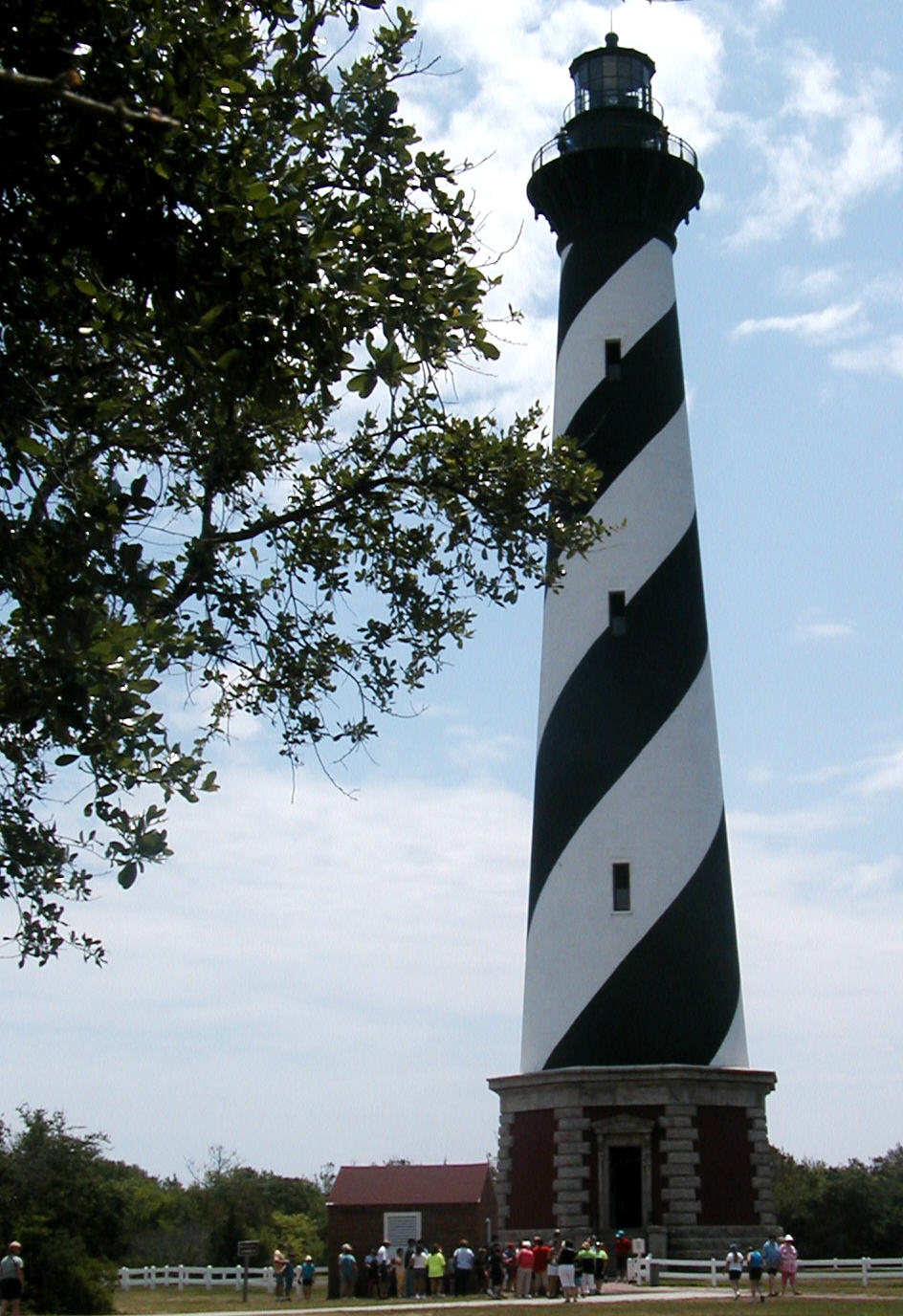
The 20-story Cape Hatteras Lighthouse
is the tallest brick lighthouse in the nation.
Early sailors along these shores had to maneuver their way through the sinister shifting shoals that gave this stretch of coastline the name, The Graveyard of the Atlantic. Adding to the dangers over the years was Edward Teach, the notorious pirate known as Blackbeard who used the area below Cape Hatteras as a hideout because his shallow-draft ships could slide in and out over the sand bars that the heavier British warships couldn’t manage.
-30-
Jazz Aficionados . . .
. . . can hang around the dining room
after the buffet and
applaud the South Valley Junior High jazz quartet

OR
head to the free
Chandler Center of the Arts POP concert
if the bus isn’t full.
= = = = =
Wonders Down Under
Begin in Kiwi Country
By Tom Morrow
For Mature Life Features
AUCKLAND —- Stopping over in this North Island metropolis laced with waterways is an excellent way to acclimatize yourself to the more leisurely pace of living in this part of the world as well as stretch your way through jet lag.
Landing in this island country’s biggest city that’s home to about one-third of its population also gave us the opportunity to become accustomed to driving on the left side of the road.
Dominating its waterfront profile is the Sky City Tower that pokes up some 1,066 feet. It’s a small city unto itself with two casinos, a hotel and a theater, several shops, banks, and 10 restaurants and as many bars.
Because we didn’t have much time here, we decided to seek out the best of what the Kiwis – the locals call themselves this in honor of the odd-looking long-beaked nocturnal bird found only here – prepare best: lamb
Even if you don’t care for lamb, you must try it here. This country has just under 4 million people but more than 70 million sheep. Most of the “good lamb meat,” we were told, is exported to America, Britain, Mexico, and South America. “We’re left with the rubbish,” one hotel chef told me. “My wife works for a giant meat exporter and she says you Yanks get all our best meat.”
Still, what they serve here is superb. Here’s an example of a dish you can prepare at home. It’s a Moroccan sauce recipe from a suburban hotel’s sous chef that can be used for either beef or lamb.
Slow cook roast-beef and lamb bones with vegetables, such as leeks, onions, and celery, with bay leaves, peppercorns, and rosemary for 24 hours. Strain and cook the sauce until it is reduced by half. Add a bit of red wine and some tomato sauce. Mix to taste. Slow roast your lamb as normal, then serve the lamb (or beef) with this wonderful sauce.
You’ll be a hit at your table.
-30-
 Mature Life Features