Archive for the ‘Europe’ Category
Was Gonna Try Something . . .
. . . as soon as a I remembered

what it was I was gonna try.
But my son said
I should forget about it.
= = = = =
Walk in the Footsteps
of Nobel Winners
By Marlene Fanta Shyer, Mature Life Features
You can walk up the same marble stairs that Nobel Prize winners have climbed every Dec. 10, the anniversary of the death of the prize’s namesake, since 1901. It’s the City Hall in Stockholm and you’re in the Blue Hall gazing up at the granite pillars and exposed brick walls that stretch 75 feet from floor to ceiling.
It’s called the Blue Hall but there’s not a spot of blue anywhere. It was designed by Ragnar Östberg, a Swedish architect who was inspired by Italian design and envisioned a soaring ceiling-free space with a view of an azure sky. However, climate demanded a roof be added, but the name stuck.
As you stand on the spot where the most coveted award in the world is celebrated annually, Stockholm comes very much alive, but it’s just part of reason to visit the city. Built on 14 islands and called everything from “image-conscious” to “trend-hungry” to “tech-friendly,” it is richly historical with its Old Town of narrow cobblestone streets and clutter of shops, its Royal Palace, and National Museum.
A Viking ship that sank in the Baltic about three miles from the city in 1628 was discovered some 60 years ago. It was pulled out of the deep complete with 27 bodies, casks of spirits, and the bones of meat intended to feed the passengers. After being rebuilt, it draws more than 800,000 visitors to the museum every year.
Wherever you head in Stockholm, water views are always close by as are some of the finest
restaurants in Europe.
Anyone Still Interested . . .
. . . in writing their life story

can get started in the weekly writing class
at 1:30 p.m. in the 2nd floor multi-purpose room.
= = = = =
I’ve always felt it’s
better to be thought of as being
abreast rather than behind.
= = = = =
Getting to Know the British Mind
By Igor Lobanov, Mature Life Features
British dramatist George Bernard Shaw is credited with remarking that “America and Britain are two nations divided by a common language.” But different word usage is perhaps the lesser part of the split. If you’re contemplating a trip to the British Isles, learning about differences in how we and the English think and act may help make the trip more enjoyable.
Pittsburgh native Jane Walmsley, who is married to a Brit and has lived and worked as a television broadcaster, producer and journalist in England for more than two decades, has compiled several different customs and characteristics that set Yanks and Brits apart.
Starting with the way we look at life. Americans, Walmsley notes, think death can be delayed by aerobics, prune juice, and plastic surgery. Britons live life with a certain detachment and let events run their course and are “never be seen to try too hard.” Simply, that means never run for a bus or skip afternoon tea.
Americans want lots of choices, she says, and want the right to substitute a tossed salad for French fries. In short, we like to live life a la carte. The English keep their number of choices limited – “dresses come in four sizes, shoes one width, ice cream in three flavors.” They believe that too many options sew confusion.
She sees Yanks as having a go-for-it mentality and adoring movers and shakers, even flawed ones. Many ask, “If I can have it all, why haven’t I got it?” Brits prefer to relax and enjoy working within life’s natural boundaries and find a lot of satisfaction from small successes.
Then there is regionalism. As Walmsley explains, the British Isles is about the size of Pennsylvania encompassing 11 distinct and potentially warring parts. These include Scotland, Wales, Ulster (Northern Ireland), Republic of Ireland, West Country (Cornwall, Devon, Somerset), North (Manchester, Liverpool, Leeds), Northeast (the Newcastle-upon-Tyne area), Midlands (Birmingham), East Anglia (Norfolk, Suffolk), South, and Central London.
In summation, Walmsley opines that the only two things that really matter for the British are the Royal Family and the pub, which is the great leveler. What really matters for an American is even simpler, and also a leveler, is ice cream.
In another view, Roger Axtell, author of numerous books/guides on differences in international behavior, points out the really basic difference between the Brits and the Yanks: the way we hold a fork while eating.
In England, they keep the fork firmly in the left hand. By contrast, “We appear juggler-like, cutting the food with the fork in the left hand, dropping the knife, flipping the fork to the right hand, holding it like a pen and finally eating.”
Our zigzag eating style has had its ups and downs. Down (and out) were many U.S. secret agents in enemy territory during World War II who accidentally fell back into their early-childhood table manners.
Italy’s Heart Beats in Umbria
PANICALE, Umbria — Umbria is comfortable perched in the shade — not the shadow, the shade — of its more renowned neighbor, Tuscany.
While the Etruscans fashioned a culture that became identified as Florentine, Umbria wove its history through such hillside towns as Assisi, Gubbio, Orvieto, Perugia, Spello and Todi, all within an hour from this castle-cum-village plunked atop a hill midway between Rome and Florence.
Umbria wraps around most of Lake Trasimeno, the fourth largest lake on the peninsula, on the edge of the Pisa-Florence-Sienna triangle. Hills quilted with chestnut, oak, olive and grape roll away from its shores and house dozens of villages.
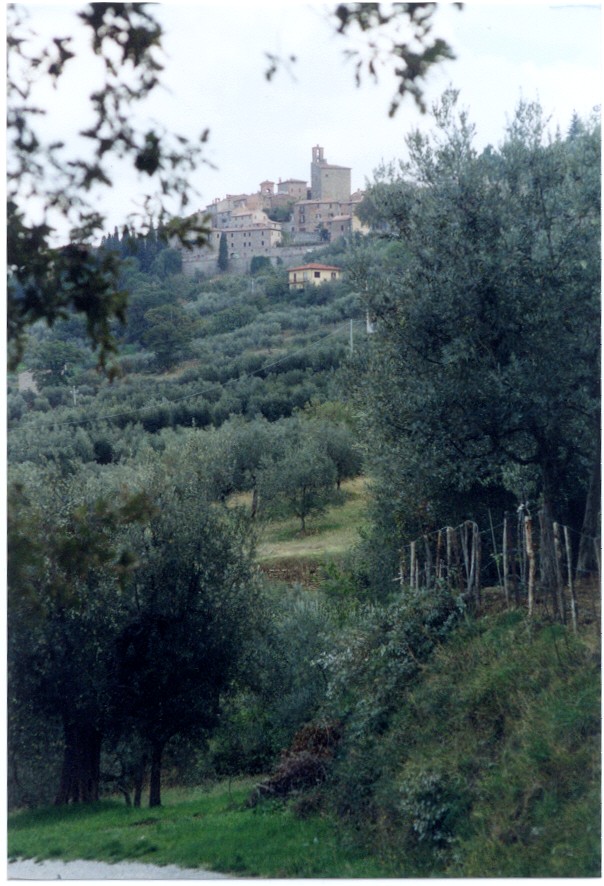
Panicale is also called the Balcony of Lake Trasimeno because of its panoramic view of the lake.
It also offers a peek into both medieval and modern living. Piazza Umberto I is built around the town’s 500-year-old fountain and is the town’s living room.
Newlyweds have wedding photos taken here. Locals begin and end their days here over espresso and wine. They stop gossiping only to stand up for crucifix-led funeral processions chanting the Pater Noster (Our Father) on their way down from the massive 1,000-year-old Umbrian gothic Church of St. Michael the Archangel that dominates the town.
Most of their city shopping in the Tuscany town of Arezzo, less than an hour north. Sometimes they shop in the capital and commercial hub of Umbria, Perugia, just 30 minutes away.
On a hillside within viewing distance from Perugia is Assisi, the birthplace of St. Francis, the founder of the religious order that established the string of 21 missions forming the backbone of California.
His remains are housed in the basilica named after him, as are those of St. Clair entombed in the church named after her at the opposite end of town. Both churches are decorated with heart-stirring frescoes, which are everywhere — inside and outside buildings in every community throughout the region.
A small church in Panicale (the town once had seven) houses a famous fresco – The Martyrdom of St. Sebastian. It was painted in 1505 by Piero di Cristoforo Vanucci, known as Il Perugino, whose most famous pupil was Raphael.
There’s a bit of local history story attached to this painting.
On each side of this landmark Renaissance work are two small groups of faceless bystanders watching Roman soldiers fire arrows into the martyr’s body. To make a fresco, the painter puts in the colors while the plaster is still wet. The people in these groups were the patrons of the painting and Il Perugino found out they weren’t going to finish paying him, so he painted their faces after the plaster dried. That’s why they have no faces now.
Il Perugino was summoned by Pope Sixtus IV in 1481 to paint a portion of the Sistine Chapel. His “Charge to Peter” is still on view in the Vatican.
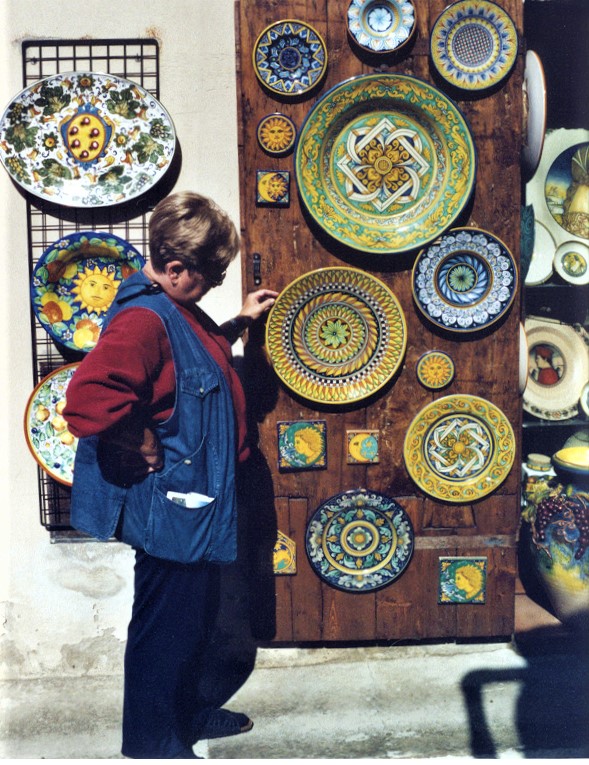
This artistic bent has filtered down to artisans. It’s evident everywhere but you can see it clearly just an hour away in Deruta, the ceramic capital of central Italy. Its shops offer baked and glazed clay in all shapes, sizes, designs and colors.
Gubbio, tucked into Umbria’s northeastern corner at the foot of the Apennines, gives you a look at what medieval life looked like. People still live in 1,000-year-old houses and work in 1,000-year-old workshops. And they attend outdoor productions at a 2,000-year-old 15,000-seat open-air Roman theater.
You can drive here, of course, but trains are best for taking you into the heart of Italy’s major cities.
Taking to the road is not the nightmare some would lead you to believe. Motorists tend to tailgate but all you have to do is get out of the way. There are many roadside pull-over areas to let drivers get by. They’ll even give you a beep-beep “thank you” as they pass.
Rather than drive, we walked four kilometers (about 2 1/2 miles) to the neighboring village of Paciano for lunch. And that’s another part of what fun things to experience besides the heart and history of Italy– the cuisine.
The food merits a story in itself — local pastas, regional salamis, veal, gelato, wild boar, roast rabbit, truffles, guinea fowl, fresh produce and salads, piquant olive oil, wine without additives, the list is endless.
A Yorkshire resident who visits Umbria regularly, said it all: “You just can’t find bad food here.”
Roman Festival Brightens Umbrian Hillside
“Why not drop around on Sunday,” Riccardo suggested, “We’ll have a few artichokes.”
The retired Alitalia pilot was our landlord when we arrived in Panicale, a medieval central-Italy castle-town. He and his wife, Mariolina, were friends when we left.
This fortress overlooks Lake Trasemino, the peninsula’s fourth largest lake, to the north, the manicured Tuscan countryside to the west, and the rolling Umbrian hills to the south and east. This body of water still soaks some 25,000 thousand Roman soldiers drowned here by Hannibal more than 2,000 years ago.
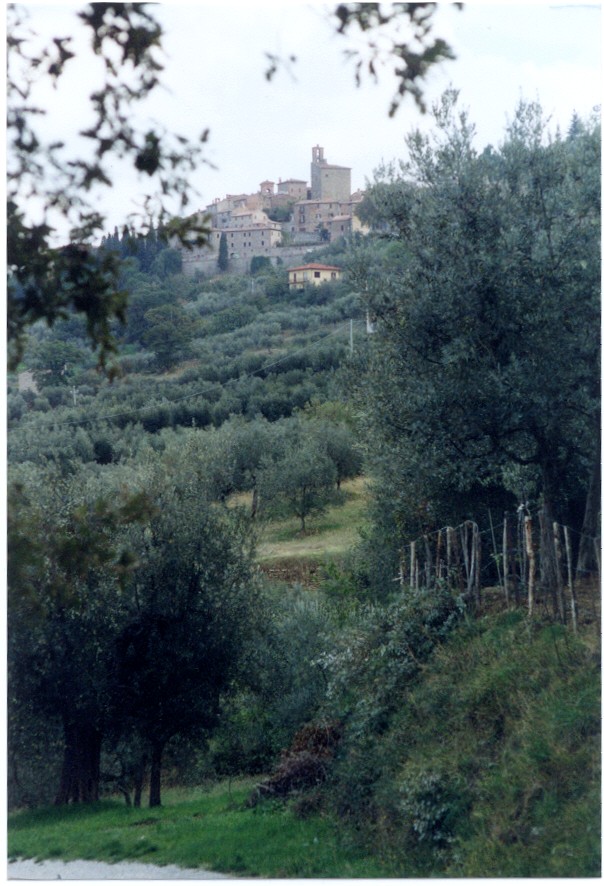
Our landlords opted out of big-city living in Rome several years ago and occupied our spacious apartment while they built a picture-book home in a hill-clinging olive grove just below the town’s centuries-old walls.
“I bought this apartment because when I look out that (living room) window, that’s Umbria,” he said.
The Umbria you see is the reddish-yellow brick-and-rock front of the Church of St. Michael the Archangel (one of seven churches in this village) leaning on a restaurant by an archway that frames the main piazza with its 500-year-old fountain and bars, hair salons, stationery and gift shops, and small groups of standing and sitting locals sorting out the various problems of the day.
We knew we were in for something special as we approached the lane sloping into their farmyard. It was like breaking into an opera.
About three dozen people wearing the full array of bright yellows, reds, greens – pick a color – were milling about chittering, chattering, and chanting in that Italian sing song from which arias emerge. The accompaniment was provided by Riccardo’s tractor as it hauled dead olive branches to a pile resembling a titanic tumbleweed.
“You don’t work, you don’t eat,” was Mariolina’s mandate.
Our immediate chore was to gather mint leaves off the plant stems and chop the stocks off the artichokes – shopping-cart-sized mounds of them. Then the mint leaves were minced with garlic and olive oil. The artichoke are given a good slam on the ground to soften them so their hearts centers can be opened up and crammed with the mint-leave-garlic-oil mixture.
Through all this, you had to balance wine with oil-soaked bread, cheese, fresh fava beans, and more wine before the fire is ready.
It was at this point that Mariolina explained these artichoke afternoons are a traditional Roman ritual because the plant originates in the region south of the capital.
The giant pile of shrubbery is burned and the ashes raked into a flat lava-like bed of coals.
Then you have to tuck your artichoke into the coals to cook. You only get to eat the one you cooked.
Again, the operatic metaphor arose as each person displayed a distinctive dance pirouetting around the blistering mound. It takes about 45 minutes for the artichokes to cook in this manner, which gave everyone time to sample more wine with the sausages and pork barbecued on a fire fed with larger chunks of trimmed olive wood.
Then flowed the desserts, all of them home-made.
This operatic event marked the end of our five week stay that included jaunts to the nearby cities and towns that dot our imaginations and the Italian landscape – Assisi, Siena, Orvieto, Cortona, Spello, Perugia, all within an hour’s drive of here – and Rome, Florence, and Pisa, each a couple of hours away.
But we also took a harder look out our window. There it was Panicale. Umbria. Italy.
No Baloney in Bologna

Fountain of Neptune anchors Bologna’s Piazza Maggiore.
Story & Photo
By Cecil Scaglione
BOLOGNA —- Bologna’s location is one of its major attractions, said Na’ama, the young Israeli economist who came here to study at the oldest university on the continent.
“From here,” she said, “you can get on a train and in a short time be in Parma or Ravenna or Rimini.”
There’s also Turin, Venice, the Italian lake country, Padua, and Florence all within a two-hour train ride.
After a 45-minute ride, we debarked onto the comfortably clean streets of Parma and fine-tuned our noses to hone in on a local delicacy — not parmesan cheese but prosciutto di Parma. Cut thin enough to almost see through, this version of the Italian cured ham is tender on the teeth and has a keen flavor that still lingers.
The following day, we headed in the opposite direction to Ravenna, just off the Adriatic coast.
Before tracking down a site to gorge on a plate of overflowing seafood, we made our way to the Basilica di San Vitale to view 1,500-year-old mosaics that reflect the town’s tenure as capital of the Byzantine Empire in Europe for three centuries.
We stopped by Dante’s tomb on the way. Dante was tossed out of is native Florence after he picked the wrong side in the ongoing battle with the papacy. In exile, he wrote “The Divine Comedy” after taking up residence in Ravenna.
Incidentally, you won’t find any baloney in Bologna. The model for the U.S. version of the large round ground-pork sausage is mortadella, which houses delectable chunks of fat and, when copied on this side of the Atlantic, was dubbed bologna/baloney.
And the street-and-sidewalk no-baloney bustle convinced us we weren’t in the typical town when one thinks of somnolent sunny Italy.
The desk clerk gave us a polite but brisk “Bon giorno.” The fellows who put together our coffees, rolls and fruit in the eating emporium down the street must have known we weren’t fully awakened to local prices. The bill for a banana was more than $4, which taught us quickly to ask the locals where they munch.
The clerks in the bank where I set off alarms by trying to exit through the wrong door did not take operatic offense. They just politely pointed me to the designated door without much more than a polite shrug.
The point is, Bologna is as much business as badinage. But it’s still as much about food as finance.
For our introduction to what Bolognese boast about — tortelloni made on the premises — we checked with merchants in the old quarter. A florist suggested Trattoria da Gianni, a hole in the wall down a little alley that we would have overlooked. The proprietor ushered us to a table crammed amongst many jammed with men and women in office attire who gathered here for the same reason we did. The fine food.
After getting fortified with the local specialty, we moved on to visit the two leaning towers that anchor the historic downtown. While not as attractive nor as storied as Pisa’s I Torre Pendente, these two monoliths lounge unruffled by the hurrying hordes and beeping buses rumbling around their bases. They appear more attuned to the music and musings that emanate from the nearby University of Bologna grounds, where Copernicus and Dante once scurried to class.
There’s an outdoor market every Friday in the Piazza dell’ VIII Agosto on the rim of the commercial hub that offers everything from boots to bracelets. Merchants in the nearby market-and-bakery complex display an array of fruit, vegetables, breads and sweets to match all the sights and scents of one’s dreams.
Among them we found a fist-sized roll with thumb-sized studs poking out in all directions. They appeared on our table at Trattoria Fantoni, another enticing hole-in-the-wall eatery, where we watched other diners break off these protuberences and eat them as breadsticks.
Asked what these rolls are called, our server said: “Sputnik.”
– 30 –
Ease Up in Belgium’s Mechelen

Margaret of Austria ruled the Netherlands from this palace in Mechelen, Belgium.
Story and photo by
Sandy Katz
MECHELEN, Belgium —- Perched on the Dijle River in the relative shadows of both Brussels and Antwerp, this town glistened when Margaret of Austria, Regent of the Netherlands, made it her capital from 1506 to 1530.
Taking advantage of Ludwig van Beethoven’s family roots, it has honored the famous composer
with an elegant statue even though he was born and raised in Bonn. The Mechelen connection
stems from Beethoven’s grandfather, who worked here as a baker, and great-grandfather, who ran a painting business.
The best way to take a look around this center for lace, baroque woodwork and drapery tapestry that’s but a an 11-minute train ride from Brussels Airport is on foot or by bicycle. There are trendy shops, friendly terraces, galleries, museums, and recreational areas for sailing, fishing, mini-golf and windsurfing.
The symbol of Mechelen is the imposing St. Rumbold’s Tower, a UNESCO World Heritage Site completed in 1536 in late Gothic style. If you can negotiate the stairs to the skywalk atop the tower, you are rewarded with a magnificent panoramic view. Eight historic churches fill the city center and each displays religious treasures.
The spectacular Renaissance facade of the Palace f Margaret of Austria frontage features
her coat of arms. The building still houses the law courts but you can still enjoy some quiet and tranquility in charming gardens. For another pleasant pastime, you can take the footpath along the back of picturesque old houses lining the Dijle.
The Kazerne Dossin is a special place of remembrance for Belgium. This center keeps alive the memory of the Holocaust and it gives a face to 19,000 of the departed.
Mechelen is just what you need for rest and respite after dashing around nearby Antwerp. Widely known as a global center for the diamond trade, Antwerp also has long been the capital of Belgium’s fashion industry. It’s also the birthplace of Flemish painter Peter Paul Rubens.
And it’s the home of the Red Star Line Museum that traces the late-19th- and early-20th-century immigration of Eastern Europeans through Antwerp to the United States and Canada.
Between 1873 and 1934, the Belgium shipping company Red Star Line transported approximately 2 million migrants from Antwerp to New York. What makes the Red Star Line’s passenger lists different is that it transported Eastern Europeans of Jewish origin mainly, including Irving Berlin and Albert Einstein, who were fleeing persecutions by the Czar of Russia and Hitler.
This museum is in a restored warehouse of the Red Star shipping company and mirrors the American-arrival story housed in the Ellis Island Immigration Museum. Not everyone who hoped for passage through Antwerp was allowed to leave on the 10-day transatlantic voyage. Everyone had to pass a medical examination first.
Between visits to the many historical gems around this country, you can sample its tasty specialties along the way. Belgium Waffles, which were introduced to America at New York’s 1964 World’s Fair, are available from street vendors and in gourmet restaurants. They’re usually served warm and dusted with confectioner’s sugar or topped with whipped cream, soft fruit or chocolate.
Potato fries – French Fries – are part of Belgium’s culinary cultural heritage. They are often eaten with mayo or served with mussels or Flemish stew. There are more than 50 dipping sauces to choose from.
Belgium endive is a popular vegetable, as are Brussels sprouts. And Belgian beer is featured in a number of recipes. Beer Central, which offers 300 types of bottled beers and has 20 beers on tap, is the perfect bar to jump into the Belgium beer culture. Connoisseurs favor Belgian beer for its variety, flavor and character. It has enjoyed the unparalleled reputation for its specialty beers since the Middle Ages.
Mature Life Features, Copyright 2015
Independent Identity Cornwall’s Charm
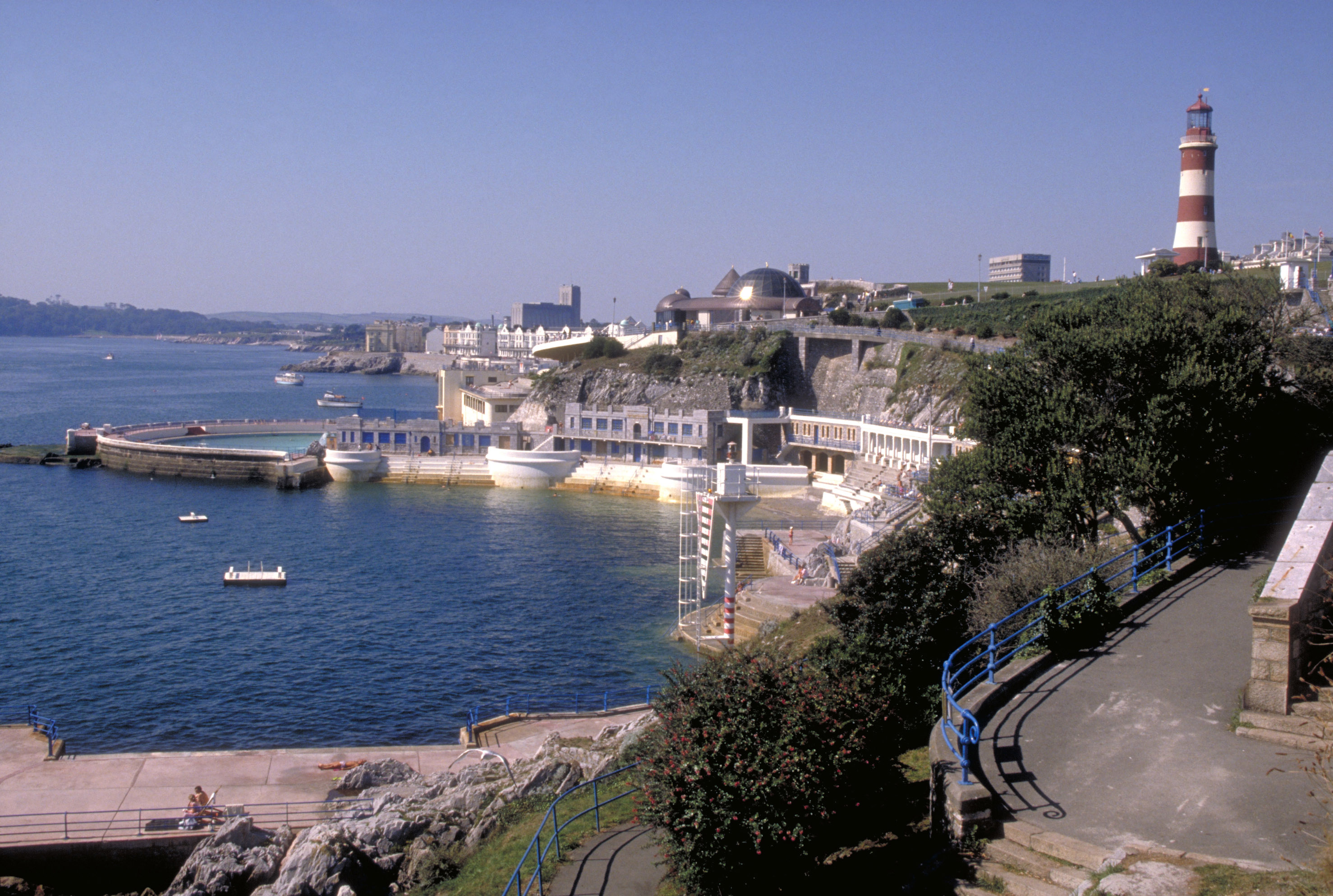 Bordering Plymouth Sound is the port’s promenade called The Hoe that includes a bowling green like that used by Sir Francis Drake before sailing against the Spanish Armada in 1588.
Story & Photo
By Pat Neisser
Mature Life Features
PENZANCE, Cornwall — England’s southwestern tip is the magical territory where Gilbert and Sullivan set their classic fun-poking operetta, The Pirates of Penzance, and the village of Mousehole is celebrated in the tale of Tom Bawcock and his cat, Mowzer. It’s a scene fostered by a citizenry battling and beating the elements that prides itself with its own identity and keeps a wary lookout for doubters. The fishermen are serious about their livelihood and don’t brook interference. But once they’ve finished their tough day, they’re ready to befriend the visitor. The Cornish peninsula is less crowded than better-known areas of the country and its towns hug the sea with an age-old love-hate relationship. I took the train from Southampton to Exeter in County Devon and drove to Penzance after an overnight stay. Cornwall’s and Devon’s history goes back more than 4,000 years but written records reach back to 30 B.C. when seafaring visitors came looking for tin. The Spanish invaded in 1595 but were driven back into the sea, marking the last landing on English soil by invaders. Cornish miners emigrated to California and Colorado to teach silver miners a thing or two and took with them the famous Cornish pasty meat pies. Penzance and its sister villages along the coast are loaded with things to do. Even if you aren’t fond of pilchards (large sardines) don’t miss a visit to the Pilchard Factory and Museum in next-door Newlyn where we were shown how the fish are salt-cured and packed for shipping all over the world. In Newlyn, one of the largest fishing harbors in England with eateries scattered along the beaches, we visited Trinity House National Lighthouse Centre to learn how the famed lighthouse saved so many sailors. A highlight of our visit was the Eden Project, which is housed in acres of environmental domes, each offering a different climate. Actors and scientists interact to explain the place of man and nature in the environmental universe. Next we visited the tiny coastal communities of Fowey, home to Daphne Du Maurier and her famous acting and writing family, and St. Ives, which romance novelist Rosamunde Pilcher calls home and where Barbara Hepworth created many of her magnificent sculptures. St. Ives is a fairy-tale seaport town with lanes that wind up and up. One of its most famous creations is the Tate Gallery St. Ives that shows modern art from local as well as international artists. Tropical plants, such as palm trees and cacti, cover this part of England thanks to the nearby Gulf Stream, bringing a California look to the terrain. Finally, it was back to neighboring County Devon and the south-coast seaport of Plymouth. This was Sir Francis Drake’s place of business and the site of the Mayflower’s departure. We stood on the famous steps where the pilgrims boarded their ship. The old town near the water is filled with 17th century memorabilia.
Mature Life Features, Copyright 2004
Adventures Afoot in the City of Light

By Igor Lobanov
Mature Life Features
PARIS — The pigeon flitting about the domed ceiling seemed unimpressed by or, perhaps, deaf to the thunderous tones grumbling out of the more than 6,000 organ pipes. Rambling from crackling to caressing, the massive instrument in St. Sulpice almost made us believe the gates of heaven had opened in the French capital and we were to witness its glory.
A stroll from our Left Bank hotel by way of Marie de Medicis’ peaceful Luxembourg Gardens brought us to this parish church containing one of the world’s largest organs and we had wandered into a special performance.
Our euphoria ebbed a bit when we sought to order a pizza in a nearby restaurant specializing in that fare. The waiter’s disdain appeared designed to intimidate visitors in front of the locals, but succeeded only in denying him his tip.
Fortunately, such behavior was not evident in other places where we dined and was forgotten by the time we stumbled onto the second unexpected event of the day a few blocks farther along the Seine. At the Quai Voltaire, long lines of people inched across the Seine on the Pont des Arts on both sides of a bizarre battle scene stretched along the middle of the footbridge. It was comprised of life-size clay figures of cowboys, Indians, horses and other symbols of the American West by an African sculptor.
As sunset approached, we stopped in a café near Notre Dame for hot chocolate and crepes before heading back to our hotel.
The following day’s project was a meandering three-mile walk from the Boulevard du Montparnasse to the Arc de Triomphe by way of the Tuileries Gardens and Champs Elysees.
We passed through the Luxembourg Gardens, where lovers strolled, children sailed toy boats on a pond, and elderly folks played chess under the chestnut trees.
Then we passed the forbidding-looking 700-year-old Sorbonne, now called the University of Paris. The mood brightened a couple of blocks farther with the appearance of cafes along Boulevard St. Germain des Pres frequented in the 1920s by such literary legends as Ernest Hemingway, F. Scott Fitzgerald, James Joyce, and Gertrude Stein.
Crossing the river at the Pont du Carrousel took us to the courtyard of the Louvre and its pyramid-by-Pei entrance. We headed the other way, past the Tuileries Gardens with its manicured hedges, lawns and terraces framed by Napoleon’s first monument to his military victories: the Roman-style Arc de Triomphe du Carrousel.
Next we came upon the Place de la Concorde where Louis XIV, Marie Antoinette, Robespierre and others were separated from their heads. The guillotine has been replaced by a 3,300-year-old Egyptian obelisk from the Temple of Luxor.
This got us onto the broad boulevard renowned as the Champs Elysees decorated with such labels as St. Laurent, Parfum de France, Mercedes-Benz along with McDonald’s and Planet Hollywood.
Our walk ended at the Etoile, the hub of a dozen radiating streets known as Place Charles de Gaulle that contains the Arc de Triomphe.
A pedestrian tunnel beneath the traffic let us reach the monument just in time to seek shelter from a sudden shower.
But when it’s raining, and you’re in Paris, you can pretend always it’s April.
Mature Life Features, Copyright 2000
French Canals Create Barging Experts
By Joan Rattner Heilman

Mature Life Features
If, like us, you’re slightly worn adventurers who have given up black-diamond ski slopes, camping trips, and outdoor plumbing but are still game for a good challenge, rent your own canal barge.
You can skipper and live aboard your own traditional narrow-beamed barge or a cabin cruiser for a week or two while you chug along canals at five or six miles an hour as folks did to get around the country before the advent of railroads.
It’s all called barging and you stop wherever, whenever, and for as long as you please. It can be for lunch, dinner at a local restaurant, a good night’s sleep, a walk around a quaint village, a bike ride into town for groceries, or a hike to a nearby castle.
Your boat provides much the same facilities and equipment as a land-based recreational vehicle. There’s no laundry service and nobody’s going to make your bed. The size and cost depend on the number of people it can accommodate.
France, with its network of waterways that covers most of the country, is probably the most popular choice, although other favorites are England, with its miles of recently restored canals that were built during the industrial revolution, along with The Netherlands, Belgium, and Germany.
If you’d rather stay closer to home, upstate New York’s historic Erie Canal is the best-known waterway with boats for hire.
For our French canal cruising, my husband, Mortimer, and I picked up our 30-foot rental at the Crown Blue Line’s base station in the hamlet of Boofzheim on the Canal de la Marne au Rhin, not far from Strasbourg in Alsace.
“Don’t worry,” we were told during our half-hour meet-the-boat session, “It’s very easy.” And if we had a problem, “you can call us.” Our only requirement was to turn up at a village called Hesse 106 kilometers (a little more than 60 miles) away in exactly one week.
Armed with these instructions, a guidebook, map, and emergency telephone number, we gurgled off at five miles and hour.
We learned quickly that you can’t get into too much trouble at that speed. The water is always flat and calm, the canals are just wide enough for boats to pass in opposite directions, and it’s almost impossible to get lost. We did encounter a couple of boaters who required emergency engine service, which is provided by a van traveling on the towpath that runs alongside the entire length of the canals.
It took us three hair-raising attempts, with much crashing into the sides of the gates, before we managed to inch into our first lock, tie up to a stanchion, pull a green lever, and, when the lock filled with water, chug out the other end while dodging a large barge coming the opposite way. We became experts by the time we had negotiated the 43 locks on our route, two long dark tunnels carved through the mountains, and one apparatus that lifted three boats at a time 400 feet up the side of a hill.
We decided to tie up for our first night and calm our nerves at Plobsheim, a typical Alsatian farm town five locks upstream. “What you have to do,” Mortimer told me, “is jump off and tie up.” I was to grab the bow line, leap over a low wall from the rear deck onto the grassy bank about a foot below, drive a metal stake into the ground with a mallet, and tie the line firmly to it. Then I was to do the same for the stern line.
When I told him, “I’m not jumping,” he inched ahead to a spot that was level with our lower deck, allowing me to step off onto the grass and fulfill my assignment.
We unpacked our bags and explored the three sleeping cabins, two bathrooms, showers, linens, a galley equipped with pots, dishes, silverware and glasses, the living-dining area, and upper sun deck. The boat was provisioned with breakfast foods, beverages, a crusty loaf of bread, butter, milk, a bottle of wine, and a few other staples. Steering was done inside the cabin or up on deck where there was a table, umbrella, and four chairs, plus the two bicycles we arranged to carry along.
Heaving the bikes over the side onto the towpath, we rode into town to scout out a restaurant, where we tried our first tarte flambee, the Alsatian version of pizza — a paper-thin crust topped with cheese, ham, and onion.
The cabin was cold in the morning until we started the engine, left it in neutral, jumped back into our narrow bunks, and waited about half an hour for the quarters to warm up. After breakfast at our dining table, it was onward to Strasbourg, the picturesque capital of Alsace. At the Plaisance Club, a small marina designed for self-drivers, we backed into the last remaining spot along the wharf for the night. It was a short walk over a bridge to a three-star restaurant in the heart of the city. We stuffed ourselves for the first and last time on the Alsatian national dish – a huge pile of choucroute (sauerkraut) topping a couple of wursts and thick slabs of pork with a side of crusty potatoes.
We always ate breakfast aboard, lunch sometimes, and dinner once by default because restaurants in the French provinces are open only on certain days and certain hours. We traded groceries with fellow boaters, most of them entire families, we met along the way. They were Danish, Australian, Dutch, Israeli, and American. And we had twilight
drinks together on one boat or another.
By the time we reached Hesse, the tiny farm town where Crown Blue Line is the major industry, we were addicted to barging. We were already making plans for barging in Burgundy, or the Loire Valley, or maybe even the Avon Canal in England.
Mature Life Features, Copyright 2004
Rails Ring Around Switzerland
 By Igor Lobanov, Mature Life Features
ZERMATT, Switzerland — There were a couple of dozen of us and a friendly family dog in the large gondola that swooped down the cable before climbing sharply over a rock wall and nestling in a building that appeared to be glued to the sheer granite face of the mountain.
We stepped onto the summit of Klein (Little) Matterhorn, where we had a 360-degree view of sparkling snow fields on the surrounding Alpine peaks and could look straight across at its renowned relative. Below us, the village of Zermatt basked in the sunshine and skiers schussed down the broad glacier flowing from the Matterhorn.
Switzerland, slightly larger than Maryland, is crammed with lakes, rivers, lush valleys sprinkled with grazing cattle, and picture-postcard-neat villages. Linking them all is a railroad network that operates on to-the-minute schedules.
Aiming to circle the country counter-clockwise by rail, we were on a train within minutes of landing at Zurich and heading for Lucerne to spend the night and walk to its best-known attraction: the Chapel Bridge. It’s a roofed wooden walkway built over the river Reuss in the 13th century, and rebuilt after a 1993 fire. The original Water Tower was used to store treasures from foreign wars, as a prison, and even a torture chamber.
Our 2 1/2-hour journey from Lucerne to Grindelwald by way of Interlaken took us past lakes whose glass-like aquamarine waters mirrored the mountain peaks and passing clouds. The overriding word for this route is green. Grindelwald sprawls along a narrow valley whose miles of hiking paths meander over and around nearby slopes, most notably on the lower reaches of the 13,000-foot Eiger, which looms craggily over the community.
For a bird’s-eye view, we took the five-minute gondola ride up to Pfingstegg, where a tiny restaurant clings to the cliff hundreds of feet over the valley. Nearby, you can ride a small toboggan down a metal chute to the valley floor and be towed back up again.
Our next stop was the 13,642-foot Jungfrau that, with its sister peaks Eiger and Month, offers one of the more dramatic ice-and-rock settings in Europe. Cogwheel trains depart Grindelwald at regular intervals to Jungfraujoch, the country’s highest railroad station, called The Top of Europe. The two-hour trip takes you over meadows, past small towns, and through a long tunnel. Clinging to the mountainside at 11,225 feet is a small complex that includes a restaurant, exhibit area, and viewing platform.
Then it was a six-hour train trip to Zermatt. Those who choose to drive must leave their cars in the nearby resort of Tasch and ride shuttle trains the last few miles. People here mostly walk public transportation is provided by electrically-powered taxis and horse-drawn carriages.
There are two ways to get close to the Matterhorn: the large gondolas to Klein Matterhorn, or small gondolas to Schwarzsee and its restaurant at the foot of the major peak. Klein Matterhorn and the Jungfraujoch offer tunnel-and-cavern complexes carved deep into glaciers, with niches containing ice sculptures. For another take on these peaks, you can visit the climbers’ cemetery at Zermatt’s St. Maurizius Church.
A day-long ride east from Zermatt on the Glacier Express took us to Switzerland’s preeminent hideaway of the rich and famous: St. Moritz. And our journey around Switzerland ended where it began, in the nation’s business and financial capital, Zurich, whose tree-lined Banhoffstrasse, with its chic, world-famous boutiques is cited as one of the world’s finest shopping venues.
The Limatt River separates the city’s two best-known churches. The Grossmunster, a former monastery said to have been founded by Charlamagne, has striking stained-glass windows by 19th century artist August Giacometti. On the opposite river bank, visitors to the former convent and church of Fraumunster will find a series of Old- and New-Testament representations in glass by the 20th century master, Marc Chagall. The best viewing in both churches is with morning sunlight.
Mature Life Features, Copyright April 2004
 Mature Life Features
