Archive for the ‘Travel’ Category
A tip of the toque to Cecil
(A tickle and treasure by National Editor Don Wall in the February 2013 issue of FYI — “Forever Young Information, Canada’s Adult Lifestyle Publication,” online at http://www.foreveryoungnews.com)
It’s a familiar byline to longtime readers of FYI, and recently came word that veteran travel writer Cecil Scaglione has earned a citation in the San Diego Press Club’s 39th annual Excellence in Journalism Awards, for the second year in a row.
Scaglione may run an editorial service out of San Diego these days, while we are here in snowy Ontario, but this colleague and I share a special link. Some time back in the mid-1990s, soon after FYI entered into a deal with him to use his writing services, we realized we were both raised in the same town, North Bay, Ont.
Have you ever noticed how home towns seem to become more important to you, the further in time it is since you lived there? Coming from the same small town can link spirits together, and this was the case even though we determined that Scaglione never lived there when I did; he was born in the 1930s and left town to work down south (that’s Toronto!) for the Telegram in 1955, while I was born three years after that. (This means, as the North Bay joke goes, we never went to separate schools together.) So there has been a regular, soulwarming swapping of stories as we share our love for the beautiful city on the shores of Lake Nipissing.
As for his career, after the Telegram, Scaglione moved on to the Windsor Star, the Detroit News and the San Diego Union. He started his editorial service in 1991. The feature that earned Scaglione his travel-writing award this year ran in FYI in April and was titled Chartwell: Churchill at Home. His award-winning travel piece from last year, called The Naples Nobody Knows, saw my friend visiting the hometown of his Italian ancestors. Both stories are posted on our website at foreveryoungnews.com.
Cecil, keep up the good work. – Don Wall
Rhode Island Mansions House Opulent Past

Doris Duke’s “cottage”
By Pat Neisser
Mature Life Features
NEWPORT, R. I. — Most people, if they think about this town at all, revive images of robber barons and billionaires who invaded Newport in the 19th century and built “cottages” of 100 or so rooms that resembled European palaces.
These opulent mansions draw thousands of visitors, especially during the annual August Jazz Festival, Van Alen Cup tournament every summer at the International Tennis Hall of Fame, and the hundreds of fairs and activities staged each year.
The settlement was an early seaport in the 1630s that rivaled Boston and New York in the amount of shipping to far corners of the world. It’s much more laid back today. You can spend hours walking on Historic Hill or the Point, and chatting with homeowners weeding their gardens or repainting old shingles.
Cobblestones can make bike riding in town a bit rough, but you can pedal along the Cliff Walk, or the harbor. Still, walking among the restored buildings is a delight for any history buff. And the piers are packed with seaside eateries and shops housed in period buildings.
The schooner America sailed out of Newport in 1851 and defeated a British boat in a race around the Isle of Wight to win what became known as the America’s Cup. It remained here until 1983, when an Australian crew snatched it away before America regained it four years later.
Although the trophy was not returned to Newport, the community has retained its position as a sailing center. You can take all sorts of cruises around the area, as well as paddle a canoe or kayak in the bay.
But a major reason many people visit Newport is still to see the historic mansions built during the 18th and 19th centuries by the wealthy. Some still are privately owned but are open to the public. You can view several of these from the outside or go inside by joining a group at the Newport Restoration Organization Office.
We dined with a group in the gold-encrusted ballroom at Marble House, built for William and Alva Vanderbilt by famed architect Richard Morris Hunt. Versailles has nothing on this mansion.
My favorite is Doris Duke’s 105-room Rough Point. Duke played serious piano and studied art in a studio crammed with antiques, mother-of-pearl pieces, and tapestries. The solarium, her favorite room, housed one of her pet camels during a hurricane.
(Newport, R. I., Convention and Visitor Bureau photo)
Mature Life Features, Copyright April 2004
Stretch Out Stress in Redondo Beach Sun and Sand
Story and Photo by
Cecil Scaglione
Mature Life Features
REDONDO BEACH, Calif. – So you’re going to Disneyland.
And Hollywood. And Malibu. And Universal Studios. And Knotts Berry Farm. And Rodeo Drive. And maybe squeeze in a day at the San Diego Zoo. And…
Whew!
Whizzing and whirling through La-La-Land to “do California” can leave you in a tizzy.
But just about a quarter of an hour south of Los Angeles International Airport is Redondo Beach, where you can soak in sun, sand, surf and seafood at a leisurely pace that would make the Beach Boys, who are from this largest of the South Bay beach cities, proud.
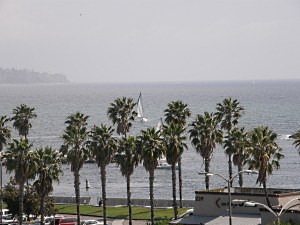
Redondo – it means “round” in Spanish – Beach sits just north of the Palo Verdes Peninsula, which wraps itself around both Hermosa Beach and Manhattan Beach, with Catalina Island perched on the horizon. It could mean redolent because it’s a comfortable California corner to hang around and smell the sea.
It’s also known as Surf City. The first surfing outside of Hawaii occurred in Redondo Beach in 1907. Irish-Hawaiian George Freeth was paid to “walk on the water” by Henry Huntington to mark the opening of and attract attention to his railway connecting Redondo Beach with Los Angeles. Soon after, small groups of people began catching the waves that rolled onto Redondo and the practice spread. Freeth, who died of the Spanish flu in 1919 in his mid-30s, also became California’s first official lifeguard.
Walking alongside the forest of sailboat masts crowding the shoreline here, you’re likely to be invited to join in a Frisbee toss by a mixed group of surfers, homeless, locals and whomever are just enjoying the climate and community. This can be before or after you’ve downed a half dozen, or more, oysters at one of the fresh-fish markets lining the horseshoe-shaped pier.
If you think that’s all there is, just look around. Hop onto a whale-watching boat that takes just minutes to get from its berth to the open ocean, pedal a glass-bottomed boat to view marine life in the harbor, paddle a kayak out to the barking seal colony hanging around the buoys, or buy a kite and watch it fly alongside the Pacific. How about taking a chance on improving your fortune by picking out your own oyster at one of the assortment of shops and saloons on The Pier and having the proprietor shuck out its pearl for you.
You can rent a bike and, if your legs hold out, pedal up to the famed Santa Monica pier. If you’re really dedicated, you can keep on going all the way to Malibu. You don’t have to trek that far to bump into a celebrity or two, for a couple of reasons.
First of all, developers dubbed this beach area “The Hollywood Riviera” in the 1920s. There’s a Riviera Village on the city’s southern border offering shopping from a Farmers Market that lets you sample its produce and fashion and furnishings boutiques packed into a six-block area peppered with exquisite eateries.
Redondo Beach is not only pretty handy for the residents of movieland, it’s also a handy site for cinema shoots. You might recognize segments and scenes from “Pirates of the Caribbean,” “Baywatch,” “X Files,” “The Cannonball Run,” “90210,” “Star Trek,” “24,”and “CSI:Miami,” to name a few of the dozens and dozens of movies and television shows shot here.
If you happen to be here on a weekend, check the Hermosa Beach Comedy and Magic Club a few blocks north of the Redondo Beach border to see if late-night television host Jay Leno is on tap. He does a show there about 40 Sundays a year.
At the northwest corner where these two beach cities meet is the imposing AES electric power plant. Many cinematic sequences have been taken inside this cavernous building but its outside bears the life-size depiction of “Gray Whales Migration,” a mural painted in 1991 by marine-life artist Robert Wyland. It’s across the street from the SeaLAB, a see-and-touch attraction for folks of all ages operated by the Los Angeles Conservation Corps to rescue and rehabilitate creatures sucked into the power plant’s turbines.
Mature Life Features, Copyright March 2011
French Canals Create Barging Experts
By Joan Rattner Heilman

Mature Life Features
If, like us, you’re slightly worn adventurers who have given up black-diamond ski slopes, camping trips, and outdoor plumbing but are still game for a good challenge, rent your own canal barge.
You can skipper and live aboard your own traditional narrow-beamed barge or a cabin cruiser for a week or two while you chug along canals at five or six miles an hour as folks did to get around the country before the advent of railroads.
It’s all called barging and you stop wherever, whenever, and for as long as you please. It can be for lunch, dinner at a local restaurant, a good night’s sleep, a walk around a quaint village, a bike ride into town for groceries, or a hike to a nearby castle.
Your boat provides much the same facilities and equipment as a land-based recreational vehicle. There’s no laundry service and nobody’s going to make your bed. The size and cost depend on the number of people it can accommodate.
France, with its network of waterways that covers most of the country, is probably the most popular choice, although other favorites are England, with its miles of recently restored canals that were built during the industrial revolution, along with The Netherlands, Belgium, and Germany.
If you’d rather stay closer to home, upstate New York’s historic Erie Canal is the best-known waterway with boats for hire.
For our French canal cruising, my husband, Mortimer, and I picked up our 30-foot rental at the Crown Blue Line’s base station in the hamlet of Boofzheim on the Canal de la Marne au Rhin, not far from Strasbourg in Alsace.
“Don’t worry,” we were told during our half-hour meet-the-boat session, “It’s very easy.” And if we had a problem, “you can call us.” Our only requirement was to turn up at a village called Hesse 106 kilometers (a little more than 60 miles) away in exactly one week.
Armed with these instructions, a guidebook, map, and emergency telephone number, we gurgled off at five miles and hour.
We learned quickly that you can’t get into too much trouble at that speed. The water is always flat and calm, the canals are just wide enough for boats to pass in opposite directions, and it’s almost impossible to get lost. We did encounter a couple of boaters who required emergency engine service, which is provided by a van traveling on the towpath that runs alongside the entire length of the canals.
It took us three hair-raising attempts, with much crashing into the sides of the gates, before we managed to inch into our first lock, tie up to a stanchion, pull a green lever, and, when the lock filled with water, chug out the other end while dodging a large barge coming the opposite way. We became experts by the time we had negotiated the 43 locks on our route, two long dark tunnels carved through the mountains, and one apparatus that lifted three boats at a time 400 feet up the side of a hill.
We decided to tie up for our first night and calm our nerves at Plobsheim, a typical Alsatian farm town five locks upstream. “What you have to do,” Mortimer told me, “is jump off and tie up.” I was to grab the bow line, leap over a low wall from the rear deck onto the grassy bank about a foot below, drive a metal stake into the ground with a mallet, and tie the line firmly to it. Then I was to do the same for the stern line.
When I told him, “I’m not jumping,” he inched ahead to a spot that was level with our lower deck, allowing me to step off onto the grass and fulfill my assignment.
We unpacked our bags and explored the three sleeping cabins, two bathrooms, showers, linens, a galley equipped with pots, dishes, silverware and glasses, the living-dining area, and upper sun deck. The boat was provisioned with breakfast foods, beverages, a crusty loaf of bread, butter, milk, a bottle of wine, and a few other staples. Steering was done inside the cabin or up on deck where there was a table, umbrella, and four chairs, plus the two bicycles we arranged to carry along.
Heaving the bikes over the side onto the towpath, we rode into town to scout out a restaurant, where we tried our first tarte flambee, the Alsatian version of pizza — a paper-thin crust topped with cheese, ham, and onion.
The cabin was cold in the morning until we started the engine, left it in neutral, jumped back into our narrow bunks, and waited about half an hour for the quarters to warm up. After breakfast at our dining table, it was onward to Strasbourg, the picturesque capital of Alsace. At the Plaisance Club, a small marina designed for self-drivers, we backed into the last remaining spot along the wharf for the night. It was a short walk over a bridge to a three-star restaurant in the heart of the city. We stuffed ourselves for the first and last time on the Alsatian national dish – a huge pile of choucroute (sauerkraut) topping a couple of wursts and thick slabs of pork with a side of crusty potatoes.
We always ate breakfast aboard, lunch sometimes, and dinner once by default because restaurants in the French provinces are open only on certain days and certain hours. We traded groceries with fellow boaters, most of them entire families, we met along the way. They were Danish, Australian, Dutch, Israeli, and American. And we had twilight
drinks together on one boat or another.
By the time we reached Hesse, the tiny farm town where Crown Blue Line is the major industry, we were addicted to barging. We were already making plans for barging in Burgundy, or the Loire Valley, or maybe even the Avon Canal in England.
Mature Life Features, Copyright 2004
Rails Ring Around Switzerland
 By Igor Lobanov, Mature Life Features
ZERMATT, Switzerland — There were a couple of dozen of us and a friendly family dog in the large gondola that swooped down the cable before climbing sharply over a rock wall and nestling in a building that appeared to be glued to the sheer granite face of the mountain.
We stepped onto the summit of Klein (Little) Matterhorn, where we had a 360-degree view of sparkling snow fields on the surrounding Alpine peaks and could look straight across at its renowned relative. Below us, the village of Zermatt basked in the sunshine and skiers schussed down the broad glacier flowing from the Matterhorn.
Switzerland, slightly larger than Maryland, is crammed with lakes, rivers, lush valleys sprinkled with grazing cattle, and picture-postcard-neat villages. Linking them all is a railroad network that operates on to-the-minute schedules.
Aiming to circle the country counter-clockwise by rail, we were on a train within minutes of landing at Zurich and heading for Lucerne to spend the night and walk to its best-known attraction: the Chapel Bridge. It’s a roofed wooden walkway built over the river Reuss in the 13th century, and rebuilt after a 1993 fire. The original Water Tower was used to store treasures from foreign wars, as a prison, and even a torture chamber.
Our 2 1/2-hour journey from Lucerne to Grindelwald by way of Interlaken took us past lakes whose glass-like aquamarine waters mirrored the mountain peaks and passing clouds. The overriding word for this route is green. Grindelwald sprawls along a narrow valley whose miles of hiking paths meander over and around nearby slopes, most notably on the lower reaches of the 13,000-foot Eiger, which looms craggily over the community.
For a bird’s-eye view, we took the five-minute gondola ride up to Pfingstegg, where a tiny restaurant clings to the cliff hundreds of feet over the valley. Nearby, you can ride a small toboggan down a metal chute to the valley floor and be towed back up again.
Our next stop was the 13,642-foot Jungfrau that, with its sister peaks Eiger and Month, offers one of the more dramatic ice-and-rock settings in Europe. Cogwheel trains depart Grindelwald at regular intervals to Jungfraujoch, the country’s highest railroad station, called The Top of Europe. The two-hour trip takes you over meadows, past small towns, and through a long tunnel. Clinging to the mountainside at 11,225 feet is a small complex that includes a restaurant, exhibit area, and viewing platform.
Then it was a six-hour train trip to Zermatt. Those who choose to drive must leave their cars in the nearby resort of Tasch and ride shuttle trains the last few miles. People here mostly walk public transportation is provided by electrically-powered taxis and horse-drawn carriages.
There are two ways to get close to the Matterhorn: the large gondolas to Klein Matterhorn, or small gondolas to Schwarzsee and its restaurant at the foot of the major peak. Klein Matterhorn and the Jungfraujoch offer tunnel-and-cavern complexes carved deep into glaciers, with niches containing ice sculptures. For another take on these peaks, you can visit the climbers’ cemetery at Zermatt’s St. Maurizius Church.
A day-long ride east from Zermatt on the Glacier Express took us to Switzerland’s preeminent hideaway of the rich and famous: St. Moritz. And our journey around Switzerland ended where it began, in the nation’s business and financial capital, Zurich, whose tree-lined Banhoffstrasse, with its chic, world-famous boutiques is cited as one of the world’s finest shopping venues.
The Limatt River separates the city’s two best-known churches. The Grossmunster, a former monastery said to have been founded by Charlamagne, has striking stained-glass windows by 19th century artist August Giacometti. On the opposite river bank, visitors to the former convent and church of Fraumunster will find a series of Old- and New-Testament representations in glass by the 20th century master, Marc Chagall. The best viewing in both churches is with morning sunlight.
Mature Life Features, Copyright April 2004
Molly Maguire Country
Whizzing along the pavement winding through the hills of northeastern Pennsylvania is like sailing through the treetops, which are trying mightily to change colors right now. This is hard-coal country and site of vicious battles fought by railroad barons and mine owners and workers. The scars no longer show — although small strip-mining operations here and there recall the era — but trauma was caused by such vicious conflicts as that between Irish coal miners known as Molly Maguires and strike-breaker Pinkertons imported by the mine owners. A more pleasant operation in these parts is the Yuengling Brewery, where you can stop for a tour and sudsy sip before heading back home.
Lewd Lightens Up
Snickers and snorts have always greeted our mentions of Intercourse, Pennsylvania, a comfortable and well manicured community nestled in the arms of Pennsylvania-Dutch/Amish Mennonite country that we re-visited today. (We started off with a scoop of home-made raspberry ice cream.) It takes its name from the intercourse — intersection — of two main roads where neighbors would meet and greet — have intercourse — during the early years of the settlement. A magnet for craft and food lovers, its no-nonsense air is visible on the main-street sign of the Village Harness Shop that suggests flatly “No Tourist,” unless you have some horse needs. Several of its tourist-welcoming shops do take advantage of the smirking by offering such items as T-shirts proclaiming “I Love Intercourse … Pa.”
We Made it…
Flight was easier and less stressful than anticipated. Drive from Philadelphia airport was different — rain and dense fog doubled the drive time to our relatives’ home.
But it’s wonderfully peaceful here. The backyard of Bev’s uncle — her late mom’s brother — is a quiet church cemetery that covers an area equal to about three city blocks on a rolling slope behind the row of houses on this block.
Slept deep and late overnight and then EZd, picked up rental car about mid-day. Then planned tomorrow’s activities, which include visit to a couple of local factories and a pig out at Yoder’s, a renowned Pennsylvania-food smorgasbord near here.
We’re Packed!!!
It’s R & R time — relatives and reminiscing — again. And it’s our favorite month for travel. October weather usually is more amiable and amenable than the rest of the years, especially when you head where we’re going — Back East. We’re going to visit Bev’s folks in Pennsylvania for a bit and then freeload off my family in Toronto for a bit more.
We also plan to pick up some travel-story material by visiting a handful of factories in Pennsylvania, which is the factory-tour capital of the galaxy. And we might take a jaunt to Ottawa — Canada’s capital — when we’re Up North.
Not even worried about bills because house sitter will alert us when they slip over the transom.
Stay tuned
Kentucky Cradles Appalachian Art
 By Marlene Fanta Shyer

Mature Life Features
MOREHEAD, Ky. —- If Kentucky’s bluegrass soul races through its thoroughbreds, its heart is held in the hands of its artisans. An arts council established to preserve the heritage of the 49 counties in the eastern part of the state pays homage to its folk art in an array of galleries and museums and you can find Appallachian Mountain artifacts ranging from potholders to painted gourds in gifts shops peppered throughout the region.
There is much to see but a car is a necessity. For example, Lexington’s Blue Grass airport is a two-hour drive away. But the roads are fine and trundle alongside mountains, rivers and pretty white churches, mostly Baptist.
The Folk Art Museum in Morehead has the most comprehensive collection in the area. The artists, many of whom live in isolation, usually are self-taught and much of their work is childlike. Minnie Adkins’ folksy wood figures represent local life and the colorful and glossy walking sticks that seem to be everywhere can bear intricate designs or be whimsical, as is one with twin croquet-ball protrusions inspired by Dolly Parton.
In Hindman, a one-traffic-light town, is the modern Artisan Center with its bright workshop, a former grocery store that is now a museum/shop. Everything is crafted locally. Among with the carved dulcimers, bird houses, and wooden toys we found some beautifully made and reasonably priced fabric pocketbooks.
Outstanding examples of ceramic art are lanterns that hold candles or electric light bulbs. Their sides are pierced and cut to peek-a-boo the light and project interesting shadows.
Next came Whitesburg, where The Cozy Corner Craft Shop offered more “true mountain handicrafts” and an extensive collection of books about Appalachian culture and history. This is one of many places in which to see the ubiquitous quilts (see photograph) that are wildly popular in this area. A hand-stitched and hand-painted prize-winner can be priced as high as $1,600 but prices are generally lower there is a variety of
Next door is the Courthouse Cafe, which is a reminder that this region’s “country cooking” is generally inexpensive and the payoff comes at dessert. Most places serve up spectacular pies, usually home-made.
Pack your own liquid fire if you want to be assured of a drink because some counties are dry. It’s a local joke: Bourbon County is dry; Christian County is wet. The state parks are all dry, but they’re the best bet for lodging.
You can try the Jenny Wiley resort that offers much more than a standard-issue motel. Named for a heroic pioneer woman who endured the slaying of her children by the Cherokees, the lodge is on Dewey Lake, surrounded by wooded trails, and offers resort activities like hiking, birding, and pontoon-boat rides. Children’s activities also are available.
For visitors who need more than a fix of folk art, other attractions in the area include a visit to Loretta Lynn’s birthplace in Butcher’s “Holler,” which is interesting not only because it’s the home of “The Coal Miner’s Daughter” but because it is typical of the poverty of its time and place. It’s also fun to read messages left by fans that cover every inch of her home’s wallpaper: “We are a coal miner’s family also,” ” From a coal miner’s granddaughter: You touched my life in a way no other human being ever has” and “I’ll be back when I’m a country star.”
Also worth a visit is the original “Moonlight school” in Morehead. It was founded in 1911 by Cora Wilson Stewart to teach the three Rs to farmers and their wives but only on nights bright enough “so the mules wouldn’t go into the creek.” The first night, 150 people were expected, but 1,200 showed up. The idea caught on. This school movement is considered the genesis of adult education.
An earlier time is on view at the Mountain Home Place, a “living history museum” in Paintsville. It is a reconstructed 1800s farmstead with costumed interpreters and includes an excellent video, featuring Richard Thomas of the television Waltons.
In Magoffin, a collection of log buildings also of the same era has been relocated from various places in surrounding counties.
To wrap up our trip, we took a winding road to Breaks Interstate Park on the Virginia border and checked the view across the Russell Fork River and the Cumberland Mountains. Called the “Grand Canyon of the South,” it’s not folk art, but ranks among nature’s best landscape work.
Mature Life Features, Copyright 2004
 Mature Life Features
