Archive for the ‘United States.’ Category
I Haven’t Slept . . .
for a week,

because
that would be too long.
= = = = =
Perry Mason Still Lives in Ventura
By Beverly Rahn, Mature Life Features
VENTURA, Calif. —- One of the biggest mysteries to locals is why the ghost of Erle Stanley Gardner hasn’t lured more visitors to his home town. Hundreds of thousands of tourists and travelers, most of them from the sprawling Los Angeles metropolis an hour away, visit Santa Barbara next door each year, said Paul Navratil as we watched traffic stream by on Highway 101, better known as the Ventura Freeway. “And they just drive right by us to get there.”
We were sitting in the Pierpont Inn, where the creator of Perry Mason went for victory dinners after his successes in the nearby Ventura County courthouse. Gardner began his 150-novel career, which he launched with a short story using the pseudonym Charles M. Green, in his second-floor law office at California and Main streets overlooking downtown’s commercial core. He didn’t have to turn to writing to achieve success, according to locals. Ventura’s most famous resident was a good lawyer and probably would have become a California Supreme Court judge, but he preferred to be like his well-known creation – Perry Mason. To keep from getting mixed up, Gardner used the local courtroom, his office and the views from each of them as models for his settings.
Visitors to the courtroom enter the City of Buenaventura — that’s the official name of the municipality popularly known as Ventura — city hall through its bronze sliding grilled entrance adorned with depictions of lima beans. Ventura was once billed the lima-bean capital of the world. Railway officials shortened the city’s name because it was too long for their schedules.
Keeping an eye on the comings and goings in front of City Hall is a bronze statue of Fr. Junipero Serra, the Franciscan friar who founded Mission San Buenaventura in 1782. The mission, a half-dozen blocks below the civic center, features a triangular buttress across its face — a support installed after an 1812 earthquake fractured its face. Also visible are two metal crosses imbedded on each side of the front door. These are assurances that the building will remain operating as a Roman Catholic church into perpetuity.
Visitors can circle these two complexes on a variety of walking and motor tours of such attractions as blocks of Victorian houses, oil-boom mansions from the 1920s, flower gardens, some three-dozen antique boutiques downtown alone, and a meandering string of art studios, galleries and workshops.
Ventura’s oceanfront harbor, which offers marine diversions to please visitors of all ages, is embraced by a 150-year-old pier and some 30 acres of galleries, cafes and restaurants to suit all tastes. Boats shuttle several times a day to and from the Channel Islands for hiking, picnicking, snorkeling and camping. The price of whatever vessel you choose is worth it just to watch the porpoise pods slip, slide, slap, soar, swoop and swish all around your boat as pelicans patrol overhead. You’re also likely to encounter orcas or gray, minke, humpback or blue whales.
Twenty minutes southeast of town, the Ronald Reagan presidential library is enshrined atop a Simi Valley hill.
It’s Been Said . . .
. . . about what I’m about to say
so I won’t bother repeating it.
= = = = =
On a Mission to Sip and
Savor California Wines
SAN LUIS OBISPO — The “real California,” that land of myth and movies, does exist.
You’ll find it along the section of the California mission trail that connects Mission San Juan Bautista outside Salinas to the mission for which this city is named, mid-way between Los Angeles and San Francisco.
We started along the River Road that parallels the Salinas River and Highway 101 as far south as Mission Soledad. This quiet out-of-the-way mission was the 13th the Franciscan friars established in the chain that forms the spine of the Golden State. It sits on a site that was served by native-built redwood aqueducts from hot springs a few miles away on the flanks of the Coastal Range.
Within a couple of hours’ drive-time north of “Obispo” are several other missions — Carmel, Santa Cruz, San Juan Bautista, San Miguel, and San Antonio. The last is the next one down the road from Soledad. San Antonio, founded third after San Diego and Carmel, is on the Hunter Ligget Military Reservation, the only one on a military base. Besides providing settlement centers, the 21 California missions served as military complexes and were built roughly a day’s horse-ride apart.

Its southern neighbor is San Miguel that was established in 1797. It’s the 16th mission to be strung along El Camino Real (The King’s Highway). Window panes were made of stretched sheepskin as a substitute for hard-to-get glass.
We next ducked into Paso Robles, one of the best-kept secrets on this out-of-the-mainstream tourist trail. It anchors a rolling Tuscany-lookalike landscape that supports some 70 wineries.
Before taking the 30-minute drive to San Luis Obispo, we spent a couple of days in Paso Robles to soak in its restfulness and romance while stopping by several wineries for savory sampling. When we finally rolled up to Mission San Luis Obispo, we were welcomed by chants of Sunday Mass coming from the church as we strolled along the creek walk that proclaims the present and past of this historic town.
It Sounds Like . . .
. . . 100 percent of the people in this country

think at least 50 percent of the people in this country
have lost their minds.
= = = = =
Backyard Travel in Vogue
The coronavirus has dealt crippling blows to the travel industry, but folks hooked on or interested in tramping new ground can still get out and about.
They can explore their neighborhoods, cities and nearby countrysides without threatening their fellow man with contagion.
It’s still possible to take a bike ride along forest breaks that used to be railway lines to enjoy the quiet and comfort of the countryside.
And you can drive up to such major attractions as the Grand Canyon, South Dakota’s Mount Rushmore, and bluffs on the Atlantic or Pacific coast to watch sunrise and sunsets without having to get out of your car.
There‘s much to see, hear and taste in our environs.
While Baltimore lures you with the finest crab cakes in the galaxy, it’s difficult to match fresh-lobster dining offered on Canada’s Prince Edward Island.
The Monterey scenic drive still provides long-lasting memories for travelers.
Trains offer comfortable vistas of the Pacific Coast and the Prairies, to mention a couple of interesting travels that are handy.
Most RVers will tell you there are North American vistas that vie with the most picturesque parts of the world – the Rockies, Yosemite National Park, Mackinac Bridge, Toronto Skyline, the St. Lawrence Seaway’s Thousand Islands, Carlsbad Caverns, Niagara Falls, and Seattle Space Needle, to cite a few sights.
Many food venues are attractions, including Kansas City steaks, New Orleans jambalaya, ballpark hotdogs, and home-cooked Amish dishes in Pennsylvania-Dutch country.
If you haven’t dropped by your hometown for a few decades, a revisit can be a door to an entirely new world wrapped around your old memories.
Tuesday Opens August . . .
. . . with monthly
Food Service and Town Hall meetings
beginning at 3 p.m. in the 2nd floor theater.
= = = = =
Living in Santa Fe
is an Art Form
By Fyllis Hockman, Mature Life Features
SANTA FE, NM – This state capital with some 70,000 inhabitants that leans against the Sangre de Cristo mountains is a state of mind more than a city; a way of life more than a place to live.
With more than 250 galleries housing Santa Fe art ranging from Southwestern to Native American to contemporary, no one is surprised to learn this is the first city in the country to be designated a UNESCO Creative City for Craft and Folk Art.
Visitors can start with museums, picking from a list that includes the SITE Santa Fe Museum of Contemporary Art, Museum of International Folk Art, New Mexico History Museum, New Mexico Museum of Art, Museum of Indian Arts and Culture, Wheelwright Museum of the American Indian, and Georgia O’Keefe Museum.
Each one is an immersion into whatever and whoever it is celebrating. The same as the hundreds of galleries proffering paintings and pottery, artworks and art wear and artifacts, jewelry, ceramics, sculpture, photography – have I forgotten any form of artistic expression? And if by any stretch of the imagination you have not seen enough art, there are galleries on steroids and shopping opportunities galore at the Railyard Arts District, Canyon Road and, of course, all around the central plaza that forms the heart of the city.
But Santa Fe also offers some more leisurely sightseeing stereotypes.
Among these are three very old structures, each sporting its own history and appeal.
The Loretto Chapel was built in 1873 as the first Gothic (as opposed to adobe) structure west of the Mississippi. It is home to probably the most inspirational staircase anywhere.
The architect building the church died before access to the choir loft could be constructed. The chapel was too small to allow for a traditional staircase. So the nuns did what nuns do: they prayed to St. Joseph, the Patron Saint of Carpenters for nine days, at which time a carpenter appeared without any of the tools needed to build a staircase. And yet a spiral staircase, taking up little floor space, was built – at which point he disappeared without thanks or payment.
Mystery still shrouds the Miraculous Staircase, as it is known. Wooden pegs have been used instead of nails and the wood is not native to the American Southwest. It has two complete 360 degree turns with no center pole for structural support. The entire weight of the staircase rests on the bottom stair. And the identity of the builder is still unknown.
Then there’s the Oldest House. Its adobe foundation dates back to an ancient Indian Pueblo circa 1200. The museum itself is relatively new, as recent as 1646. Two rooms with even newer household artifacts from the 1800s to 1900s rest on part of the original foundation conveying a sense of the family life that thrived back then. Not surprisingly, a sheaf of dried red peppers so prevalent in modern-day Santa Fe also make their appearance here.
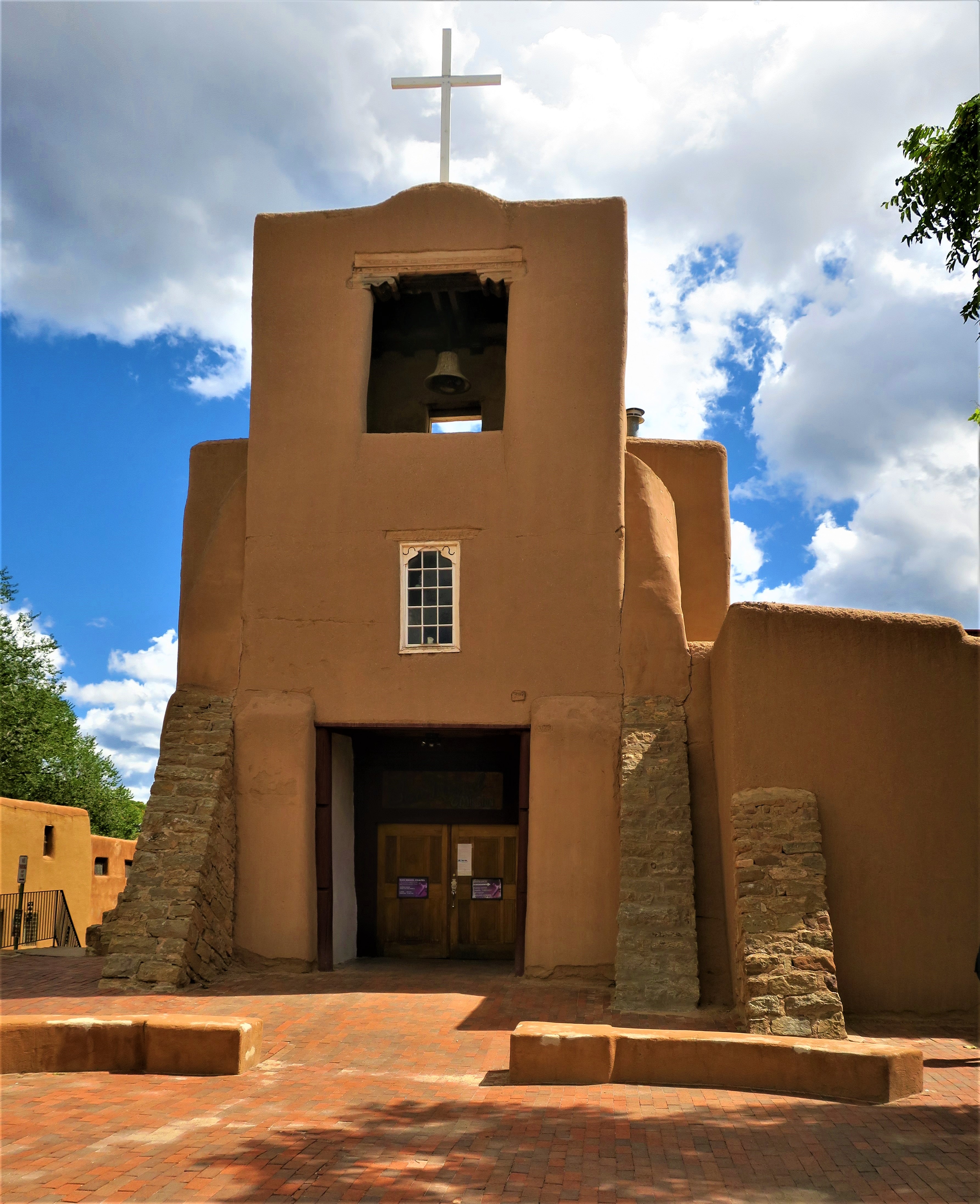
Nearby is San Miguel Mission, which stakes its claim as the nation’s oldest church that’s still operating today. Santa Fe and the church were pretty much born in the same year – 1610 – and once again, the original foundation is still evident. There are a number of very old paintings flanking the walls but the most intriguing feature is a large church bell perched behind the mission pews that dates back to 1356.
The chapel, the church and the house are all on the Santa Fe Trail, an historic landmark on its own, that connected Missouri and New Mexico in 1821, heralding a decades-long period of trade, adventure and western mobility unheard of before in the new nation. The historic trail ends in the Santa Fe Plaza, where many Native Americans, whose culture permeates every facet of the city, gather daily to sell their wares. As a Washington, DC, resident, I was amused to see a Redskins cap on the head of one of the vendors. When I mentioned the controversy surrounding the name (many claim it is culturally derogatory) he said, “I am a Redskin,” alluding to a lot more than the football team. As for those who object? “That’s only East Coast lawyers wanting to make money,” he asserted. We left with a hearty, “Go Redskins,” having brought all the history of Santa Fe into the modern era.
-30-
Think The Food’s Bad?
Find out what’s good for you

at the “Taking Care of Yourself Nutritionally”
presentation in the theater at 2 o’clock.
Then enjoy yourself an hour later during Thirsty Thursday in the bistro.
= = = = =
Evergreen Triangle Links U.S.-Canada
By Sandy Katz, Mature Life Features
You can sample two national cultures with plenty of time for sightseeing, dining, entertainment and outdoor recreation while traveling the “Evergreen Triangle,” formed by the three cities in the Northwest — Seattle in the state of Washington and Victoria and Vancouver in Canada’s province pf British Columbia.
I launched my trip aboard the Victoria Clipper, a high-speed ferry that connects Seattle to Victoria’s Inner Harbor. From there, I took a leisurely stroll along the winding pathways of the city’s celebrated Butchart Gardens — the century-old 50-acre plot of formal plantings that are always in bloom in this provincial capital.
By late afternoon, I was enjoying high tea in tje majestic Empress while planning my trip to Vancouver the next day.
On the BC Ferries craft that morning, I noticed a brochure describing a helicopter ride from atop Grouse Mountain, the peak I got to by bus and tram rides before stepping over a blanket of snow to board an open sleigh for a high-speed ride on the mountain to catch a helicopter at the peak for birds-eye swing over the countryside.
The day’s excitement still was not over. On the bus ride back to the city, I got off at Capilano Park to walk the Capilano Suspension Bridge, the 450-foot-long plank-and-hemp-rope span said to be the world’s longest pedestrian suspension bridge that swings and sways with pedestrians 25 stories above the Capilano River.
The third leg of the Evergreen Triangle took me back to Seattle. My first objective was the Space Needle, the city’s enduring symbol from the 1962 World’s Fair. The 518-foot elevator ride takes you to the observation deck for a panoramic view of the city, Puget Sound and the Cascade and Olympic Mountains. At the base of the needle is the 74-acre Seattle Center housing civic and cultural attractions in a garden setting with plazas and fountains.
The Monorail is the best mode of transportation between the Space Center and downtown, where you can watch fish fly. Just head the Pike Place Fish Market, fishmongers pluck seafood orders and hurls them down the counter to another worker, who catches it with a flourish, wraps it for the customer, and collects the money.
OK, So The Dining Services Meeting . . .
. . .has been resked for
2 p.m. next Tuesday
in the 2nd floor theater.
So now get down to
3 p.m. Thirsty Thursday because this will be
Nick’s last turn behind the bistro bar.
= = = = =
Nevada’s Other Side Also a Good Bet
By Beverly Rahn, Mature Life Features
ELY, Nevada — If you want to get away from it all, this is the place.
As we zipped along Highway 50 — “The Loneliest Road in America” — that bisects this state, we saw how this land looked when pioneers bumped over it in Conestoga wagons.
We drove for hours through cactus-dotted plains under horizon-less skies just a half day from two of the glitter-gulch capitals of the world — Las Vegas and Reno. This is a land of wild mustangs and wrecked Mustangs. It’s where the deer and the antelope still play under an assortment of rainbows prancing with storms that clamber over the mountains.
We embarked on our week-long trip through rural Nevada from Reno and drove 320 miles east to Ely and 280 miles south on Highway 93 to Las Vegas.
While the land is harsh, the folks are friendly. We learned quickly the difference between a fairy tale and a cowboy story. A fairy tale begins with ‘Once upon a time.’ A cowboy story starts with, ‘Now listen, this is no bull—-.’
Planning to stretch our legs a mite on a fuel stop in Austin, we pulled over to a fence and saw a sign that said “Don’t even think of parking here.” We moved on because it was quite a clear statement in a land that has nothing but space.
In Eureka, we parked under the courthouse balcony that was used for, among other things, public hangings during the town’s heyday when it was the leading lead producer in the world. There were 13 smelters operating in this Pittsburgh of the West during the 1870s.
We took some time to hunt for pine nuts. These nuts, about the size of your little fingernail, were harvested by Native Americans each year after the first frost. They thrashed the pinon (pine) trees to tumble these seeds out their cones. The nuts were, and still are, roasted, salted or mashed into a meal or butter.
Midway through our trek, we cruised into Ely, birthplace of the late First Lady Pat Nixon and home to a Basque community (and its gusto food) that was born when these Pyrenees people were imported to tend to the flocks of sheep raised here.
We had called well ahead to make arrangements to ride the Ghost Train of Old Ely and wave to the call girls who greeted us you as the train chugged by the pleasure houses on the edge of town. We used our Golden Age passports at nearby Great Basin National Park to tour the Lehman Caves. This was another stop in the past that included several museums and a leap into prehistory to tour petroglyphs (stone etchings) across the ribbon of road and an expanse of desert from Fallon Naval Air Station.
The next morning, we took a side trip to Rachel, which is on the real loneliest road in America — Highway 375. The settlement perched on the edge of Nellis Air Force Bombing and Gunnery Range and Area 51/Groom Lake, is reportedly a major Earth terminal for unidentified flying objects (UFOs). The social center of the community is the Little A’Le’Inn, where we ordered an alienburger that tasted “out of this world,” of course.
Lore has it that it’s easy to identify aliens in the Little A’Le’Inn: they enter the watering hole and sit at a table for hours without ordering anything to eat or drink.
Gliding by sparkling Lake Mead as we dropped down into Las Vegas the next morning gave us the time cushion to adjust to our return to the clattering casinos of Reno’s neon neighbor.
It seems odd that a state in which most of the homes and buildings we saw dated back to the 19th century has enacted laws that prohibit anyone from disturbing anything that’s more than 50 years old. My husband, who’s older than that, says he likes the idea.
Food Service Meeting . . .
. . . sked for 2:30 p.m. has been
CANCELLED.
Nothing new till next month.
= = = = =
Breath-holding Utah Sights to Behold
By Fyllis Hockman
Mature Life Features
Full four-wheel drive didn’t seem to be enough to hold us from dropping 1,300-feet from the narrow cliff-side ledge as I clung to my heart. Gaping at the towering walls adorned with sharp pinnacles leaping skyward, it looked like the earth had been splashed with multi-hued red dyes, all running together.
Such is life among the five national parks of southern Utah — Arches, Canyonlands, Capitol Reef, Bryce and Zion that share uncompromising splendor, history of both the earth and the country, and a sense of personal sanctuary. After more than 150 million years, they are still works in progress.
Arches National Park is a mecca of some of nature’s most intriguing architectural designs that span space and confound logic for which no man-made blueprint was ever drawn. With more than 900 such structures, it boasts the largest concentration of natural arches in the world. The trail to Delicate Arch, one of its most famous, requires hiking slick rock at seemingly 90-degree angles at times. The visual wonder makes it worth the climb.
Nearby Canyonlands requires a four-wheel drive vehicle. The view from Island in the Sky at 6,000 feet embraces 2,000-foot cliffs rising out of a magnificently painted landscape.
The panorama at Grandview Point stretches across countless canyons providing a broad view over the entire park. “Scenic Overlook” signs become redundant. Shafer Trail, a dirt road that’s rough in spots and very rough in others, is bordered on one side by perpendicular cliffs and on the other by a sheer 1,300-foot drop.
Although geologic history is stressed in every park, it’s what defines Capitol Reef that ranges from 80 million to 270 million years old.
A stroll along the nearby Grand Wash River bed, so narrow in parts you can touch both canyon walls at the same time, evoked old western film images of the lonesome cowboy out on the trail. Butch Cassidy used to ride along this stream bed (it had water in it then) and hide among the cavernous cliffs overhead. It’s now called, not surprisingly, Cassidy Arch.
Bryce Canyon is synonymous with hoodoos — phantasmagorical images emerging from weird and wonderful rock formations. There are thousands of the little (and not so little) guys in all shapes, colors and sizes. Rain and ice have sculpted these fanciful folk out of the rusted limestone.
Arriving at Zion reinforces the idea that each park is unique. At the other parks, your line of sight extends out toward the horizon as well as down into the canyons. At Zion, you look straight up, and up, and up. The soft-running Virgin River is responsible for creating the huge rock gorges that encircle the park. It took only 5 million to 16 million years to do so.
If They . . .
. . .arrested the devil,

would they charge him
with possession?
America’s Colorful Hall of Fame
We smelled it as soon as we swooshed through the cool glass doors from the oppressive Pennsylvania humidity into the revitalizing air-conditioned building.
“Crayons,” my wife said.
We had entered the Crayola Hall of Fame nestled in a high rolling Easton meadow close by the New Jersey border just 90 minutes from downtown Manhattan.
It was a timely visit because a mittful of tones were to be retired to be replaced by a similar number in the colorful contingent. I lobbied for the enshrinement of a violet orange I developed when an old crayon melted in my water color set long ago but I was too late.
The initial move to modernity was made a few decades ago after interviews with Crayola’s major consumers – kids – revealed a need for brightness among the corporate colors. We asked our guide if there was any move to add a scent to the product. “Are you kidding?” was the response. Studies show that crayons are among the 20 most-recognized scents in America. Coffee and peanut butter top the list.
It was almost disappointing to see how such colorful pieces of my life could be the product of such a cramped and constantly-clattering plant. It was like discovering that Santa’s workshop is in a carport.
Workers did display an elfin dedication to quality in the care and concern they show in making sure every Crayola has a straight label and perfectly pointed tip. Color was splattered all over as paraffin was recycled in large globs, colorful paper sleeves awaited the cylindrical sticks of color, and the familiar orange-and-green boxes of various sizes housed hundreds of thousands of Crayolas ready for shipment around the globe.
Crayolas have rolled out of this site since the first eight-color pack was produced in 1903 and sold for a nickel. The trade name Crayola derives from the French word craie for chalk and the Latin oleum for oil. Crayolas are made of paraffin and pigment. And crayon is the generic term for a colored writing stick.
The one person I hunted for but never found: the inspector who checks for crayons that stay inside the lines.
Dolphins Dance off Clearwater
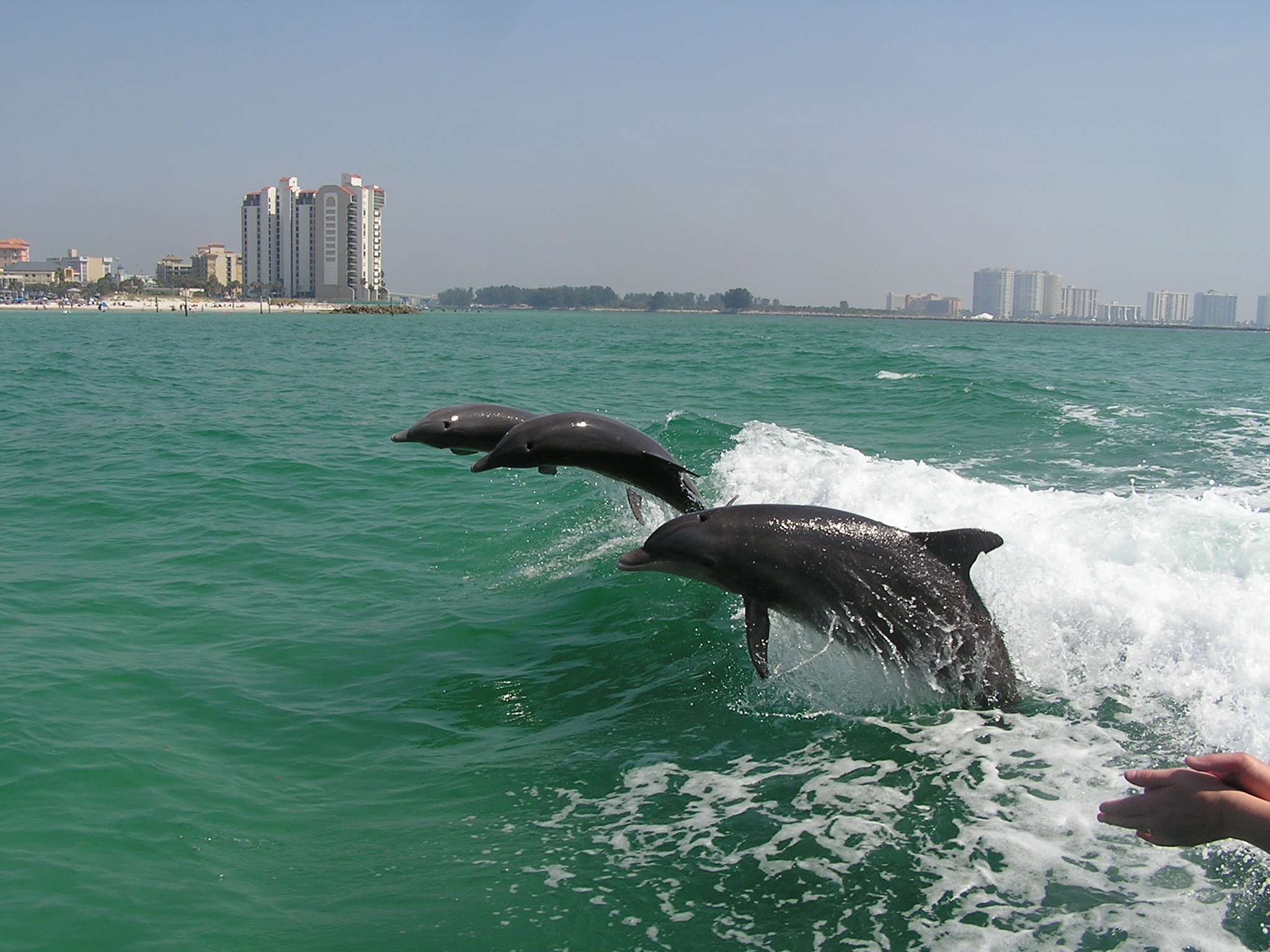
Everyone scrambled to the back of the boat as the captain gunned the vessel to create a wake he claimed the dolphins can’t resist.
More than half a dozen bottlenose dolphins pranced in, out, over, and under the stern swell as the 40-foot tourist-laden tugboat roared through the emerald Gulf of Mexico waters less than a mile off Clearwater.
After listening to passenger squeals and squeaks of delight for about 20 minutes, he cut the speed and the cavorting cetaceans with the constant grin skittered off.
Dolphins play and prey along this coast of Florida but they also become victims.
A celebrated case is Winter, which lost its tail to a crab trap. It was about three months old when found near Cape Canaveral in late 2005 tangled tightly in the trap’s buoy line.
Rescuers took it to the Clearwater Marine Aquarium. The mangled flukes fell off but tender loving care restored the mammal to health.
Winter made history because a coalition of several agencies and experts worked on designing and fitting the dolphin with a prosthetic tail. A movie was made of the entire development.
This marine attraction preaches and practices the three Rs: rescue, rehabilitate and release. Dolphins, otters, sea turtles, sharks, and sting rays are returned to the wild.
It also monitors sea turtle nests that abound on the barrier islands that protect much of this shoreline. The egg-laying season begins May 1 and the last hatchlings head for the open sea in late August.
Many of these newborns need help to guide them to the water because they use the moonlight to get there but city lights and other illumination can confuse them.
Reading Stretches From Peanuts to Pagoda
READING, PA – Like prime real estate, Reading’s major attractions are location, location, location.
As an industrial center, it forged its place in history as a major player in the formation of this nation and a source of Conestoga wagons that played a vital role in the drive to develop the West.
Its geographic position in the shoulder of Mount Penn on the banks of the Schuylkill River is an hour’s drive or less from the fecund and food‑filled Lancaster County, capital of Amish country; the glitter and gourmet seafood of Atlantic City and the New Jersey shore, the historic sites of Valley Forge and Gettysburg, and Independence Hall, the cradle of our constitution in Philadelphia.
This manufacturing city designed in 1748 by William Penn’s sons, Thomas and Richard, is to outlet shopping what Bethlehem is to Christendom. It brags that it’s the Outlet Capital of the World, citing the opening of its first manufacturer’s outlet surplus sales shop more than half a century ago.
“America’s Oldest Brewery” is just up the road in Pottsville, the boyhood home of author John O’Hara, where the Yuengling family has been fermenting barley and hops at the foot of the Appalachian Trail since 1829.
This cozy complex that opened in the early 1700s as a food stop for muleskinners hauling barges along the Schuylkill River Canal System is still home to the ghosts of at least one of the owners, an owner’s mistress, a Revolutionary War soldier and a young girl who died of a respiratory ailment.
“We’ve had waitresses who’ve seen these ghosts and think they’re customers,” we were told.
A network of riverside walking and bicycle trails links the heart of this city of 80,000 with the countryside and much of its history. Donald Linderman, a nearby resident pedaling with a local group through a covered bridge leading to a former wagon works transformed into a museum, informed the group why there are no windows on covered bridges.
“They were built to get horse‑drawn wagons across the river and horses get skittish when they see anything moving under them. There are no windows so horses wouldn’t see the water rushing under them.”
After that lesson, it was time for a stop at downtown’s best‑known watering hole and power‑lunch stop ‑‑ Jimmie Kramer’s Peanut Bar. First‑timers tend to shuck peanut shells back into the bowl on their table. “Throw ’em on the floor,” sang out our server.
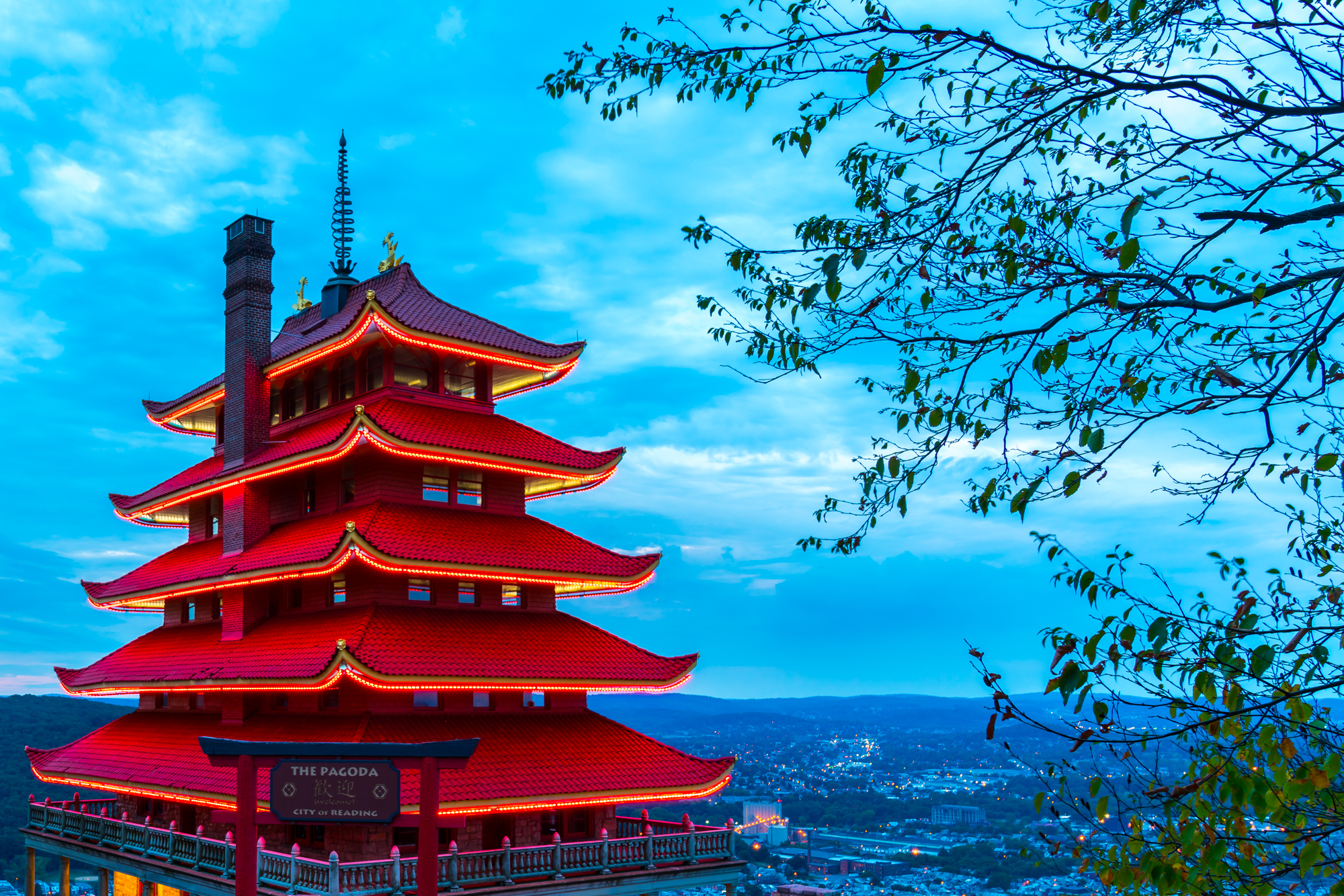
Before leaving this seat of Berks County, we headed up Mount Penn to the Pagoda on Skyline Drive for a semi-bird’s-eye view of this food- and fun-filled historic corner of our world.
 Mature Life Features