It Sounds Like . . .
. . . 100 percent of the people in this country

think at least 50 percent of the people in this country
have lost their minds.
= = = = =
Backyard Travel in Vogue
The coronavirus has dealt crippling blows to the travel industry, but folks hooked on or interested in tramping new ground can still get out and about.
They can explore their neighborhoods, cities and nearby countrysides without threatening their fellow man with contagion.
It’s still possible to take a bike ride along forest breaks that used to be railway lines to enjoy the quiet and comfort of the countryside.
And you can drive up to such major attractions as the Grand Canyon, South Dakota’s Mount Rushmore, and bluffs on the Atlantic or Pacific coast to watch sunrise and sunsets without having to get out of your car.
There‘s much to see, hear and taste in our environs.
While Baltimore lures you with the finest crab cakes in the galaxy, it’s difficult to match fresh-lobster dining offered on Canada’s Prince Edward Island.
The Monterey scenic drive still provides long-lasting memories for travelers.
Trains offer comfortable vistas of the Pacific Coast and the Prairies, to mention a couple of interesting travels that are handy.
Most RVers will tell you there are North American vistas that vie with the most picturesque parts of the world – the Rockies, Yosemite National Park, Mackinac Bridge, Toronto Skyline, the St. Lawrence Seaway’s Thousand Islands, Carlsbad Caverns, Niagara Falls, and Seattle Space Needle, to cite a few sights.
Many food venues are attractions, including Kansas City steaks, New Orleans jambalaya, ballpark hotdogs, and home-cooked Amish dishes in Pennsylvania-Dutch country.
If you haven’t dropped by your hometown for a few decades, a revisit can be a door to an entirely new world wrapped around your old memories.
I Didn’t Realize . . .
. . . how many dear old gals
knew the F word

until I heard on of them yell
“Bingo!”
= = = = =
Another busy Friday with
bocce, billiards, bridge & bingo.
= = = = =
Get Busy to Do Nothing
Most people have figured out what they’re going to do when they retire.
Travel, visit the kids, play golf, grab some coffee with old friends, and go fishing are high on the list of plans.
But most people haven’t figured out what their going to do when there’s nothing left they want to do.
There’s an art to doing nothing when you know you can do anything you want to do whenever you want to do for as long as you want to do it.
So you might want to start practicing.
Recent studies indicate doing nothing – giving your brain a rest — can actually stimulate your mind. Researchers report that sitting back and doing nothing for a spell can refresh your brain and enhance your creative abilities.
Studies have revealed that, when boredom sets in, your brain is actually daydreaming – and those dreams can be productive.
However, doing nothing all the time can calcify your thinking.
To start doing nothing, get away from your television set, mobile phone, book, jigsaw puzzle or whatever else around you that can command your attention.
Some experts suggest you start doing something boring, like counting cars streaming by your window or stroll down to the nearby park to stretch out on a bench and stare into the pond or at the overhead clouds.
Killing time by wandering through the internet, meditating or checking messages doesn’t work because they don’t allow your mind to wander, to daydream. The idea is to eliminate all stimulation and activity so your body and your mind and emotions can do nothing.
Even listening to music can be a distraction when you’re trying to do nothing.
If you have to be doing something, try coloring in a coloring book – something that keeps our hands busy but doesn’t require any brain work.
These do-nothing periods can not only boost your awareness as you proceed through the day, they can help develop more creative pastimes to help you enjoy the times when you’re not doing nothing.
If Your Flight . . .
. . . is delayed or cancelled,
shouldn’t the airport
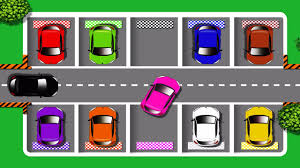
give you a refund for parking?
= = = = =
Golden Age Depends Upon Your Age
By Tom Morrow, Mature Life Features
We often hear the phrase “that was back in the ‘golden age’ of” – fashion, cars, Hollywood, you pick it.
High on the list of the most commonly discussed golden age deals with communication and spans a wide variety of topics: magazines, newspapers, radio and television.
Remember the heydays of Collier’s, Saturday Evening Post, Life, and Look? If you don’t, you didn’t arrive on earth until after the 1950s because these poplar weekly publications were the People magazines of their day. News magazines such as Time and U.S. News & World Report were vogue by mid-20th century.
One could say the golden age of newspapers stretched from the late 1800s through the first half of the 20th century. Every major city in America had at least two newspapers. New York City had seven until the late ‘70s. Chicago still has three.
Today, Los Angeles has just one, down from three just a couple of decades ago.
Interestingly enough, overseas cities such as London, Paris, Melbourne, Sydney, and Berlin still have more than four. Most of those cities sell their newspaper via street vendors. Door-to-door delivery seems to be an American thing.
The automobile’s golden age began in the 1920s and lasted through the ‘60s. Some f the most inventive vehicles were born and sold during this era.
There was the Stanley Steamer. Yes, it was powered by steam and went very fast. There was the luxurious hand-built Duesenberg, which was a “real doozie.” There were a number of electric-powered cars way back then – one-third of all cars on the road in 1900 were powered by electricity.
One of America’s first transportation companies, Studebaker, built horse- and oxen-drawn wagons during the Civil War and many of the so-called “Prairie Schooners” for the great migration to settle the West.
A friend writes that his family owned a 1929 four-door Studebaker-Erskine, named after Erskine, the president of Studebaker during the late ‘20s. The sedan was turned into scrap metal during WWII since gas-ration cards limited gasoline availability.
Those of you who have been around since the ‘30s may recall the Packard, Willys, Kaiser, Frasier, Crosley, and the short-lived the Tucker. One of the best-built but ugliest might have been Ford’s Edsel. Its gruesome grille might have had something to do with its short life.
Radio’s ruled the air waves from the late ‘20s through the 1940s. Many of television’s star performers, sit-coms and drama formats were developed during this period.
Many of us rushed home from school to listen in on “The Lone Ranger,” “Sky King,” “Sergeant Preston of the Yukon,” and “Straight Arrow.” On Sunday afternoons it was “The Shadow,” and “Nick Carter, Private Eye.” Weeknights it was “Johnny Dollar” and “Lux Radio Theater.” Every night “Fibber McGee & Molly,” “Bob Hope, “Jack Benny, “George Burns & Gracie Allen” made us laugh.
Today’s television programming is far-reaching. There’s very little that you can think of that isn’t available on a wide variety of “streaming” channels.
On-demand programming has new movies available while they’re still in the theaters – if you can find one that hasn’t closed down. Cable TV offers 24-hour news and talking heads spewing all sorts of opinions.
The not-too distant generation might look at the present time as TV’s golden age with sets bigger, better and lower-priced than ever before. Added to this is the array of computers, cell phones, and video games.
They might say this was the “Golden Age of Indulgence.”
(Tom Morrow’s books are available at Amazon.com and on Kindle.)
You Don’t Have To . . .
. . . believe everything you hear

to repeat it.
= = = = =
It’s old-farts’ discount
today at Fry’s.
= = = = =
How Rockefeller Came to Mean Rich
By Tom Morrow
John Davison Rockefeller Sr., one of the original six moguls who built America, is considered by many to have been the world’s wealthiest man ever with an estimated worth of some $410 billion in current dollars.
He was born July 8, 1839, and, with the founding of the Standard Oil monopoly in his 20s, he controlled the American petroleum industry for most of his adult life. That made him one of the so-called “robber barons” of our nation’s history.
The company’s origins date to 1863 when he hooked up with a couple of partners in the oil-refining business in Cleveland. Seven years later, after some ownership shifts, he incorporated Standard Oil and focused on refining oil rather than drilling for it.
Oil was used throughout the country as a source for fueling lamps until the introduction of electricity and then as a fuel and lubricant with the invention of the automobile.
As the need for kerosene and gasoline grew, his company controlled as much as 95 percent of all oil refining in the United States.
By establishing a maze of refining, marketing and affiliated companies, he also gained enormous influence over the railroad industry, which transported his oil around the country. Standard Oil became the first great business trust in the United States and, in 1911, the U.S. Supreme Court ruled it violated federal anti-trust laws and ordered it be dismantled.
It was broken up into 34 separate entities that included companies that eventually would become ExxonMobil and Chevron, among others. Individual pieces of the company were worth more than the whole and shares of these doubled and tripled in value in their early years,
Rockefeller became the country’s first billionaire with a fortune worth nearly 2 percent of the national economy. In 1913, his peak net worth was estimated at $336 billion (in 2007 dollars). He spent the last 40 years of his life in retirement at his estate in Westchester County, NY.
His fortune was used to create the modern systematic approach of targeted philanthropy. His foundations pioneered the development of medical research and were instrumental in the near-eradication of hookworm and yellow fever in the United States.
Religion was a guiding force throughout his life and he believed it to be the source of his success. He supported many church-based institutions and was a faithful congregant of the Erie Street Baptist Mission Church, where he taught Sunday school and served as a trustee, clerk and occasional janitor. He adhered to total abstinence from alcohol and tobacco all his life
He also was considered a supporter of capitalism based on a perspective of social Darwinism and was quoted often as saying, “The growth of a large business is merely a survival of the fittest.”
At age 86, Rockefeller penned the following words to sum up his life:
I was early taught to work as well as play,
My life has been one long, happy holiday;
Full of work and full of play
I dropped the worry on the way
And God was good to me every day.
(Tom Morrow’s books are available at Amazon.com and on Kindle.)
Sitting Around With . . .
. . . long-ago pals during my recent trip back home
we drug up the long-ago story about
the kid on the farm down the rod who was
given a pet pig
and he named it

Chris P. Bacon.
= = = = =
Falls Happen Any Time of Year
Half of the 32,000 deaths caused by falling happen to folks 75 years or older.
Falling is second only to heart disease as the major cause of deaths, and aging is the number one factor involved in these fatalities.
Three major causes of the more than 35 million falls reported annually are a step, slip or trip, all of which can be prevented, according to a consensus of health officials across the land.
Maintaining a healthful regimen is the initial process in the campaign to avoid falling.
Eat regularly and drink plenty of water to prevent dehydration. Develop and a keep up a regular exercise program that includes stretching and balance exercises as well some stamina, such as walking or swimming or biking.
Get regular medical checkups as well as hearing and vision tests.
Talk with your doctor about the effects and interaction of the medications you’re taking and ask if you should add vitamin D or calcium to the list.
Meet with them immediately if you’re having light-headed, dizzy or fainting spells.
Have all your prescriptions filled at one pharmacy and get your supplements there so you can discuss how everything interacts.
When you get home, remove all loose mats and rugs that make easy trip-over material. Check your furniture layout to ensure you have plenty of room to move around. Get rid of excess pieces that may look nice but are in the way.
Wear non-slip footwear around the house.
If it’s suggested that you might need a walker or cane, get one, and use it. Consider getting a medical alert device, especially if you’re living alone.
To avoid slipping, install non-slip flooring in your tub/shower and install grab bars at critical spots in the bathroom.
Add nightlights and handrails along the corridors that lead from your bedroom to bathroom.
While you’re at it, install night lights and handrails along the stairs to your basement and bedroom. Keep all passages well lighted and clear of rugs and objects you can trip over.
Store everything – canned goods, tools, laundry soap – within easy reach without the need of a ladder or step stool.
Tuesday Opens August . . .
. . . with monthly
Food Service and Town Hall meetings
beginning at 3 p.m. in the 2nd floor theater.
= = = = =
Living in Santa Fe
is an Art Form
By Fyllis Hockman, Mature Life Features
SANTA FE, NM – This state capital with some 70,000 inhabitants that leans against the Sangre de Cristo mountains is a state of mind more than a city; a way of life more than a place to live.
With more than 250 galleries housing Santa Fe art ranging from Southwestern to Native American to contemporary, no one is surprised to learn this is the first city in the country to be designated a UNESCO Creative City for Craft and Folk Art.
Visitors can start with museums, picking from a list that includes the SITE Santa Fe Museum of Contemporary Art, Museum of International Folk Art, New Mexico History Museum, New Mexico Museum of Art, Museum of Indian Arts and Culture, Wheelwright Museum of the American Indian, and Georgia O’Keefe Museum.
Each one is an immersion into whatever and whoever it is celebrating. The same as the hundreds of galleries proffering paintings and pottery, artworks and art wear and artifacts, jewelry, ceramics, sculpture, photography – have I forgotten any form of artistic expression? And if by any stretch of the imagination you have not seen enough art, there are galleries on steroids and shopping opportunities galore at the Railyard Arts District, Canyon Road and, of course, all around the central plaza that forms the heart of the city.
But Santa Fe also offers some more leisurely sightseeing stereotypes.
Among these are three very old structures, each sporting its own history and appeal.
The Loretto Chapel was built in 1873 as the first Gothic (as opposed to adobe) structure west of the Mississippi. It is home to probably the most inspirational staircase anywhere.
The architect building the church died before access to the choir loft could be constructed. The chapel was too small to allow for a traditional staircase. So the nuns did what nuns do: they prayed to St. Joseph, the Patron Saint of Carpenters for nine days, at which time a carpenter appeared without any of the tools needed to build a staircase. And yet a spiral staircase, taking up little floor space, was built – at which point he disappeared without thanks or payment.
Mystery still shrouds the Miraculous Staircase, as it is known. Wooden pegs have been used instead of nails and the wood is not native to the American Southwest. It has two complete 360 degree turns with no center pole for structural support. The entire weight of the staircase rests on the bottom stair. And the identity of the builder is still unknown.
Then there’s the Oldest House. Its adobe foundation dates back to an ancient Indian Pueblo circa 1200. The museum itself is relatively new, as recent as 1646. Two rooms with even newer household artifacts from the 1800s to 1900s rest on part of the original foundation conveying a sense of the family life that thrived back then. Not surprisingly, a sheaf of dried red peppers so prevalent in modern-day Santa Fe also make their appearance here.
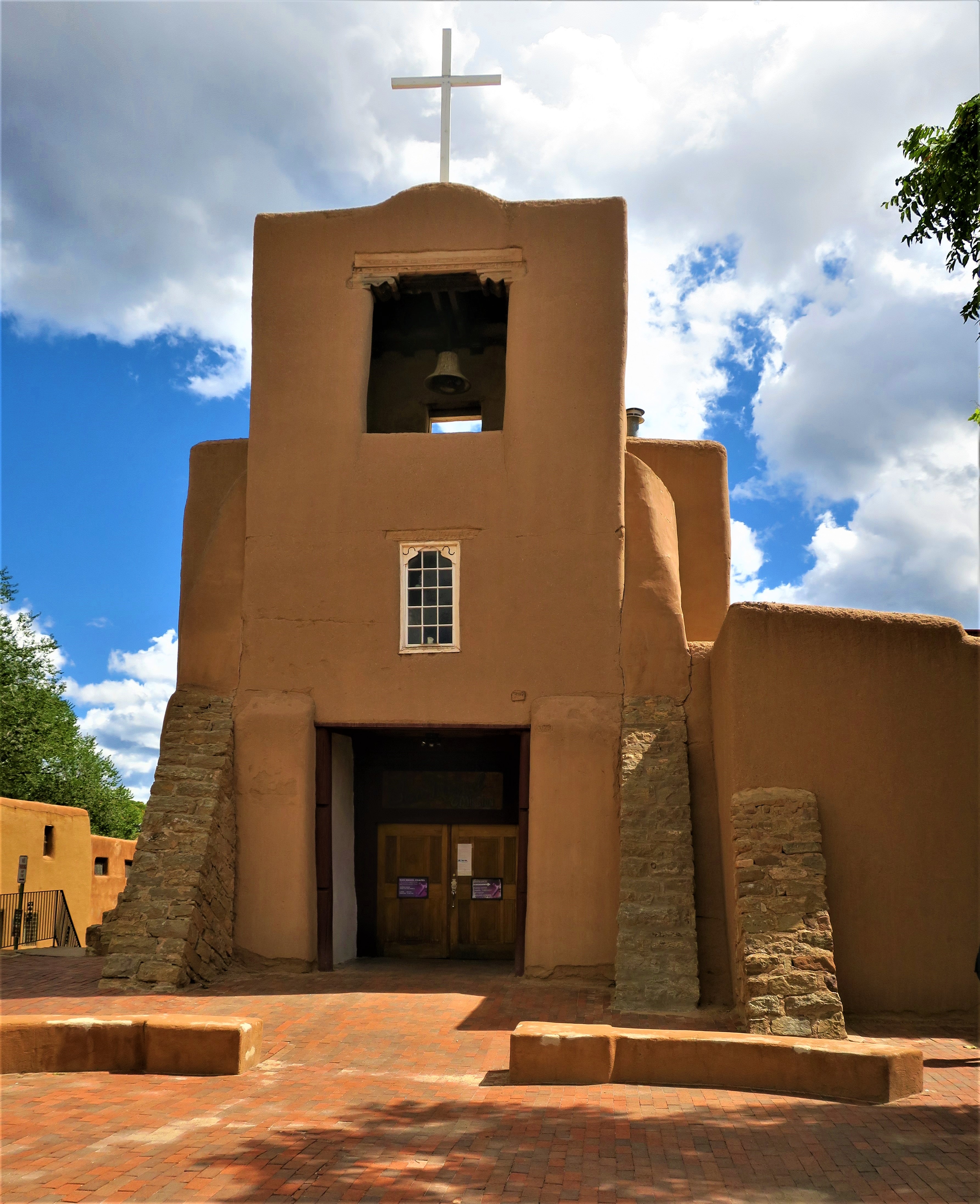
Nearby is San Miguel Mission, which stakes its claim as the nation’s oldest church that’s still operating today. Santa Fe and the church were pretty much born in the same year – 1610 – and once again, the original foundation is still evident. There are a number of very old paintings flanking the walls but the most intriguing feature is a large church bell perched behind the mission pews that dates back to 1356.
The chapel, the church and the house are all on the Santa Fe Trail, an historic landmark on its own, that connected Missouri and New Mexico in 1821, heralding a decades-long period of trade, adventure and western mobility unheard of before in the new nation. The historic trail ends in the Santa Fe Plaza, where many Native Americans, whose culture permeates every facet of the city, gather daily to sell their wares. As a Washington, DC, resident, I was amused to see a Redskins cap on the head of one of the vendors. When I mentioned the controversy surrounding the name (many claim it is culturally derogatory) he said, “I am a Redskin,” alluding to a lot more than the football team. As for those who object? “That’s only East Coast lawyers wanting to make money,” he asserted. We left with a hearty, “Go Redskins,” having brought all the history of Santa Fe into the modern era.
-30-
I Passed Up . . .
. . . on an old friend’s invitation
to his upcoming third wedding.

So he wouldn’t get miffed,
I responded “Maybe next time.“
= = = = =
THE 1%ERS
Contributed by a Fellow Inmate
99% of those born between 1930 and 1946 (worldwide) are now dead. If you were born in this time span, you are one of the rare surviving one percenters of this special group. Their ages range between 77 and 93 years old.
INTERESTING FACTS ABOUT THE 1% ERS:
You are the smallest group of children born since the early 1900s.
You are the last generation, climbing out of the depression, who can remember the winds of war and the impact of a world at war that rattled the structure of our daily lives for years.
You are the last to remember ration books for everything from gas to sugar to shoes to stoves.
You saved tin foil and poured fried meat fat into tin cans.
You can remember milk being delivered to your house early in the morning and placed in the “milk box” on the porch.
Discipline was enforced by parents and teachers.
You are the last generation who spent childhood without television; instead, you “imagined” what you heard on the radio.
With no TV, you spent your childhood “playing outside.”
There was no Little League.
There was no city playground for kids.
The lack of television in your early years meant that you had little real understanding of what the world was like.
We got “black-and-white” TV in the late ‘40s that had 3 stations and no remote.
Telephones were one to a house, often shared (party lines), and hung on the wall in the kitchen (no cares about privacy).
Computers were called calculators; they were hand-cranked.
Typewriters were driven by pounding fingers, throwing the carriage, and changing the ribbon.
‘INTERNET’ and ‘GOOGLE’ were words that did not exist.
Newspapers and magazines were written for adults and the news was broadcast on your radio in the evening (your dad would give you the comic pages when he read the news).
New highways would bring jobs and mobility. Most highways were 2 lanes (no interstates).
You went downtown to shop. You walked to school.
The radio network expanded from 3 stations to thousands.
Your parents were suddenly free from the confines of the depression and the war, and they threw themselves into working hard to make a living for their families.
You weren’t neglected, but you weren’t today’s all-consuming family focus.
They were glad you played by yourselves.
They were busy discovering the postwar world.
You entered a world of overflowing plenty and opportunity; a world where you were welcomed, enjoyed yourselves.
You felt secure in your future, although the depression and poverty were deeply remembered.
Polio was still a crippler. Everyone knew someone who had it.
You came of age in the ’50s and ’60s.
You are the last generation to experience an interlude when there were no threats to our homeland.
World War 2 was over and the cold war, terrorism, global warming, and perpetual economic insecurity had yet to haunt life.
Only your generation can remember a time after WW2 when our world was secure and full of bright promise and plenty.
You grew up at the best possible time, a time when the world was getting better.
| More than 99% of you are retired now, and you should feel privileged to have “lived in the best of times!” If you have already reached the age of 77 years old, you have outlived 99% of all the other people in the world who were born in this special 16-year time span. You are a 1% ‘er! |
You’re Never . . .
. . . too old
to learn

something stupid.
= = = = =
Wanna reminisce?
Check in with
Flashbacks at 3:30
= = = = =
Turning Away from
Mauthausen Concentration Camp
Was Not an Option
By Fyllis Hockman
While the architectural grandeur and resounding history of the four Central European capitals – Prague, Vienna, Bratislava, and Budapest – were overwhelming and wondrous, the biggest impact on our Grand Circle Danube River Cruise was made at the Mauthausen Concentration Camp, one of the first to be built and the last to be liberated.
My first visual exposure to the horrors of the Holocaust came as a teen-ager in newsreel depictions of the emaciated survivors with their sunken eyes and gaunt bodies liberated from some camps at the end of World War II.
It helped me understand what my mother told me about the Holocaust. Six decades later, I came to understand even more.
Mauthausen, one of the largest of the camps, was built high up an Austrian hill in Linz, where Hitler was once a resident, near a large quarry. The rationale behind concentration camps evolved over the war years from imprisoning people, enslaving them and engendering fear among the general populace to simply one of extermination.
Mauthausen was considered a Level 3 Camp. The guiding principle was simple: everyone was to be killed some way or other. The SS excelled at methods of mutilation and annihilation.
The roots of this genocide, according to our guide, were fostered in and fueled by anti-Semitism.
Many bodies fed “the stairs of death” leading to and from the quarry where malnourished and mistreated prisoners were forced to carry heavy stones up very high stairs and often died in the process. Others were simply pushed down the steps. These stairs still jut out of their peaceful and bucolic setting as cold reminders of the past.
Prisoners also were forced outside during winter and had cold water poured over them. This was a particularly appealing entertainment for the SS guards who delighted in “showering” people to death – outside the actual gas chamber showers, that is.
Another favorite SS sport was to entice prisoners into situations where they might appear to be escaping – and then shoot them. Any soldier who shot an inmate trying to escape got extra days off.
Others prisoners, sick and beaten, simply died during daily roll call, a grueling process of standing in the heat or cold for four to five hours and being forced to do exercises when most of them could no longer stand.

Students tour Mauthausen
In the barracks, hundreds were housed in such degraded conditions the term unsanitary does not begin to describe them.
On a wall is written the “wheezing, hissing, moaning, sobbing, snoring” that filled the night-time air in 20 languages: “The noise fused into a single, terrible sound produced as if by a giant monstrous being that had holed up in the dark.” Another wall writer wrote: “Anyone who hadn’t been brutal when they entered the world became brutal here.”
Our tour took us to the gas chambers where thousands were killed and the ovens where their remains were burned, with a side visit to the infirmary where unspeakable experiments were carried out.
Despite being within earshot of the thousands of prisoners suffering and screaming, the neighbors in the surrounding community claimed ignorance of what was happening. Some complained about the noise, but not about why it was occurring.
The grandmother of our guide, who was seven at the time, said she could smell the stench of the burning bodies. She knew something bad was happening but nobody talked about it.
Of the 200,000 prisoners who occupied Mauthausen from 1938 to 1945, about half were killed. There were only 20,000 survivors when liberation finally came on May 5, 1945. Some 80,000 were already too ill to benefit from the end of the war.
Most of the guards went home after the war suffering no consequences and little was said about what they had done. No one talked about it. According to our guide, it took Austria four decades to acknowledge its part in the Holocaust.
There were several teen-aged school groups visiting the camp and I felt thankful they were learning of these atrocities. The Holocaust will be relegated to the status of other historical occurrences the young will hear about in class but will not relate to. Who really cares about the Crusades?
It’s Been Awhile . . .
. . . since our last talk.

I was away on a family visit highlighted by my brother’s birthday, clan picnic, return to old stomping grounds, fabulous food and muchmuchmuch cooler weather. Air Canada flights to and from Toronto were not as tedious as anticipated although both were delayed.
Memories slammed back into mind immediately because I lived in Canada’s largest city and my reporting duties required sessions there on and off for several years after moving away.
Major impetus for the trip was to attend brother Lou’s 84th. It was preceded by the annual Scaglione picnic, which has been organized by cousins I’ve never met. It was a blast because most of them had heard of me — “You’re father and my aunt were first cousins, which makes you . . .” It was a fun day out in a grassy park near Niagara Falls and everyone brought food that was shared and sumptuous.
An added fillip was the slice of raspberry pie I had each morning. Lou’s long-time friend has a bumper crop of raspberries from his backyard bushes and his wife has made dozens of pies and given them to friends. My timing made me a beneficiary. Raspberries and mangos are my top-level favorite fruit. Strawberries and apricots are pretty good, too.
Son Michael from San Diego joined us for the visit. Daughter Cris got detoured by Covid. Like all visits, it ended too soon, but it was good to get back home. The A/C is beating the THE HEAT, so life is good. Altho I still miss all the things I missed about back home before I went back home.
MTC

 Mature Life Features