
Reading Stretches From Peanuts to Pagoda
READING, PA – Like prime real estate, Reading’s major attractions are location, location, location.
As an industrial center, it forged its place in history as a major player in the formation of this nation and a source of Conestoga wagons that played a vital role in the drive to develop the West.
Its geographic position in the shoulder of Mount Penn on the banks of the Schuylkill River is an hour’s drive or less from the fecund and food‑filled Lancaster County, capital of Amish country; the glitter and gourmet seafood of Atlantic City and the New Jersey shore, the historic sites of Valley Forge and Gettysburg, and Independence Hall, the cradle of our constitution in Philadelphia.
This manufacturing city designed in 1748 by William Penn’s sons, Thomas and Richard, is to outlet shopping what Bethlehem is to Christendom. It brags that it’s the Outlet Capital of the World, citing the opening of its first manufacturer’s outlet surplus sales shop more than half a century ago.
“America’s Oldest Brewery” is just up the road in Pottsville, the boyhood home of author John O’Hara, where the Yuengling family has been fermenting barley and hops at the foot of the Appalachian Trail since 1829.
This cozy complex that opened in the early 1700s as a food stop for muleskinners hauling barges along the Schuylkill River Canal System is still home to the ghosts of at least one of the owners, an owner’s mistress, a Revolutionary War soldier and a young girl who died of a respiratory ailment.
“We’ve had waitresses who’ve seen these ghosts and think they’re customers,” we were told.
A network of riverside walking and bicycle trails links the heart of this city of 80,000 with the countryside and much of its history. Donald Linderman, a nearby resident pedaling with a local group through a covered bridge leading to a former wagon works transformed into a museum, informed the group why there are no windows on covered bridges.
“They were built to get horse‑drawn wagons across the river and horses get skittish when they see anything moving under them. There are no windows so horses wouldn’t see the water rushing under them.”
After that lesson, it was time for a stop at downtown’s best‑known watering hole and power‑lunch stop ‑‑ Jimmie Kramer’s Peanut Bar. First‑timers tend to shuck peanut shells back into the bowl on their table. “Throw ’em on the floor,” sang out our server.

Before leaving this seat of Berks County, we headed up Mount Penn to the Pagoda on Skyline Drive for a semi-bird’s-eye view of this food- and fun-filled historic corner of our world.
Only Your Computer Knows Virtual Money
It’s a tenet of investing: if you don’t understand the company or product and what it does, drop it and move on to something else.
Which makes the Bitcoin story totally bizarre. Not only is it understood by a select group of financial high flyers, no one is really sure who started it.
Since the Bitcoin’s birth a dozen years ago, it’s travelled a bumpy road the stretches from a price of $400 five years ago to more than $60,000 earlier this year. Along the way it dropped to $4,000 in 2019 from $19,000 two years earlier.
But not to worry, if Bitcoin sounds a bit scary, there are more than 6,500 other cryptocurrencies on the market.
None of these currencies involve printing presses. They exist only in computers – cyberspace. Like Bitcoin, you can’t store any of it under your mattress.
There is a growing industry servicing the spending of Bitcoins after you buy them. They’re readily available at thousands of automated teller machines around the country.
The value of Bitcoin rises only if there’s a demand for it. If no one wants it, the value drops – dramatically.
If Bitcoin doesn’t catch your fancy, you can purchase Ethereum, Litecoin, Stellar, Polkadot, Cardano and, as pointed out earlier, thousands of other options.
And there’s a whole new language involved.
For example, Ethereum claims to be “a decentralized software platform that enables smart contracts and decentralized applications (dapps) to be built and run without any downtime, fraud, control, or interference from a third party.
“The goal behind Ethereum is to create a decentralized suite of financial products that anyone in the world can freely access, regardless of nationality, ethnicity, or faith.”
Did you get all that?
Transactions are conducted through a digital ledger called a blockchain. This involves a global computer network that stores the virtual money in a digital wallet.
A lure of cryptocurrency is the ability of blockchain to process and record software programs to transfer large sums of money around the world without an intermediary.
For example, it takes five days to transmit cross-border payments at an average fee of more than 6 percent, accounting for a $4 trillion business globally. Bitcoin cuts the transfer time down to about 10 minutes. Fees vary for the various currency forms. Some are no fee.
If you feel you understand the function of virtual currencies and see them as part of your financial future, make sure you understand the beginning, middle and end of what can happen to your money if you think you’d like to get involved and invest.
If You’re Faced With a Choice . . .
. . . between two evils,

pick the one you haven’t tried yet.
Coffee Worth the Break
Coffee breaks are being recognized as more than just a brief respite from work.
Caffeine can be good for you.
Moderation matters in all corners of our lives but up to three cups a day can be healthy.
Critics warn that caffeine dehydrates your system, increases hypertension and the risk of heart attack, cuts down on your ability to sleep, is linked to gout attacks, raises blood pressure, and brings on anxiety, heartburn and stomach problems.
While coffee fans admit much of this may be true, there’s a growing list of benefits for those who drink coffee.
Surprisingly, it’s been discovered that an eight-ounce cup of java contains more disease-fighting antioxidants than a regular serving of oranges or blueberries.
Coffee drinkers reportedly have a lower risk of such chronic conditions as diabetes and heart disease as well as less cognitive decline as they age.
Researchers have found that seniors who have as many as four cups of coffee a day cut in half their risk of heart disease compared with those who take in less caffeine.
Medical experts point out caffeine interacts with many medications so go over your list of prescriptions and supplements with your primary care physician to make sure coffee is compatible.
Among the benefits being attributed to coffee is the ability to relieve a headache as well as protecting the liver and offering defense against strokes and cancer of the mouth and throat.
Coffee drinkers who get agitated or jittery after too many cups of coffee have found that drinking decaf soothes the nerves while providing the same benefits.
Cutting back on the milk and sugar also limits your calorie intake. If coffee straight doesn’t suit your taste, try adding such flavor enhancers as cinnamon that not only improve the taste but add healthy benefits of their own.

Traipsing Through Space Could Keep us Healthy
Space exploration could be good for our health.
While it might be of faint benefit to you, the health and wellbeing of your great-great-great kids could depend on it.
It has to do with the fate of planet Earth and its residents. Will climate change make it unlivable? Will the globe become overcrowded with people? Will viruses and other critters overpower humans?
A means of escape and a place to escape to already are being explored as the road to survival for the human race.
The media has been treating upper-space flights by Tesla’s Elon Musk, Amazon founder and ex-CEO Jeff Bezos as fun-filled fillips of flabillionaires. But these gravity-beating sorties by far-seeing individuals may be giving us a pee into what will save mankind.
The United Arab Emirates’ Hope reached its Mars orbit in February and is man’s first mission to study the possibility of humans living on another planet. Chinese and U.S. orbiters joined it shortly that. They’re collection of data to determine if it’s feasible to colonize the red planet is more than mere curiosity.
Extinctions have barraged the earth a handful of times, the last occurring some 65 million years ago after a giant asteroid smashed into the Gulf of Mexico resulting in a catastrophic wipe-out of half of all marine organisms and a major chunk of land creatures, including the dinosaurs. There’s no certainty that a similar event can’t happen again.
Mr. Musk argues for making life multiplanetary to safeguard the existence of humanity in the event that something similar was to happen again.
“We need to get to Mars as quickly as possible,” he said, “to establish a base.” But he doesn’t expect us to stop there.
“One does not simply hopscotch to the stars on a whim,” he said. “It will take decades, if not centuries, to progress. We need to start now.”
The process actually began back in the ‘50s when the Russians launched Sputnik, the first artificial satellite to orbit the Earth.
In the meantime, we enjoy a bundle of health benefits spawned by the space race. They include the development of memory foam mattresses and pillows that help us sleep better, more comfortable sneakers that ease pressure on legs and feet, and scratch-resistant lenses that keep our glasses clear so we can see better and avoid falling.
Mother’s Advice . . .

. . . was among the topics covered during my weekly phone chat with brother Lou.
I recalled ma’s admonition, “You can’t swim in there, it’s too deep.”
He dredged up, “You can’t go swimming in the rain, you’ll get wet.”
Just Another Saturday …
… at Sunrise of Gilbert.
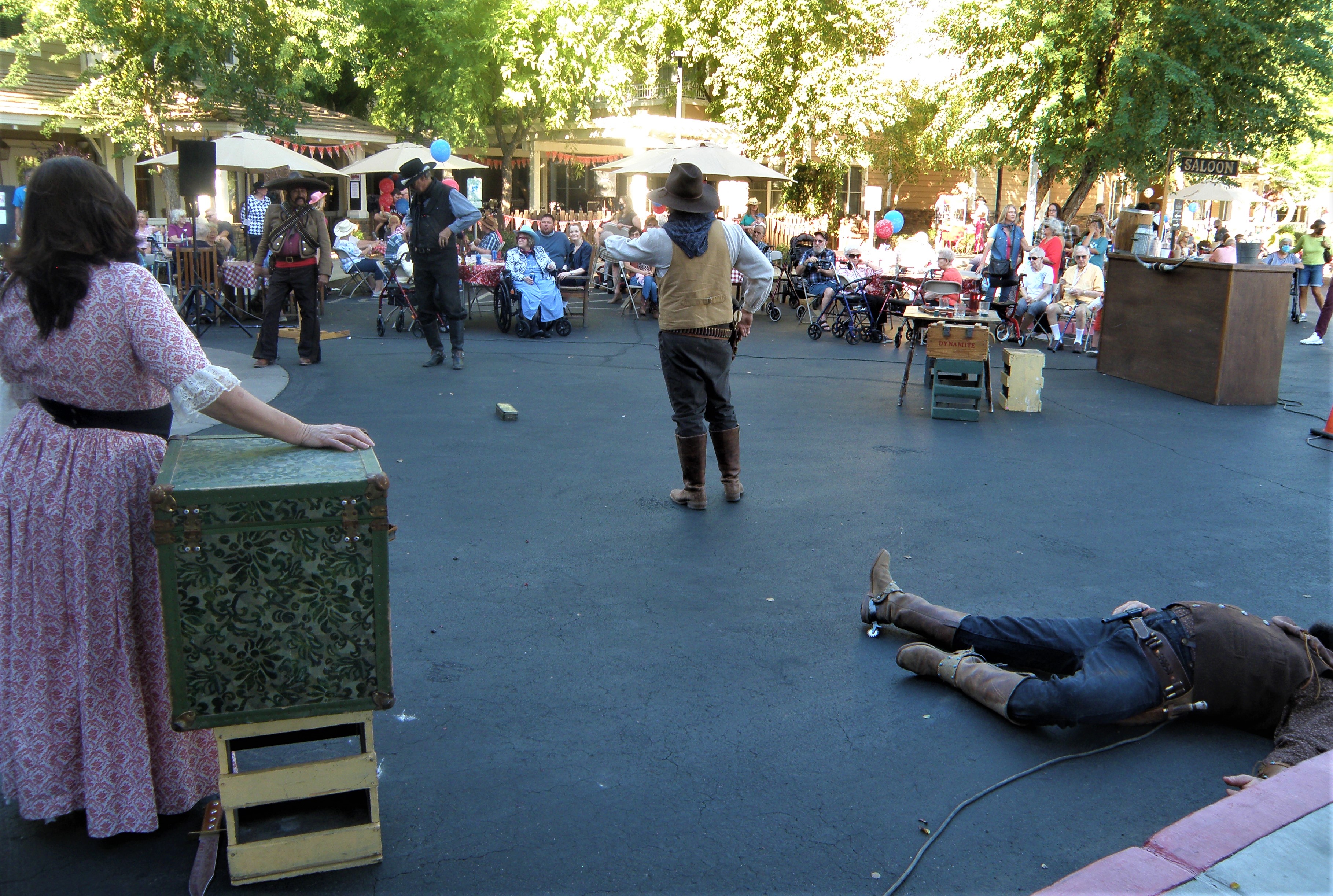
It was our Western Extravaganza with hayrides for the kids (of all ages), petting zoo, trail-rider chuck- wagon dining, line dancing, saloon shootout, fantastic weather, family visits, and favorite-tunes-for-old-farts band among the features that kept a few hundred people entertained for the afternoon.
Everyone reported sleeping well that night.
When You’re Faced With …

… finding a way to do something,
it’s a heckuva lot easier to find an excuse.
 Mature Life Features