Archive for October 2021
If You’re Faced With a Choice . . .
. . . between two evils,

pick the one you haven’t tried yet.
Coffee Worth the Break
Coffee breaks are being recognized as more than just a brief respite from work.
Caffeine can be good for you.
Moderation matters in all corners of our lives but up to three cups a day can be healthy.
Critics warn that caffeine dehydrates your system, increases hypertension and the risk of heart attack, cuts down on your ability to sleep, is linked to gout attacks, raises blood pressure, and brings on anxiety, heartburn and stomach problems.
While coffee fans admit much of this may be true, there’s a growing list of benefits for those who drink coffee.
Surprisingly, it’s been discovered that an eight-ounce cup of java contains more disease-fighting antioxidants than a regular serving of oranges or blueberries.
Coffee drinkers reportedly have a lower risk of such chronic conditions as diabetes and heart disease as well as less cognitive decline as they age.
Researchers have found that seniors who have as many as four cups of coffee a day cut in half their risk of heart disease compared with those who take in less caffeine.
Medical experts point out caffeine interacts with many medications so go over your list of prescriptions and supplements with your primary care physician to make sure coffee is compatible.
Among the benefits being attributed to coffee is the ability to relieve a headache as well as protecting the liver and offering defense against strokes and cancer of the mouth and throat.
Coffee drinkers who get agitated or jittery after too many cups of coffee have found that drinking decaf soothes the nerves while providing the same benefits.
Cutting back on the milk and sugar also limits your calorie intake. If coffee straight doesn’t suit your taste, try adding such flavor enhancers as cinnamon that not only improve the taste but add healthy benefits of their own.

Traipsing Through Space Could Keep us Healthy
Space exploration could be good for our health.
While it might be of faint benefit to you, the health and wellbeing of your great-great-great kids could depend on it.
It has to do with the fate of planet Earth and its residents. Will climate change make it unlivable? Will the globe become overcrowded with people? Will viruses and other critters overpower humans?
A means of escape and a place to escape to already are being explored as the road to survival for the human race.
The media has been treating upper-space flights by Tesla’s Elon Musk, Amazon founder and ex-CEO Jeff Bezos as fun-filled fillips of flabillionaires. But these gravity-beating sorties by far-seeing individuals may be giving us a pee into what will save mankind.
The United Arab Emirates’ Hope reached its Mars orbit in February and is man’s first mission to study the possibility of humans living on another planet. Chinese and U.S. orbiters joined it shortly that. They’re collection of data to determine if it’s feasible to colonize the red planet is more than mere curiosity.
Extinctions have barraged the earth a handful of times, the last occurring some 65 million years ago after a giant asteroid smashed into the Gulf of Mexico resulting in a catastrophic wipe-out of half of all marine organisms and a major chunk of land creatures, including the dinosaurs. There’s no certainty that a similar event can’t happen again.
Mr. Musk argues for making life multiplanetary to safeguard the existence of humanity in the event that something similar was to happen again.
“We need to get to Mars as quickly as possible,” he said, “to establish a base.” But he doesn’t expect us to stop there.
“One does not simply hopscotch to the stars on a whim,” he said. “It will take decades, if not centuries, to progress. We need to start now.”
The process actually began back in the ‘50s when the Russians launched Sputnik, the first artificial satellite to orbit the Earth.
In the meantime, we enjoy a bundle of health benefits spawned by the space race. They include the development of memory foam mattresses and pillows that help us sleep better, more comfortable sneakers that ease pressure on legs and feet, and scratch-resistant lenses that keep our glasses clear so we can see better and avoid falling.
Mother’s Advice . . .

. . . was among the topics covered during my weekly phone chat with brother Lou.
I recalled ma’s admonition, “You can’t swim in there, it’s too deep.”
He dredged up, “You can’t go swimming in the rain, you’ll get wet.”
Just Another Saturday …
… at Sunrise of Gilbert.
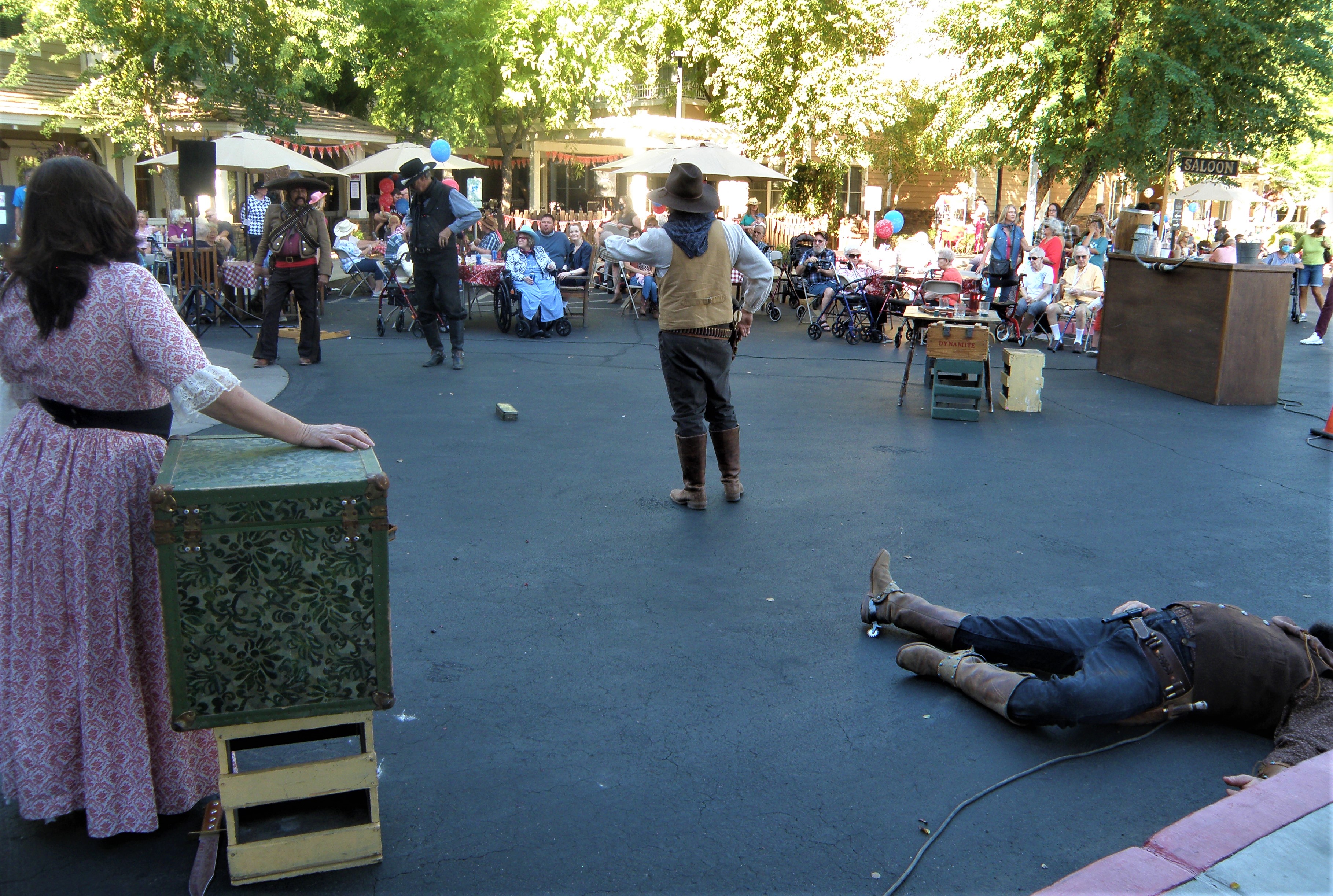
It was our Western Extravaganza with hayrides for the kids (of all ages), petting zoo, trail-rider chuck- wagon dining, line dancing, saloon shootout, fantastic weather, family visits, and favorite-tunes-for-old-farts band among the features that kept a few hundred people entertained for the afternoon.
Everyone reported sleeping well that night.
When You’re Faced With …
… finding a way to do something,
it’s a heckuva lot easier to find an excuse.
Our Remodeled Bistro Opened Tuesday …
… and the complaints are legion, of course.
The sole point of agreement with the majority of the inmates is that it looks nice. The hangout it replaced had the comfortable look and feel of corner bar with a brass foot-rail that everyone appreciated because the consensus was that it looked like a hangout should.
The most succinct comment that says it all about the new look is: “A waste of money.”
Talking with Cris on her birthday yesterday …
… burst a balloon of memories like the hole left in our home when she went off to graduate school, toddler tumbling on the living-room floor with her two younger brothers, a fun and proud Detroit Vanguard Theater afternoon ruined by an officiousCanadiancustomsofficer (all one word), and abruptly stopping laughing and giggling when she realized she’d taken her first steps on her own in a small apartment we rented in another galaxy.
There were more but that’s how they started.
Urban Sprawl May be Harmful to Your Health
By Cecil Scaglione
Walking, which has been called the best exercise investment, can be helped or hampered by where you live.
While it costs nothing, can be done anywhere at any time, and requires no special equipment – except, perhaps, for a good pair of sturdy shoes – your environs could be less than walking-friendly.
If you live in a sprawling community, you’re more likely to weigh more, have higher blood pressure, and walk less than residents of more congested counties, according to an American Journal of Health Promotion report.
A research team from the National Center for Smart Growth indicated there is a strong association between your health and urban environment, which is of serious concern to older residents.
After accounting for such personal variables as age and education, they found residents of the most compact counties weighed more than five pounds less and walked almost 1 ½ hour more a month than people living in sprawling counties.
The team gathered information from more than 200,000 people living in almost 450 counties in more than 80 metropolitan regions. The areas were graded on their levels of sprawl based on factors such as the density of its residential neighborhoods, connections between roads, and the physical separation of homes, shops and workplaces.
Poor accessibility was the common denominator of urban sprawl — nothing within easy walking distance of anything else.
Those who say they have safe, convenient places to walk or to get other forms or exercise are most likely to be physically active, said a team of Georgia Department of Human Resources researchers.
Increasing the number of desirable location destinations within a 20-minute-walk radius might encourage older women — the least active population segment – to exercise, according to a University of Pittsburgh study.
Older women in the Pittsburgh region who lived within walking distance of a biking or walking trail, park, or department, discount or hardware store logged significantly more walking time than those who did not have similar facilities nearby.
 Mature Life Features