Archive for the ‘United States.’ Category
On a Mission in San Diego

By Cecil Scaglione
Mature Life Features
Played tourist at home this weekend and took the camera to visit Mission San Diego de Alcala.
It’s worth spending some time there, especially when you move from the busy front into the quieter and more spacious courtyard encapsulated by the Spanish-colonial structure housing a museum, priests’ quarters, chapel, and more (like public bathrooms). Happened upon a wedding in the parish that Franciscan Junipero Serra established in 1769 as the first of the 21 missions that form the spine of California.
The original Spanish settlement was where Old Town is now, below the Presidio tower on the hill that allowed settlers to get a strategic early view of any ships sailing into San Diego Bay.
The friars decided to move their neophyte native converts away from the lascivious soldiers so they moved the church and school about five miles up the San Diego River – the distance in which tolling bells could be heard.
Among the exhibits is a showcase of models of the missions stretching from here to north of San Francisco in the order in which they were founded. It’s a quick look at California’s early development.
While they were situated within a day’s march of each other – anywhere from about 30 to 50 miles – they weren’t founded in order from south to north. The next mission established after San Diego was in Carmel just south of San Francisco.
However, to follow El Camino Real (The King’s Highway) formed by the mission chain, drive up Highway 5 to the largest mission in the chain – Mission San Luis Rey in Oceanside. Next is San Juan Capistrano and then there’s…
Pasadena Not Just for Smelling Roses
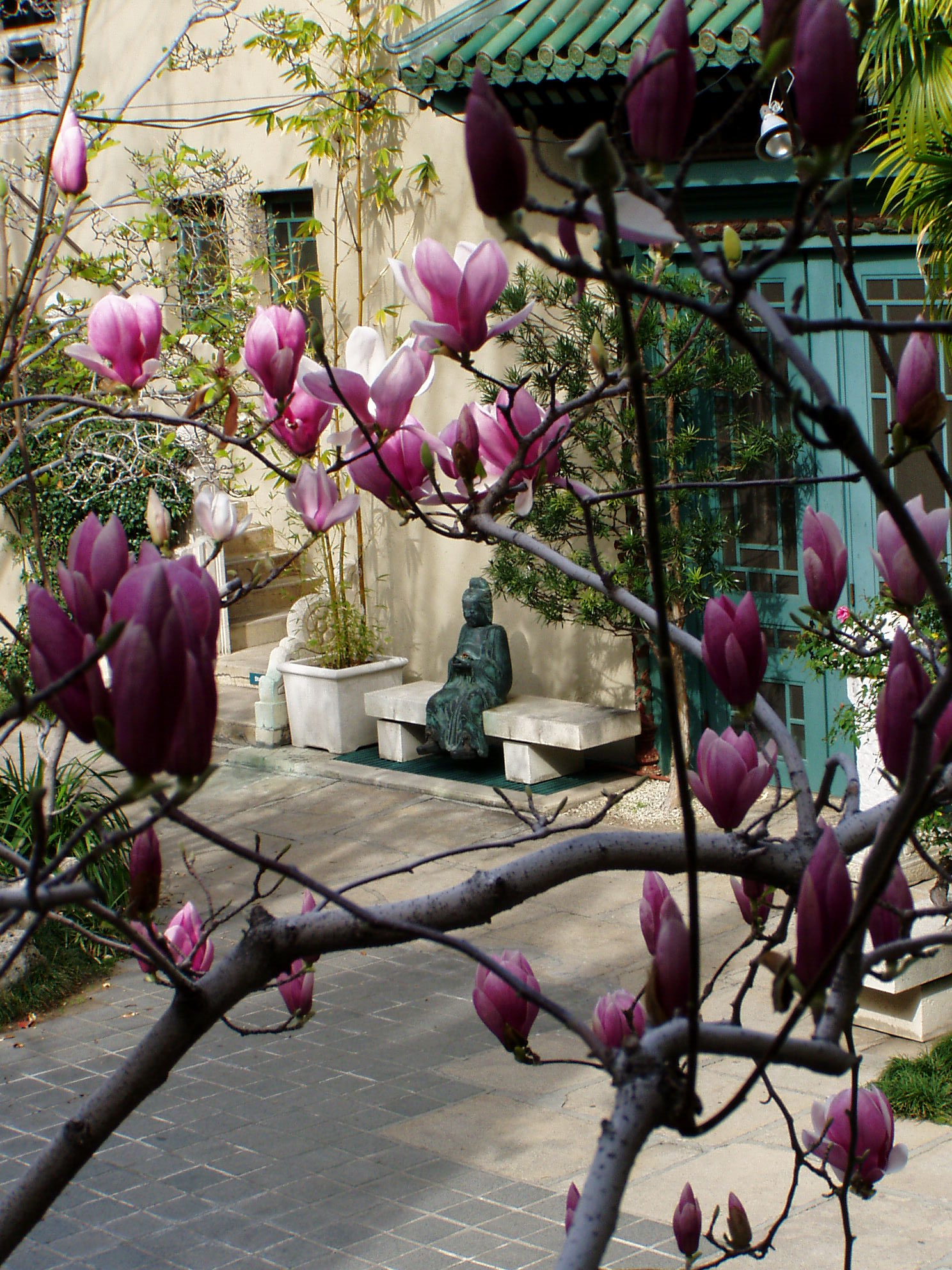
Story and Photo
By Cecil Scaglione
Mature Life Features
Pensive statue in Pasadena’s Pacific Asia Museum
PASADENA —- Much of the world becomes aware of this town 15 minute north of downtown Los Angeles when it unveils months of work on blossom-burgeoned floats in the yearly Rose Parade along Colorado
Boulevard.
This is a prelude to the granddaddy of all college bowl games: the annual New Years’ Day
football festival in the Rose Bowl, where the University of California – Los Angeles Bruins play
their home games.
But when visitors consider Los Angeles, they envision a melange of movieland, Malibu,
Disneyland, and Beverly Hills. Few folks even consider visiting this quiet community that’s as homey as a ’57 Chevy.
But you can please both your palate and your psyche in this town that appears, in spots, like it
might have been plucked out of the Poconos rather than sequestered alongside the San Gabriel
Mountains.
While teasing your taste buds at one of the 500 local eateries – this number should be no surprise
when you learn cooking icon Julia Child was born here – you may stumble upon luminaries
of big and small screen as well as stage who have long found this “city that feels like a village” a liveable
locale.
But you can get closer to much bigger stars here.
Creative minds at Jet Propulsion Laboratories monitor progress of their history-making
space probes. Reservations are required, but tours of this facility are free. Details for a visit are available at jpl.nasa.gov.
To pleasure your psyche, the Norton Simon Museum offers an intimate walk among works by,
among others, Monet, Rembrandt, Rubens, Renoir, Raphael, and Degas, including his famous
depiction of a young ballerina “Waiting.” All are within touching distance in this visitor-friendly
facility along the Rose Parade route.
While you‘re in this part of town, skip over to the Pasadena Museum of History for a quick tour
of the 18-room Fenyes House. The mansion echoes how Pasadena grew out of the Spanish
outpost established at Mission San Gabriel by Franciscan Father Junipero Serra back in 1771.
The community sprouted after the transcontinental railway reached the sleepy little town of Los
Angeles in the 1870s and the region was discovered by a handful of wealthy Midwesterners from
Indiana, Illinois, and Michigan seeking escape from frigid winters.
The Fenyes House is one of 52 grand mansions built in the late 1800s along a millionaires’ row known as “the Boulevard.”
It was millionaire railroad-and real-estate magnate Henry Huntington who established the 207-acre Library, Art
Collections and Botanical Gardens complex known simply as The Huntington.
The Library, a research center that has been dubbed the Bastille of Books, houses original
Shakespeare works as well as Benjamin Franklin’s handwritten autobiography and an original
Gutenberg Bible.
On display in the art gallery are several works by Gainsborough, including his renowned Blue
Boy. A mausoleum built on the grounds was designed by John Russell Pope and used as a
prototype for the Jefferson Memorial in Washington, D.C.
Fifteen gardens exhibit botanical eye-candy stretching from Chinese and Japanese landscaping to a
patch of desert.
It was near a knoll now supporting a rose-festooned Temple of Love that a neighbor’s young lad
used to play his war games. The boy grew up to be Gen. George Patton of World War II fame.
Between tours of these and other attractions, such as the Pacific Asia Museum, where some 50
centuries of Asian ceramics is part of its exhibits, there’s a wide choice of palate-pleasing
moments.
For example, just an interlude away from the Pasadena Playhouse – such household names as Dustin Hoffman
and Gene Hackman launched careers here – is Maison Akira, where chef Akira
Hirose fuses French and Japanese cuisine. He gets it all done, he said because “in the kitchen, its like a big orchestra and I just direct the musicians.”
After all this activity, you just might want to take a few moments to smell the roses in Pasadena.
Mature Life Features, Copyright 2004
Rhode Island Mansions House Opulent Past

Doris Duke’s “cottage”
By Pat Neisser
Mature Life Features
NEWPORT, R. I. — Most people, if they think about this town at all, revive images of robber barons and billionaires who invaded Newport in the 19th century and built “cottages” of 100 or so rooms that resembled European palaces.
These opulent mansions draw thousands of visitors, especially during the annual August Jazz Festival, Van Alen Cup tournament every summer at the International Tennis Hall of Fame, and the hundreds of fairs and activities staged each year.
The settlement was an early seaport in the 1630s that rivaled Boston and New York in the amount of shipping to far corners of the world. It’s much more laid back today. You can spend hours walking on Historic Hill or the Point, and chatting with homeowners weeding their gardens or repainting old shingles.
Cobblestones can make bike riding in town a bit rough, but you can pedal along the Cliff Walk, or the harbor. Still, walking among the restored buildings is a delight for any history buff. And the piers are packed with seaside eateries and shops housed in period buildings.
The schooner America sailed out of Newport in 1851 and defeated a British boat in a race around the Isle of Wight to win what became known as the America’s Cup. It remained here until 1983, when an Australian crew snatched it away before America regained it four years later.
Although the trophy was not returned to Newport, the community has retained its position as a sailing center. You can take all sorts of cruises around the area, as well as paddle a canoe or kayak in the bay.
But a major reason many people visit Newport is still to see the historic mansions built during the 18th and 19th centuries by the wealthy. Some still are privately owned but are open to the public. You can view several of these from the outside or go inside by joining a group at the Newport Restoration Organization Office.
We dined with a group in the gold-encrusted ballroom at Marble House, built for William and Alva Vanderbilt by famed architect Richard Morris Hunt. Versailles has nothing on this mansion.
My favorite is Doris Duke’s 105-room Rough Point. Duke played serious piano and studied art in a studio crammed with antiques, mother-of-pearl pieces, and tapestries. The solarium, her favorite room, housed one of her pet camels during a hurricane.
(Newport, R. I., Convention and Visitor Bureau photo)
Mature Life Features, Copyright April 2004
Stretch Out Stress in Redondo Beach Sun and Sand
Story and Photo by
Cecil Scaglione
Mature Life Features
REDONDO BEACH, Calif. – So you’re going to Disneyland.
And Hollywood. And Malibu. And Universal Studios. And Knotts Berry Farm. And Rodeo Drive. And maybe squeeze in a day at the San Diego Zoo. And…
Whew!
Whizzing and whirling through La-La-Land to “do California” can leave you in a tizzy.
But just about a quarter of an hour south of Los Angeles International Airport is Redondo Beach, where you can soak in sun, sand, surf and seafood at a leisurely pace that would make the Beach Boys, who are from this largest of the South Bay beach cities, proud.
Redondo – it means “round” in Spanish – Beach sits just north of the Palo Verdes Peninsula, which wraps itself around both Hermosa Beach and Manhattan Beach, with Catalina Island perched on the horizon. It could mean redolent because it’s a comfortable California corner to hang around and smell the sea.
It’s also known as Surf City. The first surfing outside of Hawaii occurred in Redondo Beach in 1907. Irish-Hawaiian George Freeth was paid to “walk on the water” by Henry Huntington to mark the opening of and attract attention to his railway connecting Redondo Beach with Los Angeles. Soon after, small groups of people began catching the waves that rolled onto Redondo and the practice spread. Freeth, who died of the Spanish flu in 1919 in his mid-30s, also became California’s first official lifeguard.
Walking alongside the forest of sailboat masts crowding the shoreline here, you’re likely to be invited to join in a Frisbee toss by a mixed group of surfers, homeless, locals and whomever are just enjoying the climate and community. This can be before or after you’ve downed a half dozen, or more, oysters at one of the fresh-fish markets lining the horseshoe-shaped pier.
If you think that’s all there is, just look around. Hop onto a whale-watching boat that takes just minutes to get from its berth to the open ocean, pedal a glass-bottomed boat to view marine life in the harbor, paddle a kayak out to the barking seal colony hanging around the buoys, or buy a kite and watch it fly alongside the Pacific. How about taking a chance on improving your fortune by picking out your own oyster at one of the assortment of shops and saloons on The Pier and having the proprietor shuck out its pearl for you.
You can rent a bike and, if your legs hold out, pedal up to the famed Santa Monica pier. If you’re really dedicated, you can keep on going all the way to Malibu. You don’t have to trek that far to bump into a celebrity or two, for a couple of reasons.
First of all, developers dubbed this beach area “The Hollywood Riviera” in the 1920s. There’s a Riviera Village on the city’s southern border offering shopping from a Farmers Market that lets you sample its produce and fashion and furnishings boutiques packed into a six-block area peppered with exquisite eateries.
Redondo Beach is not only pretty handy for the residents of movieland, it’s also a handy site for cinema shoots. You might recognize segments and scenes from “Pirates of the Caribbean,” “Baywatch,” “X Files,” “The Cannonball Run,” “90210,” “Star Trek,” “24,”and “CSI:Miami,” to name a few of the dozens and dozens of movies and television shows shot here.
If you happen to be here on a weekend, check the Hermosa Beach Comedy and Magic Club a few blocks north of the Redondo Beach border to see if late-night television host Jay Leno is on tap. He does a show there about 40 Sundays a year.
At the northwest corner where these two beach cities meet is the imposing AES electric power plant. Many cinematic sequences have been taken inside this cavernous building but its outside bears the life-size depiction of “Gray Whales Migration,” a mural painted in 1991 by marine-life artist Robert Wyland. It’s across the street from the SeaLAB, a see-and-touch attraction for folks of all ages operated by the Los Angeles Conservation Corps to rescue and rehabilitate creatures sucked into the power plant’s turbines.
Mature Life Features, Copyright March 2011
Kentucky Cradles Appalachian Art
 By Marlene Fanta Shyer

Mature Life Features
MOREHEAD, Ky. —- If Kentucky’s bluegrass soul races through its thoroughbreds, its heart is held in the hands of its artisans. An arts council established to preserve the heritage of the 49 counties in the eastern part of the state pays homage to its folk art in an array of galleries and museums and you can find Appallachian Mountain artifacts ranging from potholders to painted gourds in gifts shops peppered throughout the region.
There is much to see but a car is a necessity. For example, Lexington’s Blue Grass airport is a two-hour drive away. But the roads are fine and trundle alongside mountains, rivers and pretty white churches, mostly Baptist.
The Folk Art Museum in Morehead has the most comprehensive collection in the area. The artists, many of whom live in isolation, usually are self-taught and much of their work is childlike. Minnie Adkins’ folksy wood figures represent local life and the colorful and glossy walking sticks that seem to be everywhere can bear intricate designs or be whimsical, as is one with twin croquet-ball protrusions inspired by Dolly Parton.
In Hindman, a one-traffic-light town, is the modern Artisan Center with its bright workshop, a former grocery store that is now a museum/shop. Everything is crafted locally. Among with the carved dulcimers, bird houses, and wooden toys we found some beautifully made and reasonably priced fabric pocketbooks.
Outstanding examples of ceramic art are lanterns that hold candles or electric light bulbs. Their sides are pierced and cut to peek-a-boo the light and project interesting shadows.
Next came Whitesburg, where The Cozy Corner Craft Shop offered more “true mountain handicrafts” and an extensive collection of books about Appalachian culture and history. This is one of many places in which to see the ubiquitous quilts (see photograph) that are wildly popular in this area. A hand-stitched and hand-painted prize-winner can be priced as high as $1,600 but prices are generally lower there is a variety of
Next door is the Courthouse Cafe, which is a reminder that this region’s “country cooking” is generally inexpensive and the payoff comes at dessert. Most places serve up spectacular pies, usually home-made.
Pack your own liquid fire if you want to be assured of a drink because some counties are dry. It’s a local joke: Bourbon County is dry; Christian County is wet. The state parks are all dry, but they’re the best bet for lodging.
You can try the Jenny Wiley resort that offers much more than a standard-issue motel. Named for a heroic pioneer woman who endured the slaying of her children by the Cherokees, the lodge is on Dewey Lake, surrounded by wooded trails, and offers resort activities like hiking, birding, and pontoon-boat rides. Children’s activities also are available.
For visitors who need more than a fix of folk art, other attractions in the area include a visit to Loretta Lynn’s birthplace in Butcher’s “Holler,” which is interesting not only because it’s the home of “The Coal Miner’s Daughter” but because it is typical of the poverty of its time and place. It’s also fun to read messages left by fans that cover every inch of her home’s wallpaper: “We are a coal miner’s family also,” ” From a coal miner’s granddaughter: You touched my life in a way no other human being ever has” and “I’ll be back when I’m a country star.”
Also worth a visit is the original “Moonlight school” in Morehead. It was founded in 1911 by Cora Wilson Stewart to teach the three Rs to farmers and their wives but only on nights bright enough “so the mules wouldn’t go into the creek.” The first night, 150 people were expected, but 1,200 showed up. The idea caught on. This school movement is considered the genesis of adult education.
An earlier time is on view at the Mountain Home Place, a “living history museum” in Paintsville. It is a reconstructed 1800s farmstead with costumed interpreters and includes an excellent video, featuring Richard Thomas of the television Waltons.
In Magoffin, a collection of log buildings also of the same era has been relocated from various places in surrounding counties.
To wrap up our trip, we took a winding road to Breaks Interstate Park on the Virginia border and checked the view across the Russell Fork River and the Cumberland Mountains. Called the “Grand Canyon of the South,” it’s not folk art, but ranks among nature’s best landscape work.
Mature Life Features, Copyright 2004
Chattahoochee Trimaran Follows Different Beat
By Sandy Katz

Mature Life Features
COLUMBUS, Ga. — A stroll along the Chattahoochee Riverwalk, a 12-mile linear park along the river, is a good way to get acquainted with this city and its history.
The Chattahoochee River slips along Georgia’s southwestern edge, separating it from Alabama. Hundreds of stern- and side-wheelers plied these waters between 1828 and 1939 servicing 240 landings between Columbus and Apalachicola, Fla.
The city’s 30-block Historic District houses everything from Civil War artifacts to one-of-a-kind Victorian structures. Heritage Corner, where walking tours begin, includes a cottage occupied by Dr. John Stith Pemberton, the originator of the Coca-Cola formula, and his family in the mid-19th century. Among the exhibits at the Coca-Cola Space Science Center is a Challenger Learning Center, one of several established after the 1986 shuttle disaster.
A more down-to-earth learning experience awaited us at Oxbow Meadows Environmental Learning Center. A self-guided trail on the former land-fill site led us through an area where animal and plant species that had disappeared have been reintroduced.
The Chattahoochee Indian Heritage Center in nearby Fort Mitchell celebrates the culture of tribes in this river valley from prehistoric times to the 1830s. From, there we headed to the National Infantry Museum at Fort Benning, a few miles south here that displays a collection of hardware used by Army infantrymen over the past three centuries. The Port Columbus Civil War Naval Center opened in early 2001 offers a comprehensive look at navies of that conflict.
On a trip down the Chattahoochee aboard the 42-foot trimaran, Dragonfly, we learned the lore of the region from historian/story-teller William “Billy” Winn. We were told about the Trail of Tears that followed an 1838 government edict to move more than 15,000 Cherokee and other Native Americans from their ancestral home the eastern states to areas in the West. After being collected in concentration camps, they were forced to trek nearly 1,000 miles to the Oklahoma Territory during a harsh winter. Thousands died of hunger, dysentery and exposure. The Native American description of the journey, “Nunahi-Duna-Dlo-Hili-I,” translates to “The Trail Where They Died.”
We disembarked at Florence Marine State Park and rode a motorcoach to Westville, near Lumkin, Ga., that’s a living museum. The village bustled with circa 1850s activities, from gingerbread-making to cooking sausage biscuits over a wood stove along with blacksmithing, quilting. and woodworking in the authentically restored buildings.
Then it was on to Georgia’s Little Grand Canyon, a series of defiles officially called Providence Canyon with miles of trails amid a kaleidoscope of earth colors and wildflowers, before returning to the Dragonfly and heading to a 600-year-old Indian village the following day. Called the Rood Creek Indian Mounds, it’s a large ceremonial center with nine temple mounds fortified by a pair of moats where its chief/priest lived in a temple atop the highest mound overlooking a ceremonial plaza.
Our downriver ride ended at the Eufaula National Wildlife Refuge, an 11,160-acre reserve that is a favorite place for waterfowl and other species of migratory and resident birds. One can take a self-guided drive, stroll an interpretive trail, and climb an observation tower to bring you up close and personal with nature in this area.
Columbus Riverwalk photo courtesy of Columbus Convention and Visitors Bureau
Baltimore Crab Lovers Take the Cake
By Beverly Rahn Scaglione
Mature Life Features

Baltimore’s Washington Square
— Cecil Scaglione photo
BALTIMORE — It was time to test the proclamation that this town on the Patapsco River is the “Crab Cake Capital of the Continent.” We’d sampled crab cakes over the years prepared in kitchens throughout Pennsylvania, New York, Louisiana, California, Washington and Virginia, to mention a few. Our only rule was: eschew any that involved the “F” word – frozen.
We set up our command post in the Peabody Court Hotel perched on the edge of Washington Square, the platform for the nation’s first official monument to our first president that caps the tony Mount Vernon District. You can climb the 228 steps inside the 178-foot white marble memorial for $1. It was built in 1829 by Robert Mills, the same man who a couple of decades later designed the D.C. obelisk honoring Washington.
We strolled south past sauces and scents of the world emanating from restaurants along a dozen blocks of Charles Street leading to the waterfront’s inner harbor. We initiated our crab-cake mission at Phillips Harborplace restaurant. This outlet is part of the family firm that opened its first dining room in 1956 and currently makes more than 100,000 crab cakes a day for distribution around the globe.
As we munched on the signature miniature crab cakes and a soft-shell-crab sandwich, our server explained that the key to these seafood succulents is simple: “They’re 98 percent crab meat and prepared with tender loving care.”
Back at our hotel, we crossed the square to Mount Vernon Place Methodist Church to read the wall-mounted plaque commemorating it as the site of Francis Scott Key’s death. As we ambled back to the hotel, a relaxing resident hailed us from the stoop of his townhouse and, after opening courtesies, said Phillips’ crab cakes were atop his list. He also referred us to Little Italy, eight inner-city square blocks that boast more than two dozen restaurants.
“I’ve never had a bad meal in Little Italy,” he said. He just finds a restaurant that isn’t busy “and get served well because the competition is so keen.” We decided to try the crab cakes at Aldo’s restaurant, which he and others recommended highly. It was our first jumbo-lump kind. No one worth their crab-cake credentials will settle for less. Every crab has two large cartilage-free muscles, one on each side, that power and propel their rear fins. These are used for the top-of-the-line jumbo-lump crab cakes.
The next morning, we trundled back down to the bayfront where the tall ship USS Constellation – America’s last all-sail warship – anchors the revitalized harbor. We hopped onto one of the water taxis that depot there.
Our first stop was Tide Point, where we boarded a jitney to Fort McHenry, the inspiration for our national anthem. The garrison at this fort three miles from the city’s commercial core rebuffed an attack by the British fleet in September 1814. The 25-hour siege was witnessed by a young attorney named Francis Scott Key. When he saw the 32-foot U.S. banner still blowing in the wind behind the fort’s cannons after the British departed, he wrote a poem called “The Defense of Fort McHenry.” The words later were tacked onto the melody of a bawdy British beer-drinking ballad and became “The Star Spangled Banner.”
Back at Harborplace, we followed the red-brick road that wraps around the inlet past the National Aquarium and Maryland Science Center to get to the Rusty Scupper in our pursuit of crab-cake perfection. The crab cakes there were tanged with sweet mustard. As magnificent as these were, we had saved the best for our last day.
The unchallenged “Queen of Crab Cakes” works daily at the Lexington Market, which hasn’t closed its doors since 1792. This longest continuously operating market in the country is a 15-minute walk from the Peabody, but we toook a 10-minute detour through the Westminster Church burial grounds. Edgar Alan Poe’s grave is marked here by a concrete stone carved with a black bird and one of the writer’s most famous lines – “Quoth the Raven, ‘Nevermore.'”
As we entered Lexington Market, Bill Devine was behind Faidley’s crustacean counter, which also sells muskrat and racoon during season. He introduced us to his wife, Nancy, whose grandfather opened the seafood stand in 1886. She was delighted to discuss her crab cakes. “Boiling takes the flavor and fat out of crabs,” she said, “so we steam them, or broil them. But my crab cakes are designed to be fried. That gives them the crusty exterior and moist interior. Fry them like a steak – very hot – to seal in the juices and flavors.” She said she makes the traditional claw-meat crab cakes as well as jumbo-lump.
“It takes about 24 crabs to make one pound of jumbo-lump crab meat. Each crab cake uses about six or seven ounces – whatever my hands can hold. They’re bigger than a baseball but smaller than a softball.”
The rest is Tender Loving Care. The results are Cosmic Crustacean Cuisine. And a new crab-cake rule: eschew them all until we return to Baltimore.
Mature Life Features, Copyright 2004
Poke Through the Past in Connecticut’s Farmington Valley

By Marlene Fanta Shyer
Mature Life Features
Seven gentle towns, tied together in a lesser-known region of Connecticut by proximity, commerce and a river, call themselves Farmington Valley and offer an easy weekend of history and art just 30 minutes on I-84 from the state capital, Hartford.
A car is a must to navigate Routes 44, 10 and 4, the area’s main arteries, which are less highways than country roads bordered by foliage and wide lawns instead of neon, American flags instead of billboards as they meander through Avon and Simsbury, Canton, Farmington, Granby, East Granby and New Hartford,
Our first stop was the sparkling white 1771 First Church of Christ in Farmington, famous
for its role in the saga of the slave-ship Amistad. In 1841, the Africans who arrived on this ship as slaves and who were freed through the efforts of John Quincy Adams, were sent to this area
because of its central location and geographical proximity to Hartford, then a transportation hub.
The newly freed men and women attended weekly services at this Congregational church, at
which town meetings to determine their fate were also held. In these pews sat the people who
raised the funds that allowed the Sierra Leone natives to return home. The minister, the avowed abolitionist Rev. Noah Porter, was the father of Sarah Porter, who later founded Miss Porter’s School. The school, which includes the late Jacqueline Kennedy Onassis among its alumna, is the church’s neighbor on Main Street.
A short drive away on Mountain Road is the Hill-Stead Museum, the jewel in the
local crown, that was the private residence of the Pope family who intended to use it as a
retirement home. Designed by their architect daughter, Theodate Pope, and built in 1901 on
152 acres, it stands as it stood then, complete with its first edition of Samuel Johnson’s dictionary
in the library, and a museum-caliber collection of art on its walls. In the midst of eclectic household furnishings, against a backdrop of wood paneling and wallpaper, hang the oils of Mary
Cassatt, Whistler, Degas, and Manet. There is so much detail in the decorative arts here, so many prints, clocks, Wedgwood, vases – a Pixis Corinthian jar is 2,500 years old – that we almost overlooked the Dürer etchings and renowned Monet paintings of grain stacks in the main drawing room.
To pick up treasures for your own homestead, head for Collinsville Center. Antique shops around here are more common than pedestrians, but the Collinsville Antiques Co. allows the militant shopper a block-long, two-story experience. There is everything from a $5 Goldwater-for-President campaign pin and 1920s license plates for $20 to a $4,000 Maurer safe to hold these plums.
For more genteel antiquing, try the Balcony Antiques in Canton, voted Number One in the state of Connecticut. If you know what you’re doing – it’s even more fun if you don’t — raise your hand during the bidding wars every Saturday night at the Canton Barn every Saturday night for housefuls of the ordinary and the extraordinary. There are no holds barred and no bottom price on anything. Everything is sold. Nothing is held back. But credit cards are not accepted. To learn more, go on line to http://www.cantonbarn.com.
For a proper dinner before all the action, head for the 1780 Pettibone Tavern in Simsbury, where you’re sure to hear about the on-site ghost of Abigail Pettibone, who was beheaded by her husband, and the 4,000 bottles of wine in the cellar. You can sit down to a filet mignon accompanied with crab meat and asparagus or a glazed salmon, or sit at the bar and order some steamers with butter.
One of the many ways to work off the good eating in Farmington Valley is a hike to Heublein Tower, which was the homestead of food-and-beverage magnate Gilbert Heublein. He built the 875-foot atop the highest point of Talcott so he could view most of central Connecticut. Or you can take a two-mile bike-hike along the Farmington River between Collinsville and Unionville. Tubing is popular when the weather’s hot and the water’s cool. Canoeing, fishing, and golf are all available.
So is shopping. It’s best in Old Avon Village, where the shops cluster and the words”candles” and “soaps” comes to mind. The tiny Petite Boutique may feel smaller than your bathroom but it’s packed full of hand-made jewelry and things the proprietor describes as “vintage” and “exotic”.
Vintage is a word very much at home in the Farmington Valley. It’s a getaway that brings one back to a time of fifes and drums. You may even have to stop to let a turtle cross a road. Or you might just want to slow down anyway. There’s probably an old cemetery or some other historical site just around the next bend.
For more information, go to www.farmingtonvalleyvisit.com.
(Farmington First Church of Christ Photo by S. Wacht, GeminEye Images)Mature Life Features, Copyright 2004
Memphis Ducks Add Color to “Home of the Blues”
 By Sandy Katz

Mature Life Features
While Memphis calls itself the “Home of the Blues” and “Birthplace of Rock and Roll,” it retains an unhurried approach to life along with a healthy sense of humor. Nowhere is this more apparent than at the Peabody Hotel, a dignified local landmark that refuses to take itself seriously.
Twice a day, a flock of mallard ducks carry on a tradition dating back to the 1930s. The pampered Peabody poultry parade on a red carpet to the sound of a John Philip Sousa march on their way to the hotel lobby’s central fountain. After a day of frolicking and feasting on gourmet goodies, they waddle back home with the same ceremony.
The marching mallards are only one of many attractions in an around the hotel that’s the city’s social and business hub. Peabody Place, an indoor entertainment center next door, has 22 movie screens, plenty of dining and shopping opportunities, and a museum that features changing exhibits from various eras.
In sharp contrast is the National Civil Rights Museum at the nearby Lorraine Motel where Dr. Martin Luther King, Jr. was assassinated. This facility is dedicated to letting the public understand the lessons of the civil-rights movement and its worldwide impact on the human-rights movements.
It features such pioneers as Rosa Parks in an exhibit that a Montgomery, Ala., 1955 city bus and walk past a lifelike statue of Rosa Parks sitting in a front seat, where “she didn’t belong.” Her action is a landmark in American civil-rights history.
The Rock ‘n’ Soul Museum in the Gibson Guitar Building in the Beale Street Entertainment District houses the Smithsonian Institution’s artifacts, photos, words and music that tell of the rebellious hearts and echo the times that shaped “the Memphis Sound” rising from its Mississippi Delta roots in the 1930s. You’ll see B.B. King’s first “Lucille” guitar, and costumes worn by such performers as Johnny Cash and Elvis Presley.
Called the holy ground of American music, Memphis produced the top 20 hit songs by Elvis, Otis Redding, B.B. King, Jerry Lee Lewis and other music legends..
The Chucalissa Museum, a National Historic Landmark combining an archaeological park with a museum. Re-created amidst nature trails and picnic areas is a pre-Columbian community – an abandoned Choctaw village where Native Americans lived long ago.
The region’s natural and cultural history comes alive in the Memphis Pink Palace Museum and IMAX displays. A major feature is the 1920s mansion of Clarence Saunders, whose Piggly Wiggly self-service grocery store was the forerunner of today’s supermarkets.
Memphis also claims to be the “Barbecue Capital of the World” and the World Championship Barbecue Cooking Contest is held here each May.
But it’s back to the Peabodyd Hotel for the crème de la crème of Memphis restaurants: the Mobil four-star Chez Philippe. Exotic sauces, aromatic spices and exquisite presentation make this gourmet establishment the epitome of classic French cuisine.
Mature Life Features, Copyright 2003
Walla Walla Winds Through Washington History

Teapot Dome gas station operating
south of Walla Walla since 1922
By Sandy Katz
Mature Life Features
WALLA WALLA, Wash.—- This city of “many waters,” the name it got from the Cayuse Indians, sees itself as the cradle of Northwest history, partly because the state’s constitution was drafted here in the historic Reynolds Day. It’s also the 2001 winner of the Great American Main Street Award from the National Trust for Historic Preservation, and Sunset Magazine’s “Best Main Street in the West” title.
The frontier-era days are preserved in the Fort Walla Walla Museum. Situated on the 19th century military reserve, it showcases a life-size Lewis & Clark diorama, a 33-mule team, panoramic 1920s harvest mural, and a pioneer settlement of 16 buildings. Five large exhibit halls display a range of domestic, agricultural, commercial, and military items used by early residents. On Sundays, the museum features living history re-enactors in period costumes portraying lives of prominent Yakima Valley residents from the 1800s.
Nearby Dayton, an historic agricultural town, features the state’s oldest courthouse and depot, and has 83 homes on the National Historic Register.
An hour’s drive west of Walla Walla are the tri-cities of Pasco, Kennewick and Richland nestled in the heart of the state’s wine country. More than 50 wineries are clustered in a 50-mile radius at the southern tip of the 1.4-million acre Yakama Indian Reservation, known officially as the Yakama Nation. Just east of the reservation, on former Indian land, is the Hanford Atomic Energy Reservation that played a key role in the development of the world’s first atomic bomb in the 1940s. The Columbia River Exhibition of History, Science and Technology Museum in Richland showcases the area’s role in World War II’s Manhattan Project that produced the bomb as well as tells the story of the Columbia River basin and surrounding region. Exhibits deal with laser technology, robots, hazardous wastes, and the power of the harnessed atom.
Toppenish, 12 miles south of Yakima and the administrative center of the Yakama Nation, touts the slogan “Where the West Still Lives.” Once a center of Native American life until it was displaced by cattlemen, settlers, railroads, and farming, the town depicts its history in some 60 murals on the sides of buildings and walls.
The Yakama Nation Museum and Cultural Heritage Center features life-size dwellings of the Plateau People, dioramas, and exhibits augmented by narratives, music, and sound effects. The museum has a mannequin exhibit, “The Great Native American Leaders” and, through the nearby restaurant, can arrange tasting parties to sample such native food as fried bread and luk-a-meen (fish soup). A half-dozen tribal gatherings, known as powwows, held each year are open to the public
Mature Life Features, Copyright 2003
 Mature Life Features