The Californication . . .
. . .of what was once amiable Arizona is brutally more and more visible.
Since moving here just short of five years ago, traffic is noticeably heavier at all hours, passersby don’t give a friendly salute like they used to, AND
there’s dog shit wherever I go biking in the morning — on both sides of the sidewalks, along the canal, under the power lines, everywhere.
Welcome to Calizona! ! !
Selling His Collection . . .
. . . of books amassed over several decades as a journalist
hasn’t been a problem for an old colleague
despite the fact that many of them are minus several pages, even a few chapters.
He’s just listed them as “Limited Editions.”
Her Only Extravagance . . .
. . . one of my neighbors proclaims proudly about his wife, is that

she just likes to spend his money.
They’re Here . . .
It probably can do quantum physics in several languages, too, and doesn’t have to eat or sleep.
You Qualify as Old . . .
. . . if you remember when

our only space problem
was finding a parking spot.
I Bought an Air Canada . . .
. . . Phoenix-Toronto roundtrip ticket Jan. 30, 2020 — almost two years ago.

As the world knows, all Air Canada flights were cancelled when COVID-19 landed. After much shrugging-it-off and Canadian government haggling, I received an email last April (that I printed out) telling me I was going to get a refund for what I paid for the ticket, which was more than $1,000. I received my travel insurance refund many months ago.
I’ve called Air Canada several times and finally got to a person yesterday. She wasn’t in customer service but was delightfully helpful and patient and, after getting my ticket number and case number and ticket purchase date and some other stuff, got a third person on the line and tennis-talked with them and me.
I was finally told, “You’re still in the system. You’ll be getting an email when you’re refund is processed.”
The Neighbor Who Blithely …

. . . tells us not to worry because the things we worry about rarely happen
proves one thing:
she’s not a very good worrier.
It Only Takes a Village . . .
. . . to raise a child,

but it takes an entire nation
to send an idiot to the White house
Italy’s Heart Beats in Umbria
PANICALE, Umbria — Umbria is comfortable perched in the shade — not the shadow, the shade — of its more renowned neighbor, Tuscany.
While the Etruscans fashioned a culture that became identified as Florentine, Umbria wove its history through such hillside towns as Assisi, Gubbio, Orvieto, Perugia, Spello and Todi, all within an hour from this castle-cum-village plunked atop a hill midway between Rome and Florence.
Umbria wraps around most of Lake Trasimeno, the fourth largest lake on the peninsula, on the edge of the Pisa-Florence-Sienna triangle. Hills quilted with chestnut, oak, olive and grape roll away from its shores and house dozens of villages.
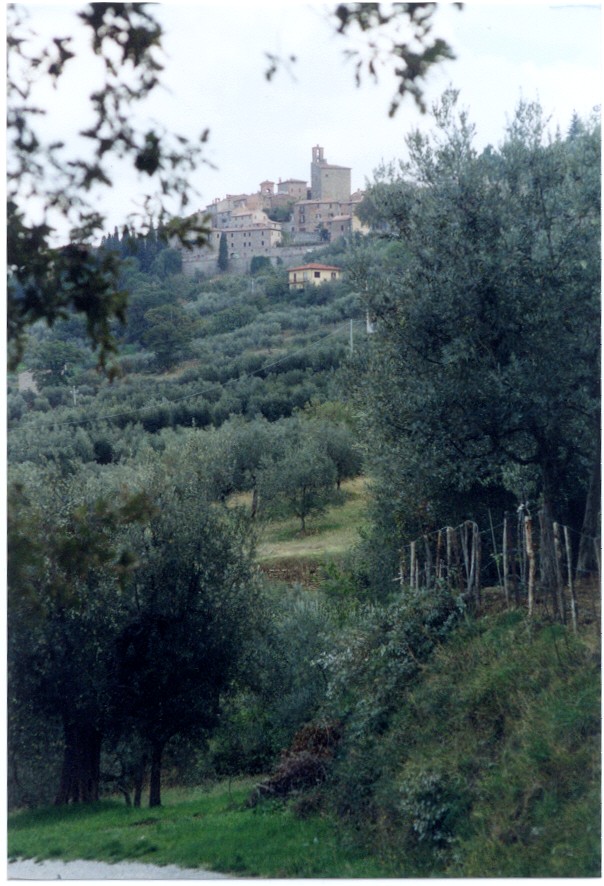
Panicale is also called the Balcony of Lake Trasimeno because of its panoramic view of the lake.
It also offers a peek into both medieval and modern living. Piazza Umberto I is built around the town’s 500-year-old fountain and is the town’s living room.
Newlyweds have wedding photos taken here. Locals begin and end their days here over espresso and wine. They stop gossiping only to stand up for crucifix-led funeral processions chanting the Pater Noster (Our Father) on their way down from the massive 1,000-year-old Umbrian gothic Church of St. Michael the Archangel that dominates the town.
Most of their city shopping in the Tuscany town of Arezzo, less than an hour north. Sometimes they shop in the capital and commercial hub of Umbria, Perugia, just 30 minutes away.
On a hillside within viewing distance from Perugia is Assisi, the birthplace of St. Francis, the founder of the religious order that established the string of 21 missions forming the backbone of California.
His remains are housed in the basilica named after him, as are those of St. Clair entombed in the church named after her at the opposite end of town. Both churches are decorated with heart-stirring frescoes, which are everywhere — inside and outside buildings in every community throughout the region.
A small church in Panicale (the town once had seven) houses a famous fresco – The Martyrdom of St. Sebastian. It was painted in 1505 by Piero di Cristoforo Vanucci, known as Il Perugino, whose most famous pupil was Raphael.
There’s a bit of local history story attached to this painting.
On each side of this landmark Renaissance work are two small groups of faceless bystanders watching Roman soldiers fire arrows into the martyr’s body. To make a fresco, the painter puts in the colors while the plaster is still wet. The people in these groups were the patrons of the painting and Il Perugino found out they weren’t going to finish paying him, so he painted their faces after the plaster dried. That’s why they have no faces now.
Il Perugino was summoned by Pope Sixtus IV in 1481 to paint a portion of the Sistine Chapel. His “Charge to Peter” is still on view in the Vatican.
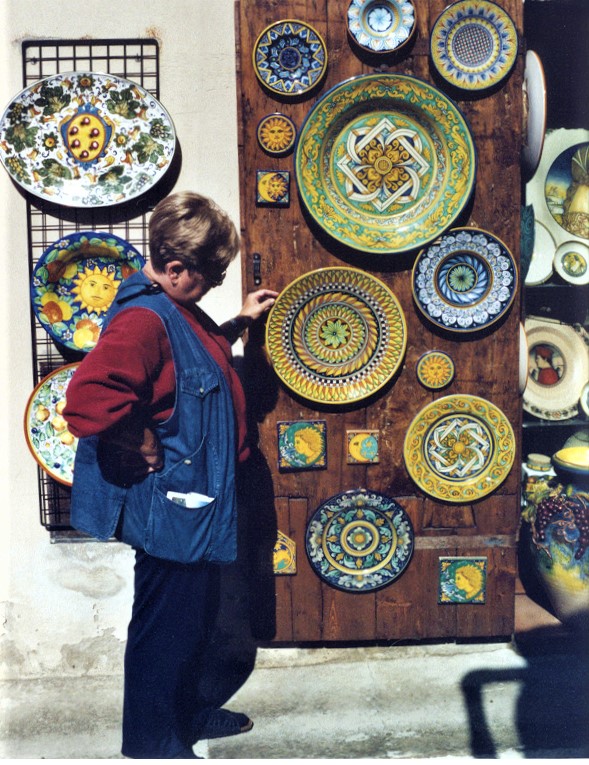
This artistic bent has filtered down to artisans. It’s evident everywhere but you can see it clearly just an hour away in Deruta, the ceramic capital of central Italy. Its shops offer baked and glazed clay in all shapes, sizes, designs and colors.
Gubbio, tucked into Umbria’s northeastern corner at the foot of the Apennines, gives you a look at what medieval life looked like. People still live in 1,000-year-old houses and work in 1,000-year-old workshops. And they attend outdoor productions at a 2,000-year-old 15,000-seat open-air Roman theater.
You can drive here, of course, but trains are best for taking you into the heart of Italy’s major cities.
Taking to the road is not the nightmare some would lead you to believe. Motorists tend to tailgate but all you have to do is get out of the way. There are many roadside pull-over areas to let drivers get by. They’ll even give you a beep-beep “thank you” as they pass.
Rather than drive, we walked four kilometers (about 2 1/2 miles) to the neighboring village of Paciano for lunch. And that’s another part of what fun things to experience besides the heart and history of Italy– the cuisine.
The food merits a story in itself — local pastas, regional salamis, veal, gelato, wild boar, roast rabbit, truffles, guinea fowl, fresh produce and salads, piquant olive oil, wine without additives, the list is endless.
A Yorkshire resident who visits Umbria regularly, said it all: “You just can’t find bad food here.”
 Mature Life Features