The Electoral College Works . . .
 .. the way it’s supposed to when you consider the following statistics brought to light by a San Diego Union-Tribune letter to the editor.
According to the writer, Hillary Clinton beat Donald Trump by 4.2 million votes in California. But her popular-vote margin nationally was only 2.7 million, which means Donald beat Hillary by 1.5 million votes in the rest of the country.
Without taking any side, it appears the Electoral College did what it was designed to do: prevent one or more factions or groups or states from determining the will of the entire nation.
Prescient Arizona Editor Predicted Pearl Harbor . . .
Editor’s note: This editorial was written by William R. Mathews, who bought the Arizona Daily Star in 1924 and was editor of the newspaper for more than 40 years. He was married to Betty Boyers and died in 1969.
This editorial, predicting that Japan would attack the U.S., possibly at Pearl Harbor, was published in the Star on Nov. 28, 1941, just days before Pearl Harbor was bombed, on Dec. 7, 1941.
THE MEANING OF MR. KURUSU’S MISSION
Failure of Secretary of State Cordell Hull and the special Japanese emissary, Saburo Kurusu, to find a basis for a peaceful settlement of the differences between the two countries emphasizes once more the apparent irreconcilability of the respective diplomatic policies, and the definite prospect that only with the sword can the differences be settled.
Mr. Hull demands that Japan evacuate French Indo-China and China proper; the Japanese demand that America stay out of that part of Asia, asserting that what goes on in that area is of no more concern to America than South America is to Japan. The Japanese refuse to withdraw. It is probable that any Japanese government that would withdraw from China would be overthrown by the Japanese people. Mr. Hull refuses to modify the American policy. There the matter stands as the economic blockade of Japan pinches tighter and tighter.
Whether American policy is correct or not is now beside the point. The important feature of this affair is that the two policies are manifestly irreconcilable and that unless one or the other gives in war is as certain as the sunrise in the morning. How soon the war breaks out is entirely up to Japan. It is possible that cooler heads in Tokyo will prevent for a while the hot-headed ones from doing anything that might precipitate hostilities. On the other hand as the pinch of the economic blockade grows tighter and tighter the chances are that the feeling this situation generates will precipitate some kind of an incident in Japan and then the war will be on. War may come within a week; it may still be six months off, but hardly more than that.
When war comes with Japan, it will come without warning. The Japanese habitually strike first and then declare war. They did this in the case of Russia when after the failure of the Japanese minister in old St. Petersburg to reach an agreement, the Japanese fleet, without warning, sailed into Port Arthur and sank a part of the Russian fleet. Between that incident and the present situation there is a strong resemblance. America will know that there is war with Japan some fine morning when the people of the country wake up and find that the Japanese have, without warning, seized Guam, surrounded our puny Asiatic fleet or sent submarines into Pearl Harbor and sunk a couple of our battleships. Very definitely Japan will choose her own time.
As matters stand today Japan will probably mark time and go just as far as she can without getting into an additional war. Consequently, since she already has her forces in French Indo-China, she probably can venture to cut the Burma road by a land attack without provoking war with America. With this road cut she will cut the last life line that the Chungking government has and thus weaken China’s ability to resist. Then by waiting for the end of the Russian campaign and the coming attack on Britain she may hope to strike when both America and Britain are desperately engaged in the Atlantic, and our fleet divided between two oceans. And then there will be a real world war on that will require every ounce of American strength to win.
The failure of the Kurusu mission to Washington thus means that war between Japan and America is inevitable. The American people are now in the position where they will soon have to put up or shut up. Since they approve of a policy that calls for war, they must expect to go to war or change that policy.
It Used to be Lynch Mobs . . .
. . . solved some of our problems.

These days, we just hold elections.
“I’m not a sports fan” . . .
. . . admits No. 1 son, Michael,
whenever discussion of the Chargers or the Padres or sports stadiums or whatnot is broached,
and points out quickly that performance has proven and is proving that
“San Diego is the perfect place to be if you’re not a sports fan.”
Never Stand . . .
. . . in front of people who 
are eating soup or cereal
while you’re telling them a joke.
My wife drives like . . .
 . . . people should drive.
The problem is, people don’t drive like they should.
My Choice of Music are the 6 Bs . . .
. . . Bach and Beethoven,
boogie and blues, and . . .
. . . big band.
There’s good reason to be pissed off . . .
. . . if you haven’t already noticed,
when you get by M and T
and have to struggle through this part of the week:

W, T, F! ! !
My Brief Military Career
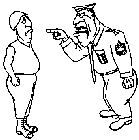 The U.S. draft did not affect me because, fortunately for both the military and me, I was born, raised and worked in Canada until I acquired a Social Security card and joined the Detroit News in my early 30s before moving to California a half-dozen years later.
But I did have a fleeting turn with the military in my 20s. A handful of us reporters at a southern Ontario daily — K-W Record — responded to a call to donate two years of our time to serve as reservists. After Press Club conversations with local military poohbahs, we drew straws to see which company we would approach. I wound up with the Royal Canadian Army Service Corps. They told me I was a second lieutenant, the company’s PIO and signed me up for an intro training weekend.
I got the Friday off and drove to Camp Borden about an hour north of Toronto. A light rain began as we assembled in the mess hall where we were assigned to small squads according to numbers handed us as we entered the building. Each unit comprised three or four regular enlisted men and three or four reservists. My sergeant (enlisted) had a map marked into squares. It was announced that each squad would search the square marked with its number on the map. And, we were told, “There’s a case of beer out there and it’s marked on the map.” The first thing I looked for after the sergeant unfolded our map was the X marking the beer. Then I hunted for the grid with our number. We were nowhere near.
So I asked the sergeant to give me one of his regulars and, while he and the rest of the men searched our grid, we would get the beer.
That’s when I learned I was not compatible with the military. He gave me a flat stare and, pressing his forefinger on the square with our number on it, said, “Sir, we can’t do that, we’re assigned to this area.” I agreed and pointed out that he and the rest of the unit would complete our task while the two of us – I wasn’t going to carry a case of beer all by myself and I needed a regular who was familiar with the camp’s terrain – would get the beer and meet them back at our bunks. He was unable to translate that thought and repeated to this civilian reservist, “Sir, our orders are to search this area.” For once in my life, I was thinking clearly. I scanned the group and recognized that his regular-enlisted 2-IC liked the logic of my approach, so I said, “Corporal, come with me.”
We got the beer (and let the sergeant share) but that obliterated any thought of further military service. The next morning, I claimed a family emergency and drove out of camp.
“I’m Allergic to Sex” . . .
. . . I notify those around me when I get a sneezing attack.
When they give me that what-the-hell-are-you-talking-about look, I tell them,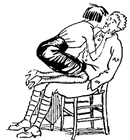
“I was just thinking about it.”

