Catch a Free Ride in Las Vegas
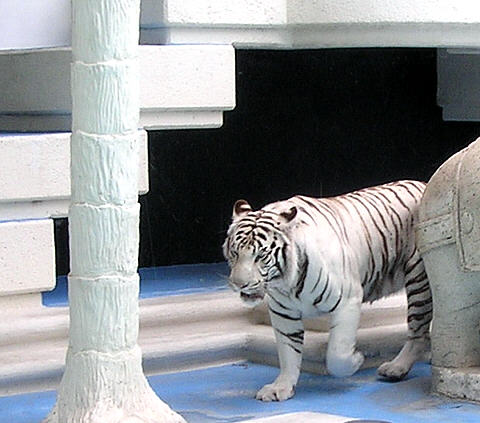
White tiger patrols its Mirage enclosure
Story & Photo
By Cecil Scaglione
LAS VEGAS —- You don’t have to mortgage your mansion to enjoy this glittering Gotham in the Nevada sand. There are more than enough free diversions to keep you enthralled and entertained during a visit here.
Since the only things permanent are the blinking neon lights, some of the freebies listed may no longer exist so look around and you’ll probably find others.
This hub of around-the-clock flashing lights is without a doubt one of the best and brightest spots for just plain people-watching. They come in more shapes and sizes than you thought possible — in attire that ranges from down-home to out-of-this-world. And much of their behavior should, as the television ads say, be left here.
Do this while making vicarious visits to New York’s Statue of Liberty, Paris’ Eiffel Tower, Philadelphia’s Liberty Bell, and Venice’s St. Mark’s Square and Rialto Bridge. Downtown, at the northern end of world-renowned Las Vegas Avenue better known as The Strip, is the Fremont Street Experience. Featured is a four-times-a-night computerized sight-and-sound show overhead on “The Biggest Screen on the Planet,” the $70 million canopy enclosing a half dozen downtown blocks.
You can also experience climatic changes as you saunter through the hot desert air of the street that’s sprayed with gusts of cool pumped out by the never-closed casinos. And catch a handful of “gambling” beads, the same kind Mardi Gras celebrants corral and collar in New Orleans that cost you a couple of bucks or more in the drugstores and novelty shops along The Strip.
All the while, you can watch femmes in frilly white skirts get their ears pierced at a sidewalk boutique or a butt-crack-jeaned macho guy gripping a yard-long neon-colored daiquiri while getting his other hand tattooed.
A $1.50 bus-ride will get you to another free show at the Stratosphere rooted at the north end of this renowned street of sex and excess. While it takes a $10 elevator ride to get to the outdoor observation deck, the view from 90 stories up is free but worth a lot more. And you don’t have to spend any money to shake and shock yourself on the carnival rides atop this 1,149-foot building. Some spectators get wobbly knees just watching screaming passengers swing dizzily in the desert air hundreds of feet above the shimmering streets below.
Back at ground level, it’s a short hike to the monorail that, for $5, takes you to the MGM Grand, where you can walk across the boulevard to New York New York and over the Tropicana Avenue bridge to Excalibur to catch a free tram connecting it with Luxor and Mandalay Bay, which anchors the south end of this megaplex.
Then decide whether to meander or monorail your way back, catching free sights and sounds in the art shows and exhibits in the lobbies of the various hotel casinos with such mind-massaging names as Bellagio, Casino Royale, Luxor, Mandalay Bay, Monte Carlo, Paris, and Treasure Island.
Stop by Aureole in Mandalay Bay and you might catch a glimpse of the “wine fairies” in this upscale restaurant. You can peer through outsized portholes in the front wall to watch as servers are winched up and down a glassed-in four-story wine tower to fetch special orders from among the 9,500 bottles in its inventory.
There’s also the Memorabilia Museum in Mandalay Bay that has sports and Presidential mementos available for show and for sale. You might see the shot of Cassius Clay’s memorable heavyweight-boxing victory over Sonny Liston, along with Beatle stuff, and an Abe Lincoln-signed military appointment with its $30,000 price tag.
At Circus Circus a few minutes away, you can gaze at glazed Krispy Kreme doughnuts rolling along their assembly line. Farther along the Strip are white tigers padding around their enclosure in the Mirage, singing gondoliers cruising canals through the Venetian, and the never-ending dancing-fountain show in front of the Bellagio.
– 30 –
Some Day …

… when I get around to it,
I’m going to start procrastinating.
— Cecil Scaglione
More from the Old Newspaperboy No. V
Milt Robinson is perched prominently in my memory banks. I have no idea what ever happened to him and I remember little about him. But his image still glistens in my brain. He was the first person I saw when I got my first pair of glasses. And he watched me make a spectacle of myself as I stumbled over a block or so of Main Street as my brain adjusted to my new spectacles. I was nine years old.

From the beginning. Much of my first decade on earth was spent learning how to see. Fortunately, I was far-sighted and, by squinting and crossing my eyes, learned to read people’s body language and movements, and facial expressions as well as lips. This all helped me tremendously for the rest of my life.
I don’t ever remember not being able to read, but I had to look cross-eyed to make out the words, or anything else I wanted to see clearly.
While I was born in town (in an apartment my mother rented over a small grocery store at the corner of First Avenue and Wylde Street just down the hill from St. Vincent de Paul Church) almost all my earliest years were spent in Feronia, a hamlet that was a seven-mile walk from town and is now a suburban enclave of North Bay.
After enrolling when I was 5 years old in the one-room schoolhouse that housed grades one through 10, I skipped grade two because I could read and knew my addition and subtraction tables and was Miss Brunella Guenther’s star pupil until our family moved into town on New Year’s Day 1943. My father finally snagged a spot with the section gang working out of the main yard (where the round house and maintenance facilities were) of the Temiskaming & Northern Ontario Railway, which later became the Ontario Northland Railway.
School resumed for me at St. Rita’s Separate School when the Christmas holiday ended. Other than being a stranger in the schoolyard for a bit, the major memorable event that spring was beginning to sell newspapers – The North Bay Daily Nugget — on the street.
I’d tried taking on a weekend Toronto Star route. That’s when I saw German prisoners of war in their denim overalls and smocks with the large red circle on their backs stretching their legs around the Canadian National Railways station when I picked up the papers early Friday mornings. The POWs were being herded out to camps/farms out West.
The Star route lasted only three weeks because the four brothers who had the route before me made the collections the day before I delivered the papers and the route manager didn’t do anything about it. Fortunately, my mother deterred him – loudly — from extracting payment from me for the papers. That whole episode became part of my education.
When school resumed in the fall, among the earliest events was a visit by the school nurse. One of her chores was to give everyone an eye test. The only thing I recall about that is the look on her face that made me think I was really stupid. She was just amazed that I could function as well as I did. She got the news to my parents that I had a vision problem.
As it turned out, my mother had begun cleaning downtown offices for a few clients to augment our income. (We also took in roomers for the three upstairs bedrooms in the large house we rented). One customer was Ken Barry, who happened to be an optometrist. And he outfitted me with my first pair of glasses — appurtenances I wore for more than six decades until I had my cataracts lasered and replaced by tri-focal inserts nine years ago.
Back to Milt Robinson. As I said, I remember very little about him but I recall he was a classmate because we both ran downtown after the final afternoon school bell to purchase our armfuls of Nuggets to sell on the street. After a quick paper-sales run through downtown, we scooted into Ken Barry’s office to get my new glasses. Mr. Barry was a bit of a blur because everything happened so quickly. When I stepped outside the office, the first person I ever saw with clarity was Milt Robinson.
And I still see him clearly.
-30-
Before registering for meditation classes …
… I’m going to think about it for awhile.
— Cecil Scaglione
California’s High-Speed Rail Line …

… is a great idea because it will allow us to go pick up some much-needed
water during our drought and bring it back in a hurry.
— Cecil Scaglione
When Times Get Tough, Get Tougher
By Cecil Scaglione
Mature Life Features
Answers to all the economic arguments lead to a definite “Maybe.” Are we still in a recession, or is it a depression? Are we moving out of one or both? Is a massive inflation-driven Fed-fed stock-market crash stumbling over the horizon?
Retailers claim consumer buying is down. Home prices are rising. The number of added jobs announced each month are proclaimed by politicians to be encouraging but the unemployment rate remains static while hiring has dropped.
So it’s time to take things into your own hands, especially if you’re in the 40-plus age bracket and have been forced out a job by layoffs, downsizing, economic cutbacks or whatever the definition given for your severance. Instead of the harrowing hunt for a regular paycheck, you might look into providing a service that the downsized companies still need.
Corporate America has learned it can get along with fewer employees, thanks to the rocketing development of computer and telecommunications technologies. At the same time, younger workers are more transient and no longer join a firm with plans to stay on the job until they retire with the proverbial gold watch. So what does all this mean to you?
It’s the era of the free-lancer, the small-business operator, the sole proprietor, the entrepreneur. While companies large and small have discovered they don’t need such a large work force as has been traditionally assumed, it doesn’t mean they don’t need the same level of production or service. Companies still need packages delivered, bills paid, machines and equipment maintained, inventory controlled, accounting kept up to date, marketing counsel, management consulting, employee training and on and on and on, that can be, and is being, provided by outside vendors.
And, as outside vendors make more money devoting their time to business, they, too, become buyers of other services, such as babysitting, landscaping, animal-care, catering and many others. So take advantage of it.
It’s as simple as renting out your address for mail delivery. It costs you nothing and the people who pay the fee come around to pick it up. If you want to make more money, you can offer to deliver the mail for a fee. You can house- or pet-sit for people who have to go out of town to work, or go on vacation. If you speak other languages — German, for example — you can earn money as a guide to tourists who visit your area from foreign lands: in this case, Germany. A foreign tongue also can make you money as a courtroom translator.
If you decide to go into business and be your own boss, there is one rule to adopt: this is a business. It isn’t a hobby or a part-time job. However, you can turn that hobby or part-time job into a full-time business.
Always look professional. One colleague, a marketing consultant who works out of an office at home, never leaves the house without wearing a shirt and tie, even if he’s just going to the post office or the nearest copy-machine center. Another home-office acquaintance controls her time by locking up her “office” at quitting time and not going back into it when she’s not working.
-30-
Confessions of a Newspaperboy Book IV
School was never my best subject. My real education is rooted in my time peddling papers on the streets of North Bay. It branched in earnest about a decade later when I became a young reporter asking everyone and anyone question after question after question.
While I only sold papers for about three years, what I saw and heard shaped me into a pavement kid and honed survival instincts that served me well during my eight-plus decades. Among the memorable moments was a piece of advice given me by Nate Rivelis, owner of a Main Street ladies’-wear shop, one of the many Jewish merchants lining the ‘Bay’s eight-block commercial core. He became one of my first regular customers along that commercial strip. He told me later it was because I was reliable. That is, I always used to enter his store about the same time of day every day and ask him if he wanted to buy a paper. None of the other paperboys had done that before. It taught me to ask for the business. It served me well in picking up several other downtown customers.
(An aside: It also helped me as a reporter, too, because I would drop by regularly to talk with the police chief and city clerk and desk-duty sergeant and mayor on my rounds because, for whatever reason, most other reporters didn’t take the time for such a nicety. As a result, I established reliable upper-level contacts and sources.)
Anyhow, among the memories that pop into mind when I picture Mr. Rivelis is a question he tossed at me one afternoon. “How much money do you have in your pocket, Cecil?” I told him I had about 20 cents. He shook his said and said, “No, no, exactly how much money do you have in your pocket.” I said I didn’t know. And he said: “Cecil, if you don’t know how much money you have in your pocket, you’ll never be rich.” Well, I never became rich but, to this day, I always know how much cash I have in my pocket.
Shortly after retiring from selling papers on the street, I launched my Main Street shoeshine venture. I quit peddling papers because we moved to the east end of town, which put me several blocks farther from the Nugget that was at the west end of downtown and I would have wound up getting my papers after most of the prime selling section was saturated by a swarm of two to three dozen other paperboys. And home delivery was beginning to take hold.
There were a few shoeshine shops in dry cleaners and pool rooms and barber shops along the main drag but I could under-price them because my overhead was low: no employees, no rent to pay, no equipment to maintain. I carried three cans of shoe polish – black, brown and oxblood – two brushes and several soft rags in an empty wooden butter box that also served as a foot stand so I could burnish the brogues. My competition was a half-dozen or so other street shoeshine boys cluttering the entrances and exits of the handful of beer parlors sprinkled around the commercial core.
Pubs were divided back then: men on one side and another side for women. Men could only enter the women’s doors accompanied by a female. They opened at noon, closed at 5:30 (to make sure men went home for supper), reopened at 7 p.m. and closed at 1 a.m. weekdays and 11:30 p.m. Saturdays. All those blue laws crumbled in the late ‘50s. The best shoe-shining times were payday, Friday and Saturday afternoons and early evenings because we’d catch guys going into the pubs – especially if they were with a lady – and coming out to head for a night on the town. I kept a copy of the Nugget for the customers to read while standing there getting his – or her, because a few women did stop now and then — shoes buffed. I also had a half-dozen papers to sell to shoeshine customers. I always stopped to ask Mr. Rivelis if he wanted a paper and I’d pick up one for him.
On these stops early on, I noticed people would look into the windows of his store and nearby shoe stores and then glance at their shoes to see if they looked as nice as the ones in the window. A lot of the times, a guy would wait outside while his wife or girlfriend was shopping in Mr. Rivelis’ store. So I set up my sidewalk shoeshine shop in front of his shop. Business boomed. While foot traffic was good at the beer parlors, many of the guys were usually in a hurry to get in for a couple of cool ones or rushing out to get somewhere and didn’t take time for a shine.
When my father saw that I was heading downtown regularly to make a few nickels, he made me a compact wooden shoe-shine box. It was about the size of a lunch pail. He fashioned a couple of blocks of wood to look like a footprint where the customer placed his (or her) foot while its shoe was being shined. Very professional. And he added a shoulder strap so I could carry it more easily.
One day, Mr. Rivelis, who used to get his shoes shined regularly, looked at me and said, “Cecil, if you’re going to keep on coming back here, why don’t you leave your shoe-shine box in the store.” And that’s how I got to maintain a downtown shoeshine venture for another couple of years that grew out of networking while I was selling papers on the street. On the way downtown, I would put together a couple of bunches of radishes or onions or beets from our garden and knock on a few doors to sell them before I got to my shoeshine stand. There were also mornings when I rode with the local milkman and his horse-drawn wagon or the bread man on his route to earn a buck or two before attending to my downtown business.
Other gigs garnered during my shoe-shining career included part-time phone-answerer and dispatcher for a cab stand, a parking-lot attendant (I just sat in the entry/exit booth to hand out tickets when cars arrived and collect money when they departed) and a behind-the-counter server at a downtown diner. The folks would come to my shoeshine stand to get me when they needed me. I kept the shoeshine business going for a couple of years until I reached my mid-teens and was old enough to get summertime work on the railroad. I broke away from hard labor after a couple of summers when I got a full-time job as day manager for a lunch counter followed by a lucrative summer as a hotel bellhop. These all stemmed from my stint as a newspaperboy.
-30-
A major problem with aging is . . .
. . . old friends keep dying off before you can make new ones.
— Cecil Scaglione
More From the Newspaperboy III
Growing up in metropolises like New York, London, Chicago, Toronto, Los Angeles, Houston or Sydney is more challenging than maturing in a small town. But prowling the streets of a little city like North Bay offers the lessons of gotham without the concomitant perils.
And my times were different. Downtown dangers were not as brutal as in the Big City. There were plenty of guns in town, but they all huddled at home greased up for hunting season. Get into a scrape and the cop kicked your butt – hard. If a shop owner caught you shoplifting, he or she slapped you silly and then the cop kicked your butt – hard. If you got into enough of these, you were dragged home – dragged – and the cop kicked your butt – hard – before you got a licking from your parents.
But the things that went on in the alleys behind Main Street were a microcosm of – they just didn’t happen as often as — what occurred in the after-dark recesses of Hong Kong, Shanghai and Tijuana. It was exciting and exhilarating for a nine- and 10-year-old kid running loose along these streets. Billy Larochelle and I used to get free gawdawful soup to warm us up during sub-zero midwinter from the elderly Chinese couple that ran a sleazy and smell-of-vomit restaurant on Oak Street, North Bay’s slums draped around the edges of the Canadian Pacific Railroad station that was just a block and a half off Main Street..
I have no idea what kind of soup it was. I didn’t even like soup, and I never asked because it probably would have made me sick. The chairs and stools in that place were stickier than the floor with grease, grime and layers of dirt. But the old couple were as comforting as their lumpy soup was tasty as we sipped it slowly to let the freeze leave our fingers while the frost on the window kept the dark outside. Keep in mind, the winter sun goes down real early that far north.
One summer afternoon I heard a muffled boom from the CPR station and ran down when I saw some smoke coming out of everywhere. When I got there, I saw the men’s washroom smelled odd and looked like it had been stepped on, so I poked myself in. There was blood, bone and gore splashed all along the walls and packed solidly into the corners and crevices that worked their way up to the ceiling. I was the first person on the scene, which earned me a hard kick in the butt by cop who got there right after me.
I read in the paper the next day, a guy had sat down on a toilet, lighted a stick of dynamite and held it to his chest to blow the top half of himself all over the walls and ceiling. His bottom half was still left sitting on the can. I saw his boots sticking out under the battered bottom of the toilet stall.
That was exciting.
In the alley beside the Chinese couple’s restaurant, I watched Big Mary put on a show one evening. Her name was Mary Commanda and she was a large – over six feet six inches – raw boned Indian who just drank a lot. She could have been 20, 30, 40 or 50, had a gravel voice that was unmistakably hers and a glistening heart of gold. She always told me that if she ever got money to buy a paper, she’d buy it from me. One late afternoon, during the beer-parlor closing hour, she was seated against a wall beside a pile of garbage behind the Chinese couple’s restaurant and using a beer bottle as a dildo while laughing raucously and merrily challenging any and all of the bums around her if they could match that.
That was funny.
There was the time we were almost on site when a guy we knew – everybody knew everybody in the Bay — pulled off something I could never have done. He was a clerk of some sort (timekeeper, I think) with the CPR and was walking through the morass of tracks when his boot got stuck in one of the frogs (a frog is an X-shaped chunk of rail that’s used in switching yards). As is always going on, locomotives were shunting tanker, freight and flat cars here, there and everywhere to assemble them into trains heading to the proper destinations. And a couple of the multi-ton cars had been shunted right at this guy. All he could do was lean over and let the loose-running freight cars run over his ankle and amputate his foot.
We – co-newspaperboy Eddie Walker and I – didn’t see that nor did we hear him scream but we did see him being carried to safety. His face was a white color I hadn’t seen before.
That was chilling.
– 30 –
When I wanted to loosen up …

… in the good ol’ days,
I’d just go out and get tight.
— Cecil Scaglione
 Mature Life Features