Ease Up in Belgium’s Mechelen

Margaret of Austria ruled the Netherlands from this palace in Mechelen, Belgium.
Story and photo by
Sandy Katz
MECHELEN, Belgium —- Perched on the Dijle River in the relative shadows of both Brussels and Antwerp, this town glistened when Margaret of Austria, Regent of the Netherlands, made it her capital from 1506 to 1530.
Taking advantage of Ludwig van Beethoven’s family roots, it has honored the famous composer
with an elegant statue even though he was born and raised in Bonn. The Mechelen connection
stems from Beethoven’s grandfather, who worked here as a baker, and great-grandfather, who ran a painting business.
The best way to take a look around this center for lace, baroque woodwork and drapery tapestry that’s but a an 11-minute train ride from Brussels Airport is on foot or by bicycle. There are trendy shops, friendly terraces, galleries, museums, and recreational areas for sailing, fishing, mini-golf and windsurfing.
The symbol of Mechelen is the imposing St. Rumbold’s Tower, a UNESCO World Heritage Site completed in 1536 in late Gothic style. If you can negotiate the stairs to the skywalk atop the tower, you are rewarded with a magnificent panoramic view. Eight historic churches fill the city center and each displays religious treasures.
The spectacular Renaissance facade of the Palace f Margaret of Austria frontage features
her coat of arms. The building still houses the law courts but you can still enjoy some quiet and tranquility in charming gardens. For another pleasant pastime, you can take the footpath along the back of picturesque old houses lining the Dijle.
The Kazerne Dossin is a special place of remembrance for Belgium. This center keeps alive the memory of the Holocaust and it gives a face to 19,000 of the departed.
Mechelen is just what you need for rest and respite after dashing around nearby Antwerp. Widely known as a global center for the diamond trade, Antwerp also has long been the capital of Belgium’s fashion industry. It’s also the birthplace of Flemish painter Peter Paul Rubens.
And it’s the home of the Red Star Line Museum that traces the late-19th- and early-20th-century immigration of Eastern Europeans through Antwerp to the United States and Canada.
Between 1873 and 1934, the Belgium shipping company Red Star Line transported approximately 2 million migrants from Antwerp to New York. What makes the Red Star Line’s passenger lists different is that it transported Eastern Europeans of Jewish origin mainly, including Irving Berlin and Albert Einstein, who were fleeing persecutions by the Czar of Russia and Hitler.
This museum is in a restored warehouse of the Red Star shipping company and mirrors the American-arrival story housed in the Ellis Island Immigration Museum. Not everyone who hoped for passage through Antwerp was allowed to leave on the 10-day transatlantic voyage. Everyone had to pass a medical examination first.
Between visits to the many historical gems around this country, you can sample its tasty specialties along the way. Belgium Waffles, which were introduced to America at New York’s 1964 World’s Fair, are available from street vendors and in gourmet restaurants. They’re usually served warm and dusted with confectioner’s sugar or topped with whipped cream, soft fruit or chocolate.
Potato fries – French Fries – are part of Belgium’s culinary cultural heritage. They are often eaten with mayo or served with mussels or Flemish stew. There are more than 50 dipping sauces to choose from.
Belgium endive is a popular vegetable, as are Brussels sprouts. And Belgian beer is featured in a number of recipes. Beer Central, which offers 300 types of bottled beers and has 20 beers on tap, is the perfect bar to jump into the Belgium beer culture. Connoisseurs favor Belgian beer for its variety, flavor and character. It has enjoyed the unparalleled reputation for its specialty beers since the Middle Ages.
Mature Life Features, Copyright 2015
Further Confessions of a Newspaperboy
V-E Day prepared me for covering such news events as downtown fires, tumultuous strikes, Detroit riots and similar chaos during my later career as a newspaperman. The prime rule is: Keep Moving.

Downtown North Bay became bedlam on Victory in Europe Day. We dodged army tanks, drunken soldiers and whooping civilians as we wiped our eyes of tears induced by the celebratory smoke bombs bursting endlessly all around. It was early afternoon on May 8, 1945 when the bells rang and we scrambled out of school. Someone – I think it was Clare Salidas who lived two houses away – was running and shouting about the war being over and hauling our ass downtown to sell the newspaper Extras that would carry the news.
It was the end of more than five years of headlines scoring the wins and losses of Allied troops (highlighting Canadians) versus Hitler’s hordes overseas. It meant husbands, sons and daughters, sisters and brothers, relatives and neighbors no longer would be fed into the war machine. It meant those in prisoners-of-war camps would be coming home. It meant we would no longer glimpse enemy prisoners of war — their uniform featured a denim jacket/smock with a large bright-red circle on the back — stretching their legs as the trains stopped at the CNR station en-route to camps out in the Prairies. It meant no more rationing. It meant time to party. As the end-of-war news tore through town, soldiers stationed at the local barracks spilled out in tanks and jeeps and, when they ran out of vehicles, ran out themselves. They chewed up the pavement rumbling up and down Main Street. I don’t recall any shots, blank or otherwise, being fired but the town was smothered by the smoke bombs popping everywhere.
All the stores closed. The staff and merchants joined the public party. My indelible first lesson was to keep moving in a crowd because you never know what turns it will take. I don’t recall if the Nugget gave us the papers that day but I had about at least a couple of dozen. I still had most of them when I got home even though I had sold them many times over.
Everyone was either drunk or acted like it. Soldiers, women, old men were all yelling, “Hey, kid, gimme a paper.” They’d flip a quarter or a dollar at me — a couple of different guys each tossed a $5 bill at me — and rarely took a paper. Soldiers and civilians alike tossed bottles of booze and beer at each other to share. Guys were climbing lampposts to try to see over the smoke. Gals were dancing in and around the moving vehicles.
The iconic sailor-kissing-a-girl on the streets of New York on V-J Day some three months later was rather tame compared with what went on during V-E day in downtown North Bay. For example, I saw one couple in kahki and swirling skirt enthusiastically making unabashed love in the front alcove of Fosdick’s Book Store. I don’t recall seeing any pictures of that. To a 10-year-old kid, all this was great fun.
It was well after dark when I dumped my papers and headed home. At the kitchen table, I counted my money. My usual tote was around to 50 cents. My V-E Day income was almost $45, which was more than my father made in a week as an Ontario Northland Railway section hand.
– 30 –
If we’re supposed to …
. . . live it up happily and carefree because “tomorrow we may die,”
why am I so stressed out about paying my bills?
— Cecil Scaglione
If life’s a test …

. . . why is everybody spending so much effort and emotion de-testing ?
— Cecil Scaglione
Confessions of a Newspaperboy
As a prologue to some of the memories that follow in what could become a series of flashbacks, my newspaper career began way back during World War II on the streets of North Bay, 220 miles (350 kilometers) north of Toronto.
It was a busy Northern Ontario railroad town just shy of 18,000 people when I became a newspaperboy selling the North Bay Nugget on the street at time when home delivery was not the norm. I was 8 years old.
My education began then, after being a rural rube all my life. We moved into town on New Year’s Day 1943 and I started selling papers in the spring after the snow and ice finally went south. Or maybe they went north. I would run the dozen blocks downtown from St. Rita’s School. Home was on the way so I dropped off my books and picked up 22 cents to buy 11 papers. We bought them still warm off the presses for 2 cents each and sold them for 3 cents. Paydays were great because a lot of buyers would flip us a nickel and let us keep the change. The paperboy price later went up to 3 cents and we sold it for 5 cents. Not as many tips then.
We fought for first place in the line at the press-room doors on Oak Street behind the Nugget that was housed in what was then the St. Regis Hotel at the west end of downtown where Algonquin Street angled off Main Street. When I got my papers, I’d scramble up one side of Main Street. They usually sold within the first two blocks. (I managed to pick up a few steady customers among the merchants.) Then I’d scramble back and buy another 11 and scoot into the pubs at the east end of Main and wrap up my sales day. Why I bought them in elevens, I don’t recall. Maybe that was all I could handle at first, but I began buying two dozen at a time before my three-year stint ended when we moved to the east end of town.
As I hustled around the eight blocks of downtown commerce peddling my papers, I used to see the Nugget’s reporter Ben Ward (he later moved on to a lengthy tenure with Canadian Press) talking with people all over: elected officials outside City Hall (it became a city in 1925), the cop on the corner, owners of the Arcadian Restaurant over a coffee, the postmaster on the steps of the Post Office. THAT’s what I wanted to do when I grew up. As it turned out, I got lucky and did “that” for several decades in such fun towns as Toronto, Sarnia, Kitchener, Windsor, Detroit and San Diego.
What turned me to thinking about those glimmering days was a recent medical visit to check a blockage in my nose. It turned out to be minor but the doctor asked me, “When did you break your nose?” I said I never broke my nose but he said I must have because of my deviated septum and other scarring. The thought clung to my skull for several days until I finally figured out when it must have occurred.
It was the third or fourth day after I became a newspaperboy. While we were horsing around waiting for the presses to rumble and roll, a 13-year-old burly bully named Maurice (Mo-Mo) Bedard walked up to me and said, “Gimme your money.” I was easy pickings because I was a slight kid, but I said no, not just because it was my money but because my mother would slap me silly if I lost my dough. So he grabbed my shirt, punched me in face and took 22 cents out of my pocket.
I recall bawling (don’t know if it was from pain or the loss of the money) but I couldn’t have been injured all that much because the nose didn’t bleed all that badly. I know that because there wasn’t much blood on my clothing — I threw away the hankie I used to soak up most of any mess and the rest didn’t show much because I was wearing a red-checkered flannel shirt — and nothing was said about my appearance when I got home. But that’s the only time my nose was ever smashed.
Billy Larochelle, who was a little guy like me but a heckuva lot more wiry and quicker and athletic and tougher and had a gravel voice that scared people, gave me enough money to buy my papers that day. I went back for a second and third batch so I could pay him back and still have enough money to show my mother when I got home.
The episode has an epilogue that bolstered my standing among my paperboy peers. A couple of weeks later, Mo-Mo, who didn’t sell papers but just hung around to steal money from kids, aimed his eyes at me again and started making his approach. I happened to have a packet of matches on me (we used to share cigarets while waiting for our papers) and the only thing I could think of was to light a match and throw it at him. As it turned out, the entire packet erupted into flames so I tossed it at him.
The gods were on my side because that fiery package flipped neatly into his shirt pocket. He began hopping around and flailing and slapping at it and cursing and swearing and had to rip off chunks of his shirt, all of which made him look like an idiot in front of the 25 or so kids waiting for papers.
He never bothered me again. Nor did anyone else because the word spread not to screw around with that Scaglione kid because “He’s crazy.”
— Cecil Scaglione
If Necessity …

… is the mother of invention, then inventions fathered Igottahavethat.
That popped into mental view while reading earlier today a list of most important inventions made during the lifetime of the writer of the article who was in his senior years. What he overlooked is dismaying.
Like gel-filled ballpoint pens that have allowed me to make notes so I don’t forget things without getting ink all over my shirt pocket. And polyester clothing that makes me pay attention to what I add to my wardrobe to avoid that cloying plastic.
Not to mention cordless phones, which I certainly wish had come along when I was younger so I wouldn’t have had to talk with my friends – and girlfriends — on the wall phone right next to my grandmother’s bedroom?
Pocket-sized Kleenex could have arrived earlier to save many a slap on the head for not having a clean handkerchief. (Remember your mother’s admonition: “Make sure you have clean underwear and handkerchief in case you get into an accident.”) I could have used the modern light-weight skis and boots back then, too.
Scotch tape arrived in time to wrap around the temples of my glasses when they snapped off during roughhousing and sports sessions. It still makes good safety covering for iPhone and tablet screens if applied properly.
Self-adhesive stamps and envelopes made paying bills less sticky. And what about Post-Its. No fridge should be without them.
Those handy palm-sized economy-priced LED flashlights make it easier to move around in the dark because you can stash them in kitchen drawers, bedside tables, workbenches, glove compartments, purses, pockets, everywhere and anywhere. They also help you find things you dropped behind other things.
He also overlooked those solar-powered yard lights that not only are eye-appealing but guide you around at night and provide vital lighting when the multibillion-dollar power grid goes down.
Other life-comforting innovations he skipped are adjustable-sized ball caps and double-jointed wine-bottle openers. Which makes it about time pull out a good bottle of red and enjoy the rest of the day.
– Cecil Scaglione
Try the Wright Stuff at Outer Banks
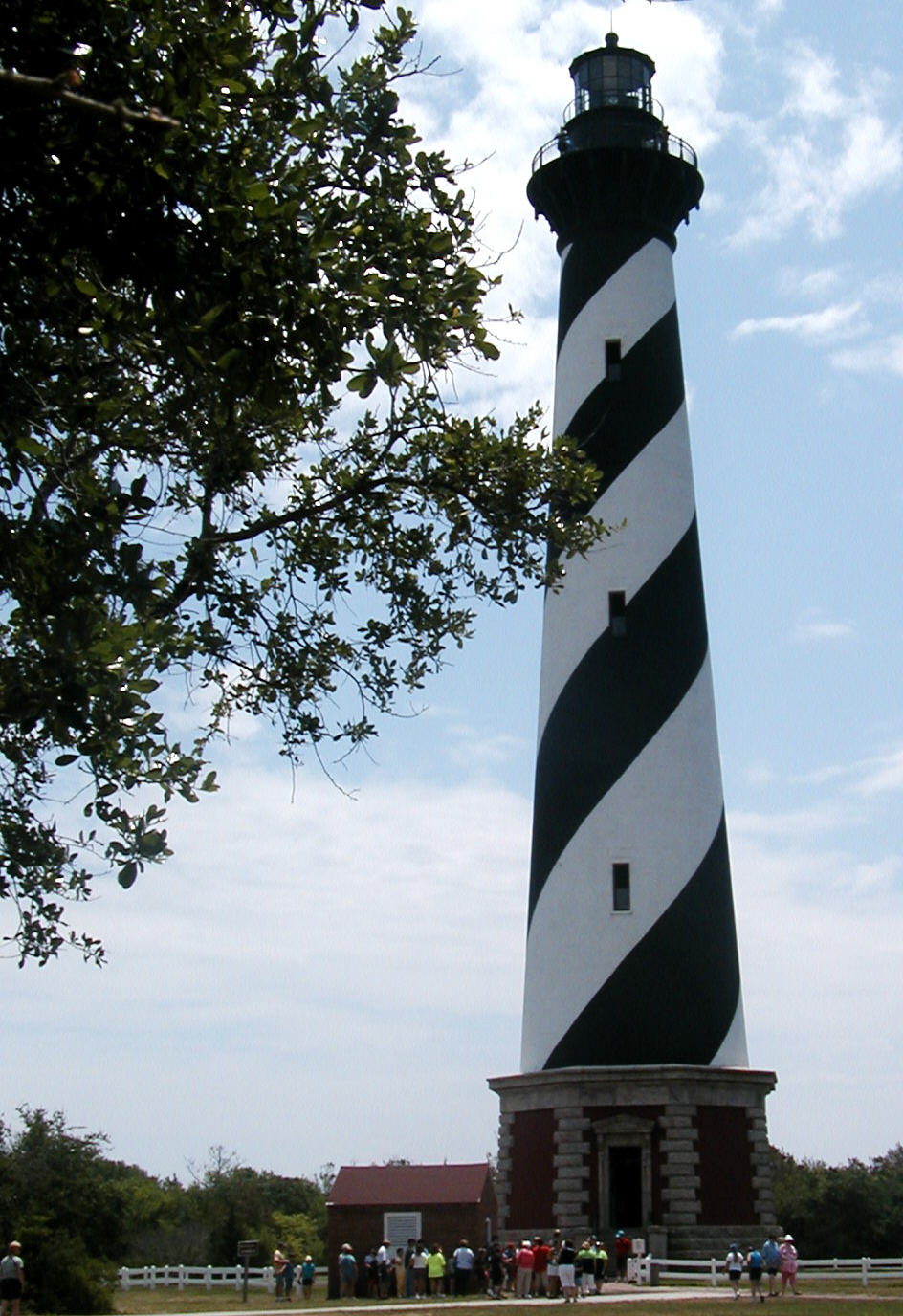
The storied Cape Hatteras lighthouse stands as high as a 20 story building, making it the tallest brick lighthouse in the nation.
Story & photo by
Cecil Scaglione
Mature Life Features
NAG’S HEAD, N.C. —- It was the Wright place and the Wright time for 73-year-old Charles Dettor and his 66-year-old wife, Ruth, to learn how to fly.
The couple donned helmets and hang-gliding harness on the largest living sand dune in America to emulate the Wrights’ historic moment more than a century earlier just up the road at Kill Devil Hills. That’s where a memorial to Orville and Wilbur Wright’s famous flights is operated by the National Park Service.
It was the wide-open rolling dunes, privacy, and persistent wind at Kill Devil Hills that opened the skies for air travel. Not Kitty Hawk farther down the road. Any local will tell you bluntly – you don’t even have to ask – that Kitty Hawk gets all the glamor because the Kill Devil Hills telegraph station was closed that December day in 1903 when the Wright brothers completed their four controlled flights. So they made their announcement to the world through the Kitty Hawk telegraph office. And that’s how that locale blew into history.
The brisk breezes that still lure hang gliders to this ring of barrier islands sheltering the North Carolina shore are what give the place its spanking-clean look. Everything is scoured by sand. Cookie-cutter salt-box houses on stilts and lattice-wrapped carports stretch along the 75-odd miles of beachfront. They come in all shades of gray – tan, white, ecru, taupe, azure, cream, yellow, and aqua, but still look gray – and straddle both sides of Highway 12, the asphalt spine that stretches south from just below the Virginia border to Ocracoke Island just past that storied point of fact and fiction, Cape Hatteras.
It’s a 90-minute drive from the Norfolk airport to the Sanderling, our lodgings just a few miles south of Currituck Lighthouse that warns ships away from the northern end of these Outer Banks. It’s a restful resort that wraps itself in the ambience of the area that’s a mix of edgy New England coolness and soft warm touch of the South. Each room has its own balcony so you can watch the sun rise out of the Atlantic and set into Currituck Sound. And it has its own fine dining room, the Left Bank, where the menu ranges from sweetbreads to softshell crab. These latter delicacies are served in most diners, saloons, and eateries all along the Banks. We learned in the nearby town of Manteo (pronounced MAN-ayo), on Roanoke Island, how they’re farmed.
“They’re called peelers,” our guide explained as as we kayaked along the Manteo waterfront. They’re trapped in wire cages much like lobster and, since crabs molt only under a full moon, light bulbs are placed over the traps to confuse the crustaceans. As soon as the peelers shed their carapaces, the crab catchers pick them out and trim them ready for sale.
Across the cove from the town’s core is the Elizabeth II – the original. It’s a three-masted barque that, with a crew of 12, sailed to Roanoke Island as part of a British squadron on a clandestine mission to collect intelligence about the motives of the Spaniards in the New World. The vessel flies the British flag of the period: a red St. Andrew’s cross in a white square at the top inner corner with a field of alternating white and green stripes, “green being the color of the Protestant Queen Elizabeth manipulating her way through a Roman Catholic Spanish world,” according to a re-enactor on board.
He explained that Sir Richard Grenville left 108 men on the island before returning to England for supplies. The crew explored the region and determined that Chesapeake Bay was much better suited for settling because Roanoke was wrapped in too many shifting sand bars and navigational hazards.
As part of the community’s efforts to nurture its roots with the past are the Elizabethan Gardens opened in 1954 as a living memorial to the original settlement. It features a niche dedicated to Virginia Dare, the first English-speaking child born in North America. It also serves as a reminder that the settlement had to become self-supporting with the original mariners carting over cattle, sheep, and even honeybees, which did not exist here before the British arrived. These sailors had to maneuver their way through the sinister shifting shoals that gave this stretch of coastline the name, The Graveyard of the Atlantic.
Adding to the dangers over the years was Edward Teach, the notorious pirate known as Blackbeard who used the area below Cape Hatteras as a hideout because his shallow-draft ships could slide in and out over the sand bars that the heavier British warships couldn’t manage. The Ocracoke Lighthouse, shortest in the state, marks the inlet Teach had mastered. It’s a few miles south of the Cape Hatteras Lighthouse, which is the tallest brick lighthouse in the nation. A few miles farther north is the fourth lighthouse on the North Carolina coast. The Bodie Lighthouse guards the Oregon Inlet, that leads to Roanoke Island and is where the sport-fishing fleet anchors.
Mature Life Features, Copyright 2005
‘Twas a good year . . .
. . . for the Scagliones.
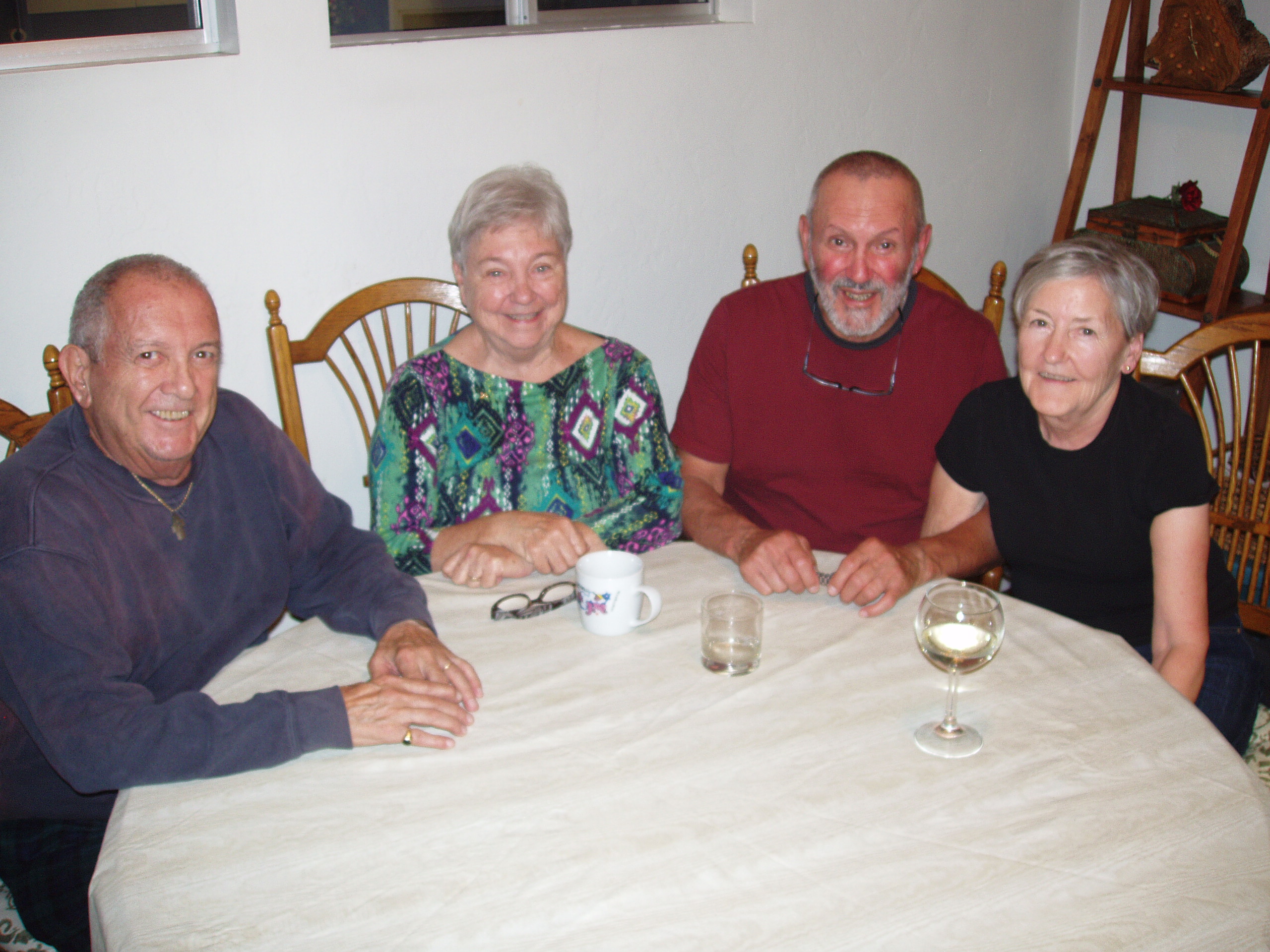
Cec Bev Lou Jean
By pre-arranged compact, Bev and I flew (not literally, we each bought a ticket for a Delta jetliner) to Toronto in July to attend Lou’s 75th birthday party put together by his wife, Jean, and they flew (not literally, etc) to San Diego for the party Bev put together for my 80th birthday in December.
Our visit up north also included a drive down to Bev’s folks in Pennsylvania, where we stayed with her uncle Don and aunt Nancy Linderman and managed to rub elbows with most of the extended family.
Earlier in the year, I was wiped out by a vicious malware program that chewed up and spat out everything in my computer. It struck while I was backing up so about a decade of data and info and pix were nuked to oblivion. So I got a new computer with Windows 8 (which I updated to 8.1) . A friend of my son Mike took my old one and scraped and scrubbed the old drive and said it would work again so I got a monitor for it and it is now my work computer. The new one is connected to the Internet but I save nothing on it. Anything I wish to save, I download to a flash drive and walk across the room to my “old” computer with Windows 7 and copy-paste files onto the computer as well onto flash drives labeled for specific files, such as Photos and Archives and Blog and Mature Life Features and so on, all in the name of Redundancy. And it works fine.
I did manage to recoup about 60 percent or so of what I lost – material that had been saved on CDs, DVDs, flash drives, an old laptop and a notebook I used to take traveling. That’s been replaced by a new tablet.
Out of both need and want, we got a new fridge, dishwasher, and dryer late in the year and I got my little red car painted – Aztec Red. I use my little red Nissan for a once-a-week Meals on Wheels run. Meanwhile, Bev has been making herself invaluable as a volunteer at Oasis, a St. Louis., Mo. – based seniors’ program that provides classes, travel groups and exercise.
A cozy Christmas to all and a comfortable New Year
The Best Present for any Birthday …
… is being present, followed by the presence of family and friends.

And what a birthday party I had this past week.
Bev worked hard on this gathering and it showed as what felt like dozens of people poured through the front and back doors last Saturday (after my 80th birthday Dec. 2) shouting Happy Birthday and tossing hugs at me and each another.
Brother Lou and his wife Jean flew in from Toronto for a two-week visit. Joe Brown, a longtime friend and former newspaper colleague from Kitchener, Ontario, and his wife Edith drove over from their winter digs in Phoenix. Daughter Heather with husband Steve and the grandkids, Dean and Melia, flew in from the Valley of the Sun. My daughter Cris, and her mother, Peg, from Culver City arrived about the same time as my son, Mike, who lives nearby. Rounding out the group were close friends ex-TV staffer John Beatty and wife Pat, our masseuse Ofelia, former neighbor Dru, and current neighbors Keri and Dave who live in Dru’s former house.
The weather was grand so the group gravitated to the back yard and everyone chatted with everyone else and – the key to any good gathering – enjoyed each other’s company. Bev (and I) forgot to point out in the invitations that gifts were not part of the day. As a result, I amassed a hoard of loot.
Thickening and sweetening the icing on the birthday cake were calls from Kay and Jerry Salyer, despite his disturbingly debilitating illness, and from Colleen and Fernando Cicci from Toronto to wrap up the weekend. The success of the entire event was due to Bev’s planning and pains.
The socializing continued into Sunday when the kids and grandkids came by and we tangled at dominos and on to Monday when Mike dropped in for a few hands of scopa and scopone It really didn’t end until this morning (Tuesday) when Lou and Jean were dropped off at the Air Canada terminal for their flight back home.
While the motion and movement of people in and around the house have ended dramatically and abruptly, the memories will only become burnished as this time slips slowly and silently into the past.
— Cecil Scaglione
As I enter my ninth decade …
 … I’ve learned that most of those things I’ve really, really wanted to do weren’t really worth doing in the first place.
— Cecil Scaglione, Mature Life Features


