Archive for the ‘Travel’ Category
Adventures Afoot in the City of Light

By Igor Lobanov
Mature Life Features
PARIS — The pigeon flitting about the domed ceiling seemed unimpressed by or, perhaps, deaf to the thunderous tones grumbling out of the more than 6,000 organ pipes. Rambling from crackling to caressing, the massive instrument in St. Sulpice almost made us believe the gates of heaven had opened in the French capital and we were to witness its glory.
A stroll from our Left Bank hotel by way of Marie de Medicis’ peaceful Luxembourg Gardens brought us to this parish church containing one of the world’s largest organs and we had wandered into a special performance.
Our euphoria ebbed a bit when we sought to order a pizza in a nearby restaurant specializing in that fare. The waiter’s disdain appeared designed to intimidate visitors in front of the locals, but succeeded only in denying him his tip.
Fortunately, such behavior was not evident in other places where we dined and was forgotten by the time we stumbled onto the second unexpected event of the day a few blocks farther along the Seine. At the Quai Voltaire, long lines of people inched across the Seine on the Pont des Arts on both sides of a bizarre battle scene stretched along the middle of the footbridge. It was comprised of life-size clay figures of cowboys, Indians, horses and other symbols of the American West by an African sculptor.
As sunset approached, we stopped in a café near Notre Dame for hot chocolate and crepes before heading back to our hotel.
The following day’s project was a meandering three-mile walk from the Boulevard du Montparnasse to the Arc de Triomphe by way of the Tuileries Gardens and Champs Elysees.
We passed through the Luxembourg Gardens, where lovers strolled, children sailed toy boats on a pond, and elderly folks played chess under the chestnut trees.
Then we passed the forbidding-looking 700-year-old Sorbonne, now called the University of Paris. The mood brightened a couple of blocks farther with the appearance of cafes along Boulevard St. Germain des Pres frequented in the 1920s by such literary legends as Ernest Hemingway, F. Scott Fitzgerald, James Joyce, and Gertrude Stein.
Crossing the river at the Pont du Carrousel took us to the courtyard of the Louvre and its pyramid-by-Pei entrance. We headed the other way, past the Tuileries Gardens with its manicured hedges, lawns and terraces framed by Napoleon’s first monument to his military victories: the Roman-style Arc de Triomphe du Carrousel.
Next we came upon the Place de la Concorde where Louis XIV, Marie Antoinette, Robespierre and others were separated from their heads. The guillotine has been replaced by a 3,300-year-old Egyptian obelisk from the Temple of Luxor.
This got us onto the broad boulevard renowned as the Champs Elysees decorated with such labels as St. Laurent, Parfum de France, Mercedes-Benz along with McDonald’s and Planet Hollywood.
Our walk ended at the Etoile, the hub of a dozen radiating streets known as Place Charles de Gaulle that contains the Arc de Triomphe.
A pedestrian tunnel beneath the traffic let us reach the monument just in time to seek shelter from a sudden shower.
But when it’s raining, and you’re in Paris, you can pretend always it’s April.
Mature Life Features, Copyright 2000
On a Mission to Capture California Wines and Times
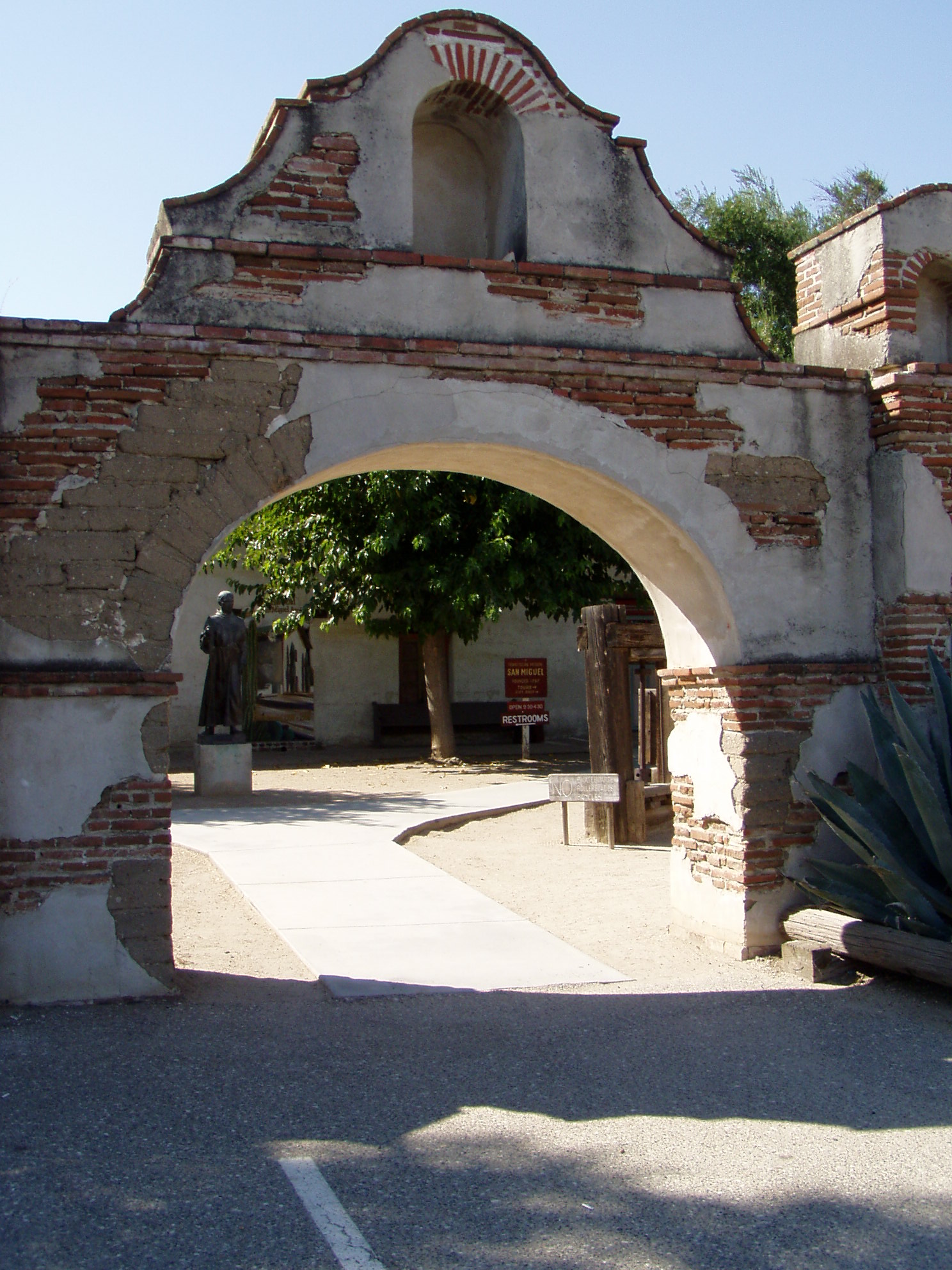 Mission San Miguel arch frames a statue of Fr. Junipero Serra, the Franciscan founder of California’s 21-mission chain.
Story & photo by
Cecil Scaglione
Mature Life Features
The real California, that land that’s a mixture of myth and movies, does exist.
All you have to do is follow the California mission trail down the 100-mile-long Salinas Valley, dubbed the Salad Bowl of the World, from Mission San Juan Bautista outside Salinas to San Luis Obispo mid-way between Los Angeles and San Francisco.
We took the scenic River Road that parallels the Salinas River and Highway 101 as far south as Mission Soledad. This quiet out-of-the-way mission is the 13th established by the Franciscan friars in the chain that forms the spine of the Golden State. It sits on a site that was served by native-built redwood aqueducts from hot springs eight miles away on the flanks of the Coastal Range.
Within a couple of hours’ drive time north from ‘Obispo are several other missions – Santa Cruz, San Carlos Borromeo del Rio Carmelo at Carmel, La Soledad, San Juan Bautista, San Antonio, and San Miguel. They’re all worth a look-see but we saved a few for a return trip.
We drove onto the Hunter Ligget Military Reservation to get to Mission San Antonio, the next one down the road from Soledad. It was established third after the missions at San Diego and Carmel and is the only such sanctuary still on a military base. Besides serving as centers for settlement, the 21 California missions were built as military complexes roughly a day’s horse-ride apart.
It’s southern neighbor, San Miguel, was established in 1797 as the 16th mission on El Camino Real (The King’s Highway). Window panes are still made of stretched sheepskin, similar to those the padres substituted for glass.
Before heading on down to 240-year-old Mission San Luis Obispo de Tolos, we ducked into Paso Robles, one of the best-kept secrets on this out-of-the-mainstream tourist trail. It anchors a rolling Tuscan-lookalike landscape that supports some 70 wineries. It’s still a land where cowboys and charros share a glass of locally made wine after a hard day corralling cattle, manhandling trucks and tractors laden with produce of all kinds, or working the vineyards that quilt the undulating countryside.
Vintners here are even known to down a cold beer after a hot day tending vines.
Mature Life Features, Copyright 2004
Free Lunch
By Cecil Scaglione
Mature Life Features
After a lifetime of being told there’s no such thing as a free lunch, I got one this week.
Well, sorta.
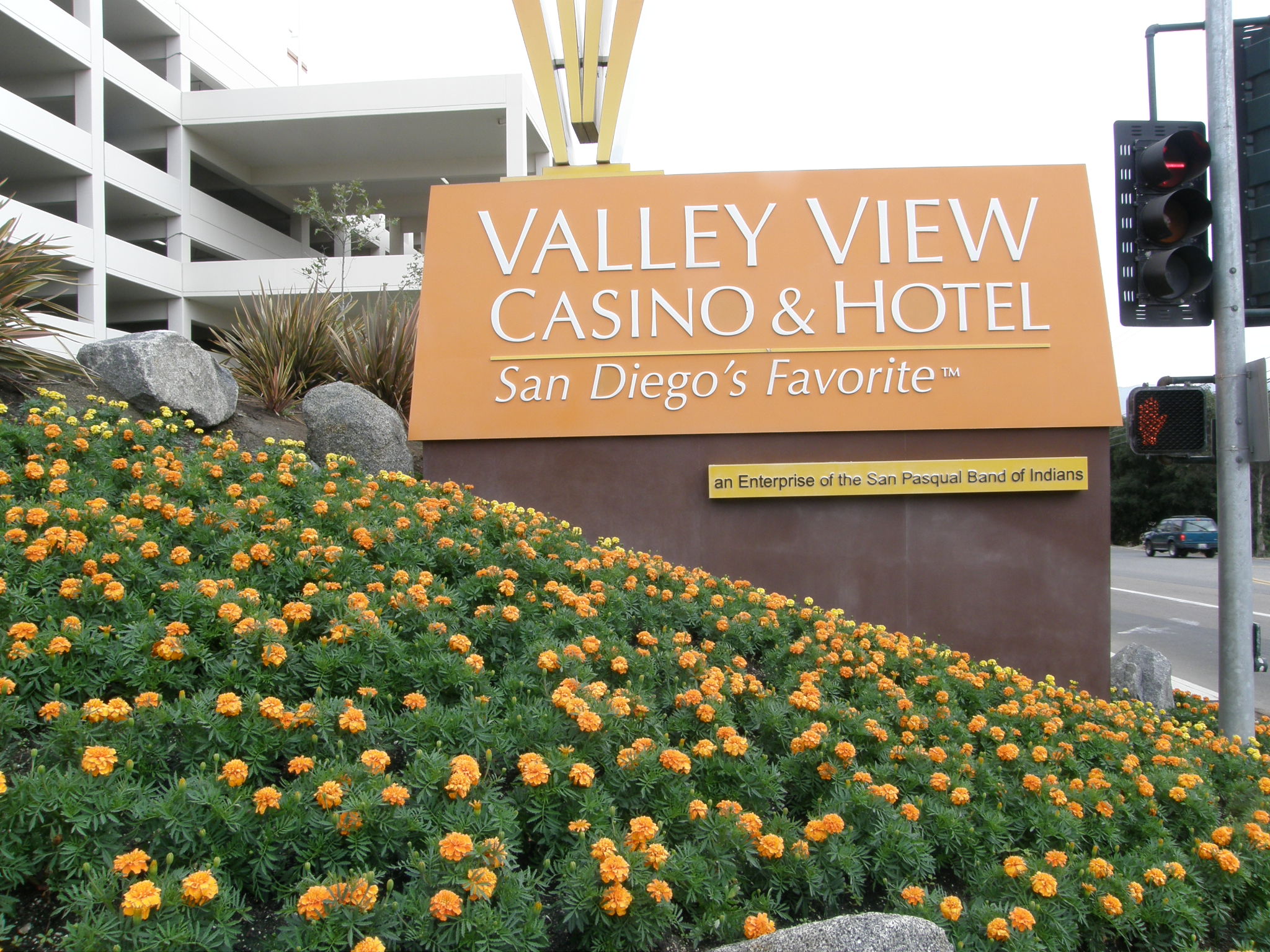
It was during a date made by my wife, Bev, to meet a long-time friend at the Valley View Casino in north San Diego County. The casino-restaurant-hotel complex calls itself “San Diego’s Favorite” and boasts about featuring lobster under a portion of its glass-covered buffet counters.
The event dictated that we not worry about what didn’t get done around the house after the kids and grandkids returned to Phoenix Tuesday, wrapping up a weekend visit. We got most things re-arranged and cleaned up but the rest was left until after Bev’s auld-lang-syne appointment because she didn’t want to be so weary she couldn’t enjoy re-gossiping about the old days and catching up on the new days with her former neighbor, who had moved to Hawaii for several years before returning to Southern California after her husband died.
It took us about an hour to drive up to the casino, one of a dozen or so in the county. As the name suggests, it’s perched on a high hill overlooking the countryside that’s made up mostly of a deep valley surrounded by scrubby-looking hills peppered with scrubby looking rocks, shrubs and trees.
As the ladies dived into reminiscing while feeding a couple of slot machines, I went to a nearby counter and registered for a Player’s Cub card so the San Pascual Indian tribe could track how much money I lose. And I was told I get a free buffet, either lunch or dinner, with my new card.
I rushed back to tell Bev and she decided to get herself a free lunch — er, Players Club card — too.
As it turned out, the ladies quit feeding the machines and decided to feed themselves about the time I was ready to build my fortune. Bev’s wins and losses had bounced up and down and she wound up around $20 down. Since the buffet costs $19.95, she broke even. And, since I never got the opportunity to test my luck, I got a free lunch.
The operators have every right to boast about the buffet. It was extensive and fresh, with plenty of variety. But no lobster at lunch, only at dinner.
Bay-Area Attractions Blend in Monterey
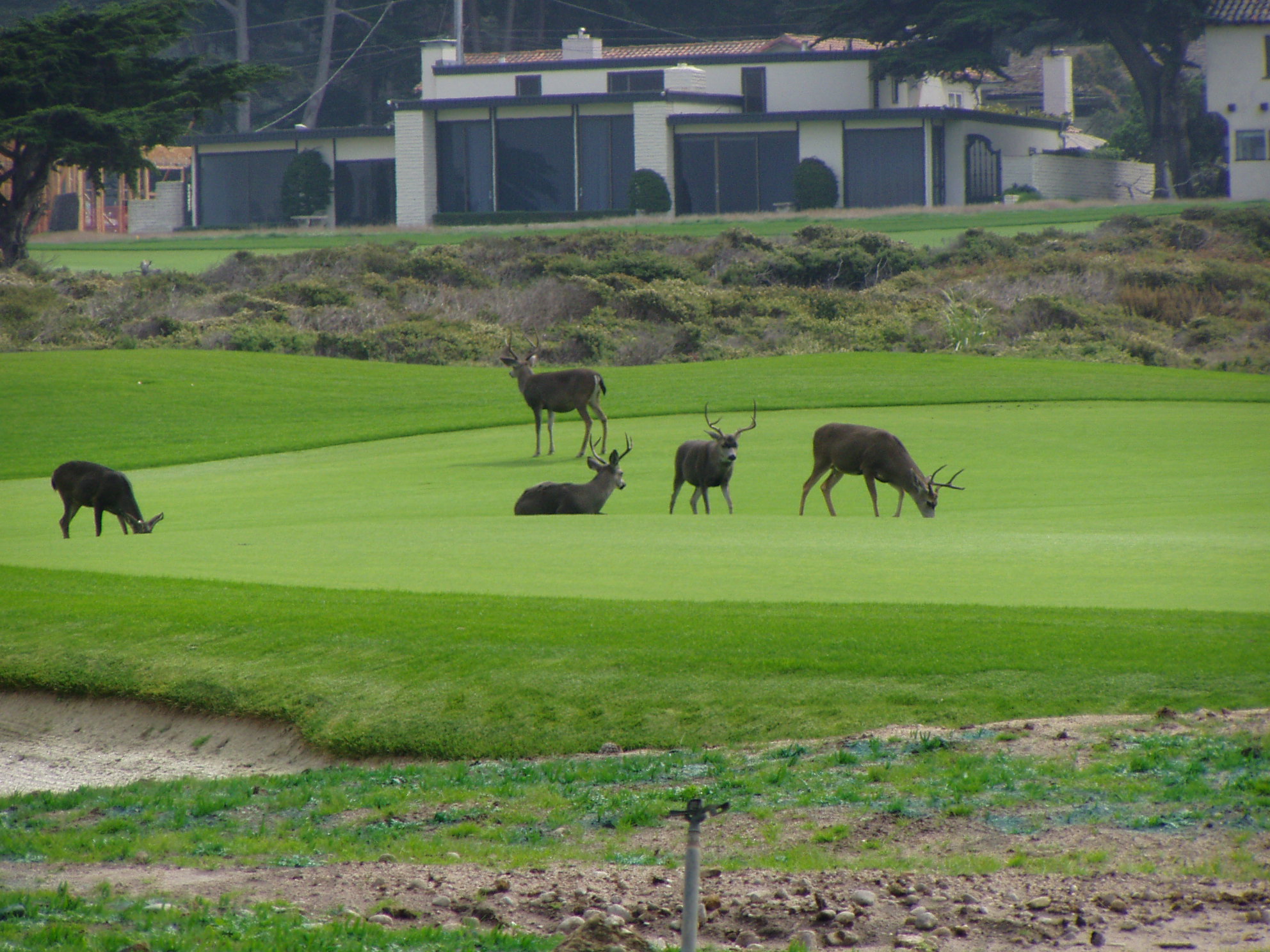 Deer manicure a Monterey Peninsula golf course.
By Cecil Scaglione
Mature Life Features
MONTEREY —- The cops warned us about the raid.
The man in the police uniform announced a few decibles above Rosine restaurant’s late-lunchtime chatter: “You have 17 minutes to move your cars.”
We either had to finish eating in that time or rush out and move our vehicles from their
downtown parking spots before a fleet of tow trucks swooped down Alvarado Street to move
them for us.
Right behind them was an army of vans and pickups that swarm into the commercial core of this
city of 29,000 to set up a weekly farmers’ market and craft fair that has been pleasing penchants ranging
from popcorn to porcelain, and puppets to pumpkin bread since 1991.
The rush is repeated every Tuesday throughout the year. Most of the produce on sale springs out of the neighboring salubrious Salinas Valley. It has been dubbed the Valley of the World by Salinas’ native son, Pulitzer- and Nobel-prizewinner John Steinbeck. It is also the model for “East of Eden,” one of his many renowned novels.
Cradled between the Coastal Range on the west and Pinnacles on the east, this funnel of fertility
stretches some 100 miles south to the Paso Robles-San Luis Obispo-Morro Bay region.
Earlier in the day, we covered the Presidio and Fisherman’s Wharf, smaller but more comfortable
versions of their similarly-named counterparts several miles north in San Francisco. They’re
much more accessible in this City by the Bay – Monterey Bay.
Within strolling distance are Cannery Row, also made famous by Steinbeck, and its world-
renowned aquarium. The carnival atmosphere of the Wharf, with its cotton candy and pull taffy, is so permeating you
begin to look for fire eaters and bearded ladies. Spielers shout enticements and offer cuisine
samples to lure you into whatever restaurant they happen to be standing in front of.
Dining is not to be pooh-poohed here. Menus at eatery entrances feature dishes ranging from
abalone to zucchini. If there isn’t enough there for the gourmand, you’re still here, just minutes away in Cannery Row with its eclectic array of boutiques, saloons, and dining dens. It also serves as a megaphone proclaiming the
dozens of wineries and their products in the Monterey Peninsula as well as reminding visitors
this is Steinbeck country.
The late author’s home town is 30 minutes east of Monterey’s neighbor, Marina, with its spume-
sprayed sand-dune beaches. There’s a Steinbeck Center in Salinas that fleshes out the author’s
course from farm laborer to literary lion with such memorable titles as “Tortilla Flats,” “The
Grapes of Wrath,” “Sweet Thursday,” and, of course, “Cannery Row.”
This agricultural hub feels longitudes away from the scenic and storied 17-mile drive, Pebble
Beach and Big Sur. Aiming your auto west for just half an hour gets you right back to the
brisk Pacific breezes that constantly massage these shores.
Our first approach was made by taking the winding 100 mile coastal Highway 1 from Carmel to Cambria.
If you plan to make this drive, take plenty of time and film. There are vistas at every curve of the
road, and there are hundreds of curves. You can also take time to visit the fabled Hearst Castle at
San Simeon or stop for a respite at the Arthur Miller Library tucked into a rock-and-tree-walled
nook alongside the road.
A pleasant surprise at the northern tip of the Monterey Peninsula are the vistas from Ocean View
Boulevard, which borders the coastal edge of Pacific Grove, Monterey’s western neighbor. And
you don’t have to pay the $9.75-per-vehicle required to take the 17-mile drive. It was
worth the price because we got to see the famed California mission at Carmel, Monterey’s
southern neighbor, before we began the scenic drive from that city’s entrance.
We also got to see deer pottering about on the golf greens overlooking Spanish Bay. This was
reprised the following morning when a doe and fawn traipsed below our balcony at the Asilomar
Conference Center, a rustic retreat on the Pacific dedicated to the simple life. It was a culture-shock away from our previous night’s stay in a luxurious Marina Dunes suite on the opposite side of Monterey Bay.
Mature Life Features, Copyright 2004
Spokane Bets Generosity Trumps Glitz ‘n’ Glamor
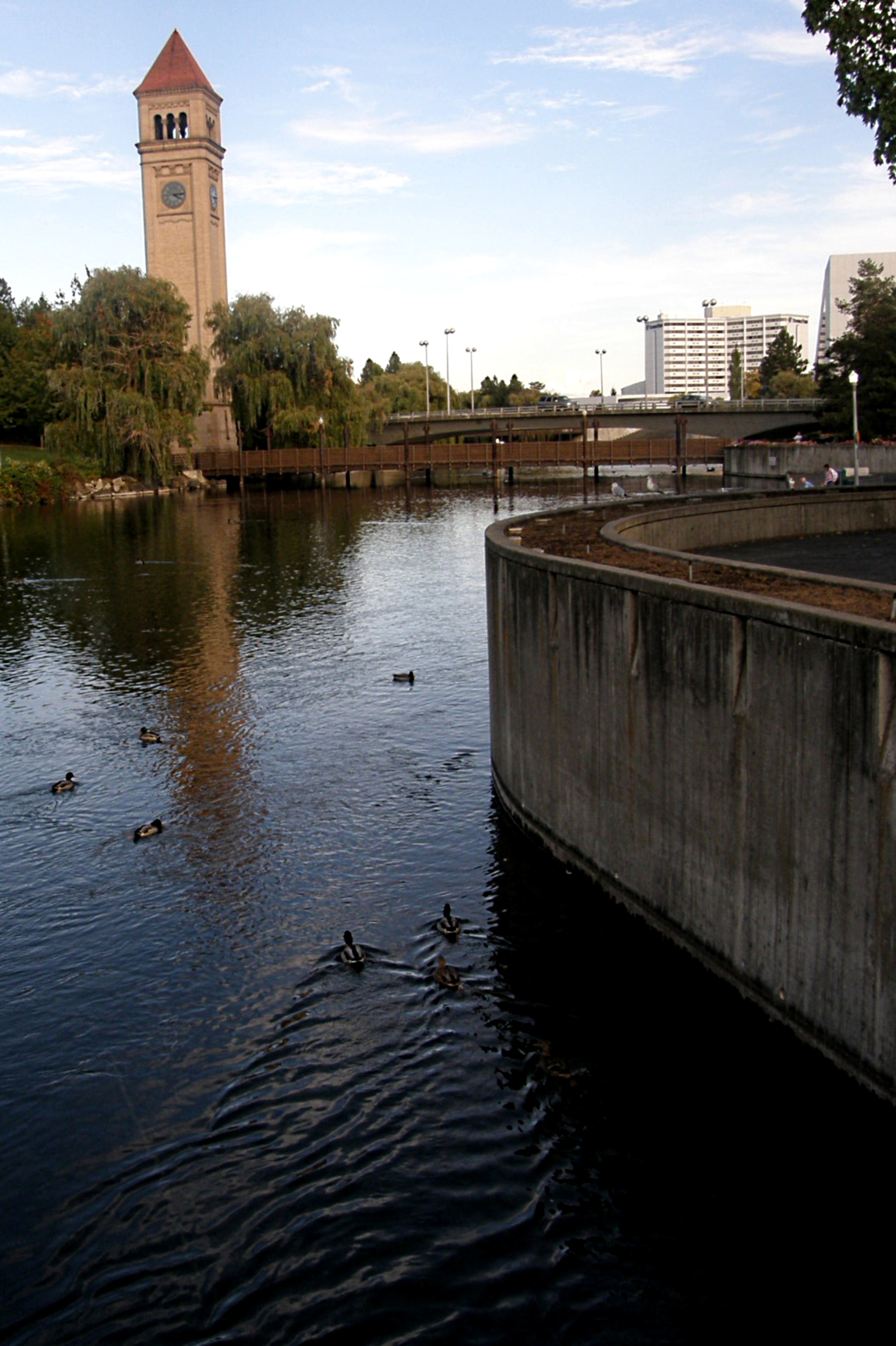 110-year-old clock tower alongside Spokane’s river
is all that remains of the Great Northern Rail Depot
Story & photo by
Cecil Scaglione
Mature Life Features
SPOKANE, Wash. – As Nevada’s Glitter Gulch kicks the “H” out of hospitality in its dedicated drive for dollars, a gaming group here is tucking it back in.
For example, players’ club members at the Northern Quest Resort and Casino about 15 minutes from downtown get a credit on their losses if they return to play. Diners at Masselow’s, the triple A Four Diamond main restaurant among the 14 eateries in the complex, receive a miniature bark-canoe-full of fry bread and huckleberry jam. Occupants of its 250 rooms, who can have a Fatburger delivered to their room at any time of night or day, get free airport shuttle service as well as to and from downtown Spokane. Women even get one-third off the price of a cigar on Ladies Night (Thursday) in the comfortable spirits club room.
It’s down-home service with a swagger. You can see it all around you on the 250-acre Quest complex that was awarded to the 400-member Kalispel tribe in trust because the contours and condition of their reservation an hour north make it unfeasible to build any commercial enterprises on that land.
Besides concerts and other on-site diversions associated with casinos, there’s plenty do when you leave a gaming table or slot machine and head for daylight. Everyone on staff is quick to tell you there are innumerable lakes and rivers and mountains within 40 minutes of the casino.
Hiking, biking, fishing, birding, skiing, snowshoeing: they’re all available. So is picking your own apples – there are more than 100 varieties to choose from – nectarines, peaches, strawberries, corn, carrots, grapes and several other types of fruit and vegetables in season. They’re tended by the dozens of farms and orchards clustered around Green Bluffs an hour north of town.
Several have mini playgrounds to keep youngsters entertained while you harvest. If you don’t have the time or energy to gather your own, you can buy just-picked picked produce, along with wedges of freshly made pies, jellies and jams, and an array of tongue-teasing homemade products.
If hunting is your hobby, “Deer are like rabbits around here,” according to one local resident.
While driving around the countryside, you can stop at any of the several wineries and sip samples. At Townshend Cellars, we were treated to a 2002 huckleberry port. An added attraction at the Arbor Crest tasting room, better known as The Cliff House, is the view. There’s the Spokane skyline over one shoulder and the mountains of Idaho over the other.
The east-west Spokane River flows below. It’s bordered by the Centennial Trial, a 39-mile paved strip open to hikers, bikers, skaters and horses that stretches from the neighboring state line to the east on through downtown Spokane’s Riverfront Park.
A major feature of the park, which was a hub of activity during the city’s 1974 World’s Fair, are the falls that pour water westward through the heart of the city.
After touring the city and countryside, your hunger can be assuaged by a 22-inch one-pound hot dog in The Q, the casino’s sports bar dominated by the largest plasma television screen produced by Panasonic. It’s 10 feet by 30 feet. You can add fries to that dog with local fry sauce, a mixture of ketchup and mayonnaise.
Mature Life Features, Copyright 2012
On a Mission in San Diego

By Cecil Scaglione
Mature Life Features
Played tourist at home this weekend and took the camera to visit Mission San Diego de Alcala.
It’s worth spending some time there, especially when you move from the busy front into the quieter and more spacious courtyard encapsulated by the Spanish-colonial structure housing a museum, priests’ quarters, chapel, and more (like public bathrooms). Happened upon a wedding in the parish that Franciscan Junipero Serra established in 1769 as the first of the 21 missions that form the spine of California.
The original Spanish settlement was where Old Town is now, below the Presidio tower on the hill that allowed settlers to get a strategic early view of any ships sailing into San Diego Bay.
The friars decided to move their neophyte native converts away from the lascivious soldiers so they moved the church and school about five miles up the San Diego River – the distance in which tolling bells could be heard.
Among the exhibits is a showcase of models of the missions stretching from here to north of San Francisco in the order in which they were founded. It’s a quick look at California’s early development.
While they were situated within a day’s march of each other – anywhere from about 30 to 50 miles – they weren’t founded in order from south to north. The next mission established after San Diego was in Carmel just south of San Francisco.
However, to follow El Camino Real (The King’s Highway) formed by the mission chain, drive up Highway 5 to the largest mission in the chain – Mission San Luis Rey in Oceanside. Next is San Juan Capistrano and then there’s…
Want Beer? Go to the Source.
What better way to get our Canadian-beer fix than to head to where it’s brewed. So we blew into the Steam Whistle facility in the Roundhouse at the foot of the CN Tower. Got a bottle and glass of fine pilsener (and a souvenir tasting glass) before heading out into the reconstructed station and pump house and locomotive roundhouse that was a loud and major working railway yard about a century ago. With appetites whetted, we headed west on the Queensway to Prego where Lou reviewed memories with owner (and chef) Angelo before we feasted on one of the house specialities — roasted rabbit. Sun’s out but wind off the lake still has teeth in it…
Time Out in Toronto
It’s been a week gone by already and we’ve finally found the sun.
The flight here a week ago Tuesday was extremely pleasant because we had to shift seats twice: as the Airbus doors slammed shut preparing for takeoff, Bev had the seat across the aisle from me and I had an empty row. A flight attendant asked me to make room for an elderly woman from up front to sit in my row (number 26) because she wanted to be closer to the bathroom. She noticed Bev and I talking and figured out we were together so she (flight attendant) agreed to have Bev move over with me and the woman take her seat. Then another flight attendant tapped me on the shoulder and asked if we’d change seats with the people right behind us — a young mother with two kids — because the audio system in one of the seats wasn’t working and her kids need them to stay amused with video. So we tumbled one row back but still had three seats for us two. Because we were so cooperative, the flight attendants gave us free food — Air Canada charges for their in-flight lunch.
Brother Lou picked us up in the 10 p.m. rain and we slept through the first day of chilly rain and clouds and got out the second day here to stretch our legs and stumble thru the cold. Lou lent us his Jeep to drive to Kitchener on Sunday during the first clean break in the weather for an auld-lang-syne gathering with three long-time friends — an ex reporter, photographer and sports editor — from the Kitchener-Waterloo Record. We’ve had dinner with old friends here in TO, have done a bit of shopping, and Lou and I spun thru Steamwhistle Brewery in the shadow of the CN Tower.
‘We’ll catch up on the rest later…
Kyoto Echos Samurai Swordplay
Samurai and ninja

Story and photo by
Sandy Katz
Mature Life Features
KYOTO, Japan — However difficult it is to envision today, legendary samurai warriors once waged bloody battles on the streets of this former Japanese capital. In the museum of Kyoto, you can see painted scrolls depicting courageous sword fights and bands of costumed crusaders proudly parading through the city’s Sanjo-dori district displaying, for all to
heed, the freshly severed heads of traitors.
The history of this nation’s seventh-largest city stretches back more than a thousand years as a renaissance city, spiritual center and battlefield. Most of the temples and landmarks have survived unscathed to present visitors a rare insight into Japanese culture.
The Hollywood film, The Last Samurai starring Tom Cruise, was filmed here. It focuses attention on this near-mythical hero whose prime duty was to give faithful service to his feudal lord. The origin of the term samurai is closely linked to a word meaning “to serve” and the samurai a code of conduct drawn from Confucianism, Shintoism and Buddhism came to be known as the way of the warrior.
Confucianism requires the samurai “to show absolute loyalty to the lord, (and) toward oppressed to show benevolence and exercise justice.” From Buddhism, the samurai learned the lesson that life is impermanent, enabling him to face death with serenity. Shintoism provided him with patriotic belief in the divine status of both the emperor and Japan, the abode of the gods.
A true samurai had endless endurance, exhibited total self-control, spoke only the truth, and displayed no emotion. Since his honor was his life, disgrace and shame were to be avoided above all else, and all insults were to be avenged. Ritual suicide was an accepted means of avoiding dishonor. One reason for this was the requirement that a samurai should never surrender but always go down fighting. Thus, as depicted in The Last Samurai, if wounded and having lost the battle, the only way to retain his honor is by sacrificing himself.
Whether at war or during peacetime, a samurai would try to find peace within himself through meditation, seeking out tranquility in his private garden or his tea house or in other serenity-producing pastimes.
The tea ceremony, with its strict rules for preparing and serving the beverage to a guest, was one such pastime. The task required great calm and concentration.The ritual’s elements of respect, purity, and tranquility were clearly apparent as our tea master prepared the hot water and then ceremonially made the beverage from green, finely powdered tea
served in small ceramic bowls. One sweet treat accompanied the tea.
Sipping is done in a prescribed manner. One turns the bowl just so while making little bows of thanks.
At Kyoto Studio Park Toe Movie Land, we met our samurai. Lee Murayama, an actor in the Last Samurai, dressed in the costume he wears in Japanese films and television shows. This studio is the only theme park in Japan where visitors can observe the filming of period dramas.
Chief among the activities visitors to Kyoto pursue is exploring the grounds of some of the city’s 1,600 temples and 400 shrines. One of the most interesting of the former was Chion-In Temple. Our priest guide, whose children live in the United States, pointed out that the shrine’s attractions tend toward the oversize. Its Sanmon Gate is the biggest in Japan, the huge Hoki hall can seat 3,000, and the bronze bell requires the muscle power of 17 monks to ring it.
Spring in Kyoto is celebrated with a dramatic ceremony called Setsubun. At Kitano-Tenmangu Shrine, men in demon masks run about the stage as cast members throw soybeans at them and shout, “Demons out, good luck in!,” symbolizing Japanese people chasing demons from their homes. Following the show, the cast hurls peanuts into the audience for people to toss them out from their own homes and giggling children scamper about gathering up the peanuts.
Our last night was spent in the Tawaraya of Kyoto, a 19-room ryokan (traditional Japanese country inn) that’s a Japanese wonderland of winding passageways, magical sliding doors, and private gardens. It’s steps away from the bustling city streets and close to the Nishiki open-air market district. For nearly 300 years its guests have slept on futon bedding on floor mats and been served by smiling maidservants in neat kimonos. A samurai would have liked it — a place of serenity within urban chaos.
Mature Life Features, Copyright 2004
Pasadena Not Just for Smelling Roses
Story and Photo
By Cecil Scaglione
Mature Life Features
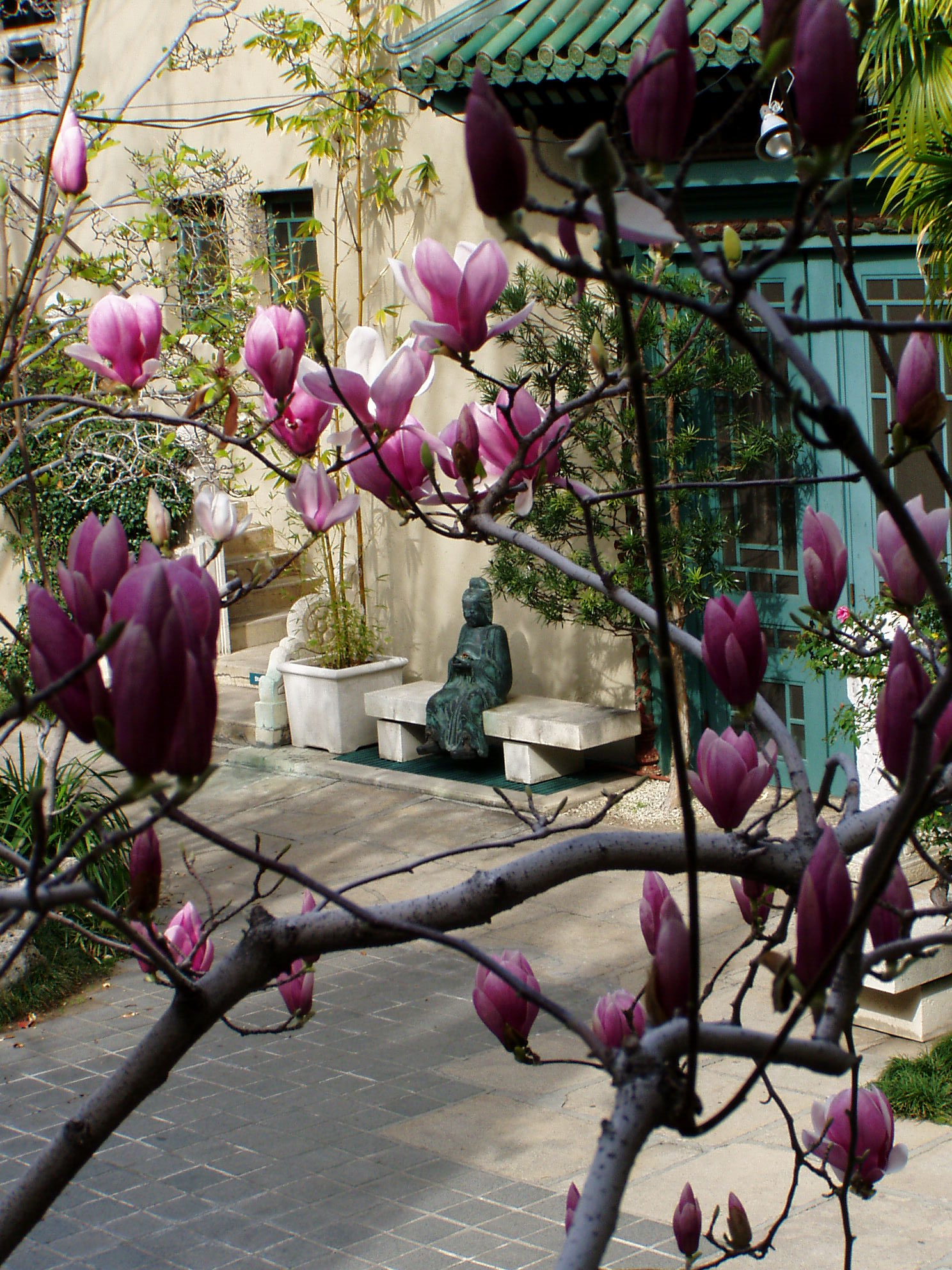
Pensive statue in Pasadena’s Pacific Asia Museum
PASADENA —- Much of the world becomes aware of this town 15 minute north of downtown Los Angeles when it unveils months of work on blossom-burgeoned floats in the yearly Rose Parade along Colorado
Boulevard.
This is a prelude to the granddaddy of all college bowl games: the annual New Years’ Day
football festival in the Rose Bowl, where the University of California – Los Angeles Bruins play
their home games.
But when visitors consider Los Angeles, they envision a melange of movieland, Malibu,
Disneyland, and Beverly Hills. Few folks even consider visiting this quiet community that’s as homey as a ’57 Chevy.
But you can please both your palate and your psyche in this town that appears, in spots, like it
might have been plucked out of the Poconos rather than sequestered alongside the San Gabriel
Mountains.
While teasing your taste buds at one of the 500 local eateries – this number should be no surprise
when you learn cooking icon Julia Child was born here – you may stumble upon luminaries
of big and small screen as well as stage who have long found this “city that feels like a village” a liveable
locale.
But you can get closer to much bigger stars here.
Creative minds at Jet Propulsion Laboratories monitor progress of their history-making
space probes. Reservations are required, but tours of this facility are free. Details for a visit are available at jpl.nasa.gov.
To pleasure your psyche, the Norton Simon Museum offers an intimate walk among works by,
among others, Monet, Rembrandt, Rubens, Renoir, Raphael, and Degas, including his famous
depiction of a young ballerina “Waiting.” All are within touching distance in this visitor-friendly
facility along the Rose Parade route.
While you‘re in this part of town, skip over to the Pasadena Museum of History for a quick tour
of the 18-room Fenyes House. The mansion echoes how Pasadena grew out of the Spanish
outpost established at Mission San Gabriel by Franciscan Father Junipero Serra back in 1771.
The community sprouted after the transcontinental railway reached the sleepy little town of Los
Angeles in the 1870s and the region was discovered by a handful of wealthy Midwesterners from
Indiana, Illinois, and Michigan seeking escape from frigid winters.
The Fenyes House is one of 52 grand mansions built in the late 1800s along a millionaires’ row known as “the Boulevard.”
It was millionaire railroad-and real-estate magnate Henry Huntington who established the 207-acre Library, Art
Collections and Botanical Gardens complex known simply as The Huntington.
The Library, a research center that has been dubbed the Bastille of Books, houses original
Shakespeare works as well as Benjamin Franklin’s handwritten autobiography and an original
Gutenberg Bible.
On display in the art gallery are several works by Gainsborough, including his renowned Blue
Boy. A mausoleum built on the grounds was designed by John Russell Pope and used as a
prototype for the Jefferson Memorial in Washington, D.C.
Fifteen gardens exhibit botanical eye-candy stretching from Chinese and Japanese landscaping to a
patch of desert.
It was near a knoll now supporting a rose-festooned Temple of Love that a neighbor’s young lad
used to play his war games. The boy grew up to be Gen. George Patton of World War II fame.
Between tours of these and other attractions, such as the Pacific Asia Museum, where some 50
centuries of Asian ceramics is part of its exhibits, there’s a wide choice of palate-pleasing
moments.
For example, just an interlude away from the Pasadena Playhouse – such household names as Dustin Hoffman
and Gene Hackman launched careers here – is Maison Akira, where chef Akira
Hirose fuses French and Japanese cuisine. He gets it all done, he said because “in the kitchen, its like a big orchestra and I just direct the musicians.”
After all this activity, you just might want to take a few moments to smell the roses in Pasadena.
Mature Life Features, Copyright 2004
 Mature Life Features