Time Out in Toronto
It’s been a week gone by already and we’ve finally found the sun.
The flight here a week ago Tuesday was extremely pleasant because we had to shift seats twice: as the Airbus doors slammed shut preparing for takeoff, Bev had the seat across the aisle from me and I had an empty row. A flight attendant asked me to make room for an elderly woman from up front to sit in my row (number 26) because she wanted to be closer to the bathroom. She noticed Bev and I talking and figured out we were together so she (flight attendant) agreed to have Bev move over with me and the woman take her seat. Then another flight attendant tapped me on the shoulder and asked if we’d change seats with the people right behind us — a young mother with two kids — because the audio system in one of the seats wasn’t working and her kids need them to stay amused with video. So we tumbled one row back but still had three seats for us two. Because we were so cooperative, the flight attendants gave us free food — Air Canada charges for their in-flight lunch.
Brother Lou picked us up in the 10 p.m. rain and we slept through the first day of chilly rain and clouds and got out the second day here to stretch our legs and stumble thru the cold. Lou lent us his Jeep to drive to Kitchener on Sunday during the first clean break in the weather for an auld-lang-syne gathering with three long-time friends — an ex reporter, photographer and sports editor — from the Kitchener-Waterloo Record. We’ve had dinner with old friends here in TO, have done a bit of shopping, and Lou and I spun thru Steamwhistle Brewery in the shadow of the CN Tower.
‘We’ll catch up on the rest later…
Kyoto Echos Samurai Swordplay
Samurai and ninja

Story and photo by
Sandy Katz
Mature Life Features
KYOTO, Japan — However difficult it is to envision today, legendary samurai warriors once waged bloody battles on the streets of this former Japanese capital. In the museum of Kyoto, you can see painted scrolls depicting courageous sword fights and bands of costumed crusaders proudly parading through the city’s Sanjo-dori district displaying, for all to
heed, the freshly severed heads of traitors.
The history of this nation’s seventh-largest city stretches back more than a thousand years as a renaissance city, spiritual center and battlefield. Most of the temples and landmarks have survived unscathed to present visitors a rare insight into Japanese culture.
The Hollywood film, The Last Samurai starring Tom Cruise, was filmed here. It focuses attention on this near-mythical hero whose prime duty was to give faithful service to his feudal lord. The origin of the term samurai is closely linked to a word meaning “to serve” and the samurai a code of conduct drawn from Confucianism, Shintoism and Buddhism came to be known as the way of the warrior.
Confucianism requires the samurai “to show absolute loyalty to the lord, (and) toward oppressed to show benevolence and exercise justice.” From Buddhism, the samurai learned the lesson that life is impermanent, enabling him to face death with serenity. Shintoism provided him with patriotic belief in the divine status of both the emperor and Japan, the abode of the gods.
A true samurai had endless endurance, exhibited total self-control, spoke only the truth, and displayed no emotion. Since his honor was his life, disgrace and shame were to be avoided above all else, and all insults were to be avenged. Ritual suicide was an accepted means of avoiding dishonor. One reason for this was the requirement that a samurai should never surrender but always go down fighting. Thus, as depicted in The Last Samurai, if wounded and having lost the battle, the only way to retain his honor is by sacrificing himself.
Whether at war or during peacetime, a samurai would try to find peace within himself through meditation, seeking out tranquility in his private garden or his tea house or in other serenity-producing pastimes.
The tea ceremony, with its strict rules for preparing and serving the beverage to a guest, was one such pastime. The task required great calm and concentration.The ritual’s elements of respect, purity, and tranquility were clearly apparent as our tea master prepared the hot water and then ceremonially made the beverage from green, finely powdered tea
served in small ceramic bowls. One sweet treat accompanied the tea.
Sipping is done in a prescribed manner. One turns the bowl just so while making little bows of thanks.
At Kyoto Studio Park Toe Movie Land, we met our samurai. Lee Murayama, an actor in the Last Samurai, dressed in the costume he wears in Japanese films and television shows. This studio is the only theme park in Japan where visitors can observe the filming of period dramas.
Chief among the activities visitors to Kyoto pursue is exploring the grounds of some of the city’s 1,600 temples and 400 shrines. One of the most interesting of the former was Chion-In Temple. Our priest guide, whose children live in the United States, pointed out that the shrine’s attractions tend toward the oversize. Its Sanmon Gate is the biggest in Japan, the huge Hoki hall can seat 3,000, and the bronze bell requires the muscle power of 17 monks to ring it.
Spring in Kyoto is celebrated with a dramatic ceremony called Setsubun. At Kitano-Tenmangu Shrine, men in demon masks run about the stage as cast members throw soybeans at them and shout, “Demons out, good luck in!,” symbolizing Japanese people chasing demons from their homes. Following the show, the cast hurls peanuts into the audience for people to toss them out from their own homes and giggling children scamper about gathering up the peanuts.
Our last night was spent in the Tawaraya of Kyoto, a 19-room ryokan (traditional Japanese country inn) that’s a Japanese wonderland of winding passageways, magical sliding doors, and private gardens. It’s steps away from the bustling city streets and close to the Nishiki open-air market district. For nearly 300 years its guests have slept on futon bedding on floor mats and been served by smiling maidservants in neat kimonos. A samurai would have liked it — a place of serenity within urban chaos.
Mature Life Features, Copyright 2004
Pasadena Not Just for Smelling Roses
Story and Photo
By Cecil Scaglione
Mature Life Features
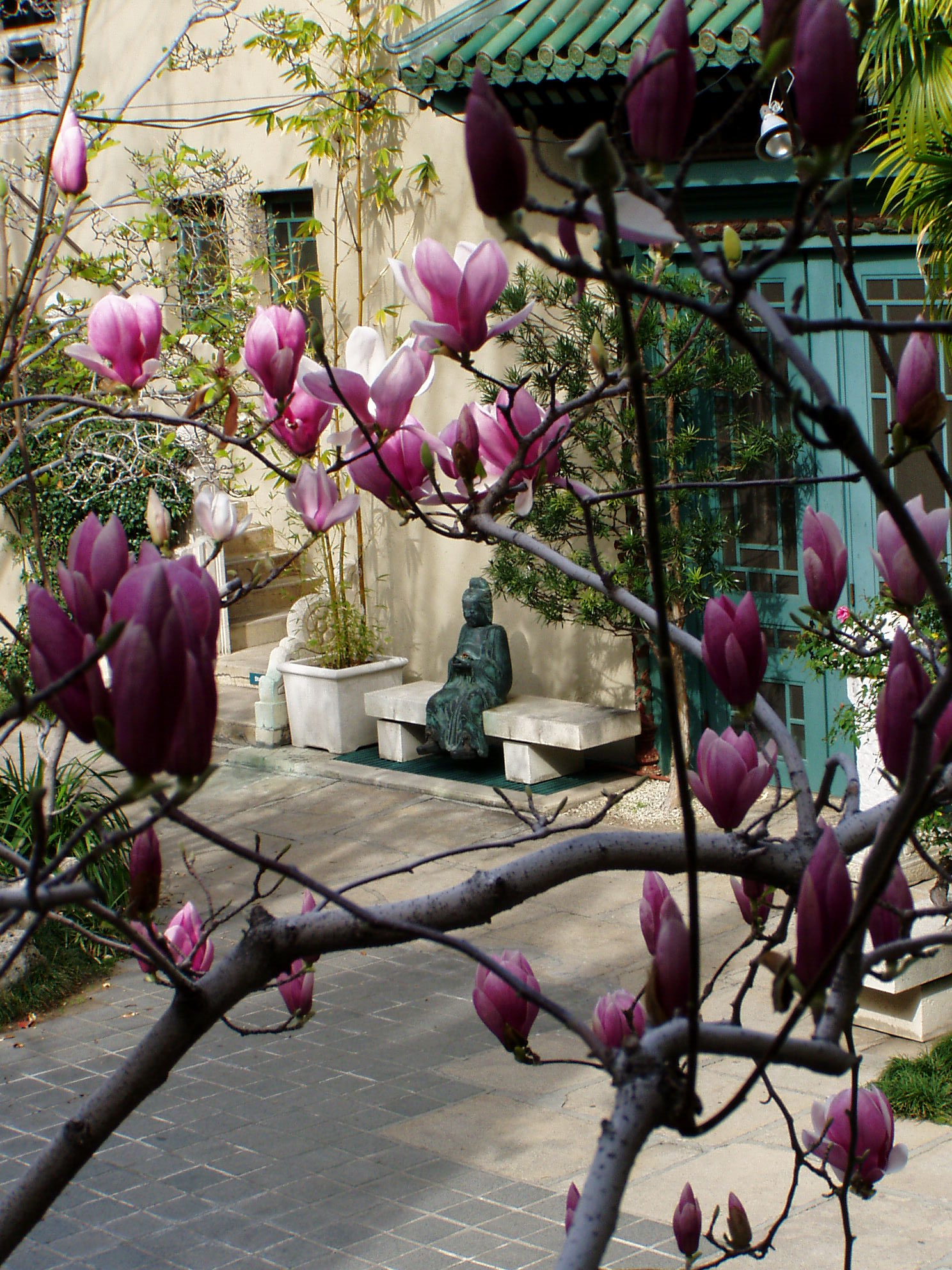
Pensive statue in Pasadena’s Pacific Asia Museum
PASADENA —- Much of the world becomes aware of this town 15 minute north of downtown Los Angeles when it unveils months of work on blossom-burgeoned floats in the yearly Rose Parade along Colorado
Boulevard.
This is a prelude to the granddaddy of all college bowl games: the annual New Years’ Day
football festival in the Rose Bowl, where the University of California – Los Angeles Bruins play
their home games.
But when visitors consider Los Angeles, they envision a melange of movieland, Malibu,
Disneyland, and Beverly Hills. Few folks even consider visiting this quiet community that’s as homey as a ’57 Chevy.
But you can please both your palate and your psyche in this town that appears, in spots, like it
might have been plucked out of the Poconos rather than sequestered alongside the San Gabriel
Mountains.
While teasing your taste buds at one of the 500 local eateries – this number should be no surprise
when you learn cooking icon Julia Child was born here – you may stumble upon luminaries
of big and small screen as well as stage who have long found this “city that feels like a village” a liveable
locale.
But you can get closer to much bigger stars here.
Creative minds at Jet Propulsion Laboratories monitor progress of their history-making
space probes. Reservations are required, but tours of this facility are free. Details for a visit are available at jpl.nasa.gov.
To pleasure your psyche, the Norton Simon Museum offers an intimate walk among works by,
among others, Monet, Rembrandt, Rubens, Renoir, Raphael, and Degas, including his famous
depiction of a young ballerina “Waiting.” All are within touching distance in this visitor-friendly
facility along the Rose Parade route.
While you‘re in this part of town, skip over to the Pasadena Museum of History for a quick tour
of the 18-room Fenyes House. The mansion echoes how Pasadena grew out of the Spanish
outpost established at Mission San Gabriel by Franciscan Father Junipero Serra back in 1771.
The community sprouted after the transcontinental railway reached the sleepy little town of Los
Angeles in the 1870s and the region was discovered by a handful of wealthy Midwesterners from
Indiana, Illinois, and Michigan seeking escape from frigid winters.
The Fenyes House is one of 52 grand mansions built in the late 1800s along a millionaires’ row known as “the Boulevard.”
It was millionaire railroad-and real-estate magnate Henry Huntington who established the 207-acre Library, Art
Collections and Botanical Gardens complex known simply as The Huntington.
The Library, a research center that has been dubbed the Bastille of Books, houses original
Shakespeare works as well as Benjamin Franklin’s handwritten autobiography and an original
Gutenberg Bible.
On display in the art gallery are several works by Gainsborough, including his renowned Blue
Boy. A mausoleum built on the grounds was designed by John Russell Pope and used as a
prototype for the Jefferson Memorial in Washington, D.C.
Fifteen gardens exhibit botanical eye-candy stretching from Chinese and Japanese landscaping to a
patch of desert.
It was near a knoll now supporting a rose-festooned Temple of Love that a neighbor’s young lad
used to play his war games. The boy grew up to be Gen. George Patton of World War II fame.
Between tours of these and other attractions, such as the Pacific Asia Museum, where some 50
centuries of Asian ceramics is part of its exhibits, there’s a wide choice of palate-pleasing
moments.
For example, just an interlude away from the Pasadena Playhouse – such household names as Dustin Hoffman
and Gene Hackman launched careers here – is Maison Akira, where chef Akira
Hirose fuses French and Japanese cuisine. He gets it all done, he said because “in the kitchen, its like a big orchestra and I just direct the musicians.”
After all this activity, you just might want to take a few moments to smell the roses in Pasadena.
Mature Life Features, Copyright 2004
An ill wind …

… as we all know, blows no good — especially when someone in the neighborhood is learning how to play the saxophone.
–Cecil Scaglione
Mature Life Features
Eye-Care Professionals Hunger for Nutrition Knowledge
 By James Gaffney
Mature Life Features
Some of you may recall, when being urged to eat your vegetables, your parents told you carrots were good for your eyesight.
While they couldn’t support this for sure, an eye-catching 86 percent of optometrists in the United Kingdom said they would take dietary supplements for eye health, according to the British journal Optician. However, less than 40 percent made such products available at their practice.
An overwhelming majority — 93 percent — reported nutrition was not included in their university education, according to a survey aimed at the application of new learning issues to their everyday practice. Nearly all of them – 98 percent — said they wanted to learn more about nutrition.
“These survey results reveal the growing awareness and interest among these practitioners, and as their knowledge is enhanced, consumers are sure to benefit,” said Dr. Cindy Schweitzer, Cognis’ senior scientist at the time of the survey and head of its North American research programs on lutein esters, mixed carotenoids, and natural vitamin E. Cognis is a worldwide supplier of specialty chemicals and nutritional ingredients and has some 9,000 employees in almost 50 countries.
Lutein esters are an effective source of lutein and are being studied for their potential benefits in the maintenance of eye health. Evidence continues to accumulate showing that intakes of the carotenoids lutein and zeaxanthin may reduce the risk of age-related macular degeneration and cataracts.
“We’d like to encourage eye-health organizations here in the United States to survey members to see how their nutritional wisdom compares to their colleagues in the UK,” she said.
Only 2 percent of the practitioners polled thought nutrition unimportant while about 65 percent said they recommend eye supplements to their patients on an occasional basis.
Several factors have come together to drive this heightened awareness and interest. Foremost is demographics. As the population ages, the incidence of age-related eye diseases rises. Long-term research studies are adding support to documentary evidence of age-related eye disease and the beneficial effects of certain vitamins and carotenoids.
Mature Life Features, Copyright 2004
A tip of the toque to Cecil
(A tickle and treasure by National Editor Don Wall in the February 2013 issue of FYI — “Forever Young Information, Canada’s Adult Lifestyle Publication,” online at http://www.foreveryoungnews.com)
It’s a familiar byline to longtime readers of FYI, and recently came word that veteran travel writer Cecil Scaglione has earned a citation in the San Diego Press Club’s 39th annual Excellence in Journalism Awards, for the second year in a row.
Scaglione may run an editorial service out of San Diego these days, while we are here in snowy Ontario, but this colleague and I share a special link. Some time back in the mid-1990s, soon after FYI entered into a deal with him to use his writing services, we realized we were both raised in the same town, North Bay, Ont.
Have you ever noticed how home towns seem to become more important to you, the further in time it is since you lived there? Coming from the same small town can link spirits together, and this was the case even though we determined that Scaglione never lived there when I did; he was born in the 1930s and left town to work down south (that’s Toronto!) for the Telegram in 1955, while I was born three years after that. (This means, as the North Bay joke goes, we never went to separate schools together.) So there has been a regular, soulwarming swapping of stories as we share our love for the beautiful city on the shores of Lake Nipissing.
As for his career, after the Telegram, Scaglione moved on to the Windsor Star, the Detroit News and the San Diego Union. He started his editorial service in 1991. The feature that earned Scaglione his travel-writing award this year ran in FYI in April and was titled Chartwell: Churchill at Home. His award-winning travel piece from last year, called The Naples Nobody Knows, saw my friend visiting the hometown of his Italian ancestors. Both stories are posted on our website at foreveryoungnews.com.
Cecil, keep up the good work. – Don Wall
Rhode Island Mansions House Opulent Past

Doris Duke’s “cottage”
By Pat Neisser
Mature Life Features
NEWPORT, R. I. — Most people, if they think about this town at all, revive images of robber barons and billionaires who invaded Newport in the 19th century and built “cottages” of 100 or so rooms that resembled European palaces.
These opulent mansions draw thousands of visitors, especially during the annual August Jazz Festival, Van Alen Cup tournament every summer at the International Tennis Hall of Fame, and the hundreds of fairs and activities staged each year.
The settlement was an early seaport in the 1630s that rivaled Boston and New York in the amount of shipping to far corners of the world. It’s much more laid back today. You can spend hours walking on Historic Hill or the Point, and chatting with homeowners weeding their gardens or repainting old shingles.
Cobblestones can make bike riding in town a bit rough, but you can pedal along the Cliff Walk, or the harbor. Still, walking among the restored buildings is a delight for any history buff. And the piers are packed with seaside eateries and shops housed in period buildings.
The schooner America sailed out of Newport in 1851 and defeated a British boat in a race around the Isle of Wight to win what became known as the America’s Cup. It remained here until 1983, when an Australian crew snatched it away before America regained it four years later.
Although the trophy was not returned to Newport, the community has retained its position as a sailing center. You can take all sorts of cruises around the area, as well as paddle a canoe or kayak in the bay.
But a major reason many people visit Newport is still to see the historic mansions built during the 18th and 19th centuries by the wealthy. Some still are privately owned but are open to the public. You can view several of these from the outside or go inside by joining a group at the Newport Restoration Organization Office.
We dined with a group in the gold-encrusted ballroom at Marble House, built for William and Alva Vanderbilt by famed architect Richard Morris Hunt. Versailles has nothing on this mansion.
My favorite is Doris Duke’s 105-room Rough Point. Duke played serious piano and studied art in a studio crammed with antiques, mother-of-pearl pieces, and tapestries. The solarium, her favorite room, housed one of her pet camels during a hurricane.
(Newport, R. I., Convention and Visitor Bureau photo)
Mature Life Features, Copyright April 2004
Fat around the belly, we’re told …
… is the worst kind of fat.

I think fat in the head is worse.
Cecil Scaglione
Mature Life Features
No Pain Required for Muscle Gain

By
Cecil Scaglione
Mature Life Features
You may be too tired to do any exercise. Or too lazy. But you’re never too old.
And you’re never too old to benefit from lifting weights, or strength exercises, according to the National Institutes of Health’s National Institutes of Aging.
That doesn’t mean you have to adopt the regimen of a Terminator body builder. Nor do you have to spend hours at a gymnasium.
There a strength-exercise guide called “Exercise: a Guide from the National Institute on Aging” available on the Web at nia.nih.gov/exercise book or by calling toll-free (800) 222-2225. There’s also a video available through its Go4Life program on the website.
You don’t have to rush down to an athletic-equipment or sporting-goods store to pick up sets of bar bells, or ankle and hand weights.
There are many household items you can use.
A one-pint bottle of water or a 16-ounce can of peas can substitute for a one-pound bar bell, for example. Or you can fill empty milk jugs or cartons with water or sand.
An early step to take during any exercise program is to check with your doctor, especially if you’re among the 40 percent of Americans who’ve been sedentary for the past few years.
Keep in mind that there are many forms of non-strength exercise: walking, swimming, bicycling, jogging, gardening, tennis, and bowling are examples. None of these require a medical imprimatur if you don’t have any serious handicap or disease.
But it’s not a bad idea to do a bit of muscle-building even if you participate in some other form of activity. A tip to follow at all times is to exercise different groups of muscles. Never exercise the same group – legs, arms, back, stomach, chest, shoulders, or arms, for example – two days in a row. Give your muscles time to rest.
You should exercise your major muscles groups, such as shoulders, back, arms and legs, twice a week. And start slowly. Start with one pound weights. And don’t rush up the poundage.
Do 10 to 15 repetitions of each exercise. Take about three seconds to slowly lift or push a weight, hold that position for a second, and take another three to five seconds to return to the original position.
Exhale as you lift or push a weight. Inhale when you relax and lower the weight to your original position. Don’t hold your breath while you’re doing exercises.
Once you can lift or push a weight 15 times easily with smooth, steady motions, you may increase the weight a couple of pounds as your muscles become stronger. This can take two to three weeks.
You should experience a bit of soreness and fatigue in the beginning. That’s normal. But you should not experience sore joints, pain, or exhaustion. Those are signs that you’re overdoing it. If any of this persists, check with your doctor again.
Just remember: forget “no pain, no gain.”
Mature Life Features, Copyright 2004
Stretch Out Stress in Redondo Beach Sun and Sand
Story and Photo by
Cecil Scaglione
Mature Life Features
REDONDO BEACH, Calif. – So you’re going to Disneyland.
And Hollywood. And Malibu. And Universal Studios. And Knotts Berry Farm. And Rodeo Drive. And maybe squeeze in a day at the San Diego Zoo. And…
Whew!
Whizzing and whirling through La-La-Land to “do California” can leave you in a tizzy.
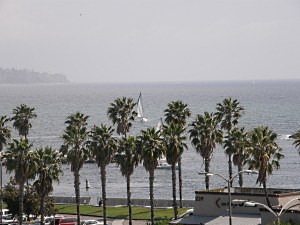
But just about a quarter of an hour south of Los Angeles International Airport is Redondo Beach, where you can soak in sun, sand, surf and seafood at a leisurely pace that would make the Beach Boys, who are from this largest of the South Bay beach cities, proud.
Redondo – it means “round” in Spanish – Beach sits just north of the Palo Verdes Peninsula, which wraps itself around both Hermosa Beach and Manhattan Beach, with Catalina Island perched on the horizon. It could mean redolent because it’s a comfortable California corner to hang around and smell the sea.
It’s also known as Surf City. The first surfing outside of Hawaii occurred in Redondo Beach in 1907. Irish-Hawaiian George Freeth was paid to “walk on the water” by Henry Huntington to mark the opening of and attract attention to his railway connecting Redondo Beach with Los Angeles. Soon after, small groups of people began catching the waves that rolled onto Redondo and the practice spread. Freeth, who died of the Spanish flu in 1919 in his mid-30s, also became California’s first official lifeguard.
Walking alongside the forest of sailboat masts crowding the shoreline here, you’re likely to be invited to join in a Frisbee toss by a mixed group of surfers, homeless, locals and whomever are just enjoying the climate and community. This can be before or after you’ve downed a half dozen, or more, oysters at one of the fresh-fish markets lining the horseshoe-shaped pier.
If you think that’s all there is, just look around. Hop onto a whale-watching boat that takes just minutes to get from its berth to the open ocean, pedal a glass-bottomed boat to view marine life in the harbor, paddle a kayak out to the barking seal colony hanging around the buoys, or buy a kite and watch it fly alongside the Pacific. How about taking a chance on improving your fortune by picking out your own oyster at one of the assortment of shops and saloons on The Pier and having the proprietor shuck out its pearl for you.
You can rent a bike and, if your legs hold out, pedal up to the famed Santa Monica pier. If you’re really dedicated, you can keep on going all the way to Malibu. You don’t have to trek that far to bump into a celebrity or two, for a couple of reasons.
First of all, developers dubbed this beach area “The Hollywood Riviera” in the 1920s. There’s a Riviera Village on the city’s southern border offering shopping from a Farmers Market that lets you sample its produce and fashion and furnishings boutiques packed into a six-block area peppered with exquisite eateries.
Redondo Beach is not only pretty handy for the residents of movieland, it’s also a handy site for cinema shoots. You might recognize segments and scenes from “Pirates of the Caribbean,” “Baywatch,” “X Files,” “The Cannonball Run,” “90210,” “Star Trek,” “24,”and “CSI:Miami,” to name a few of the dozens and dozens of movies and television shows shot here.
If you happen to be here on a weekend, check the Hermosa Beach Comedy and Magic Club a few blocks north of the Redondo Beach border to see if late-night television host Jay Leno is on tap. He does a show there about 40 Sundays a year.
At the northwest corner where these two beach cities meet is the imposing AES electric power plant. Many cinematic sequences have been taken inside this cavernous building but its outside bears the life-size depiction of “Gray Whales Migration,” a mural painted in 1991 by marine-life artist Robert Wyland. It’s across the street from the SeaLAB, a see-and-touch attraction for folks of all ages operated by the Los Angeles Conservation Corps to rescue and rehabilitate creatures sucked into the power plant’s turbines.
Mature Life Features, Copyright March 2011
 Mature Life Features