On a Mission to Capture California Wines and Times
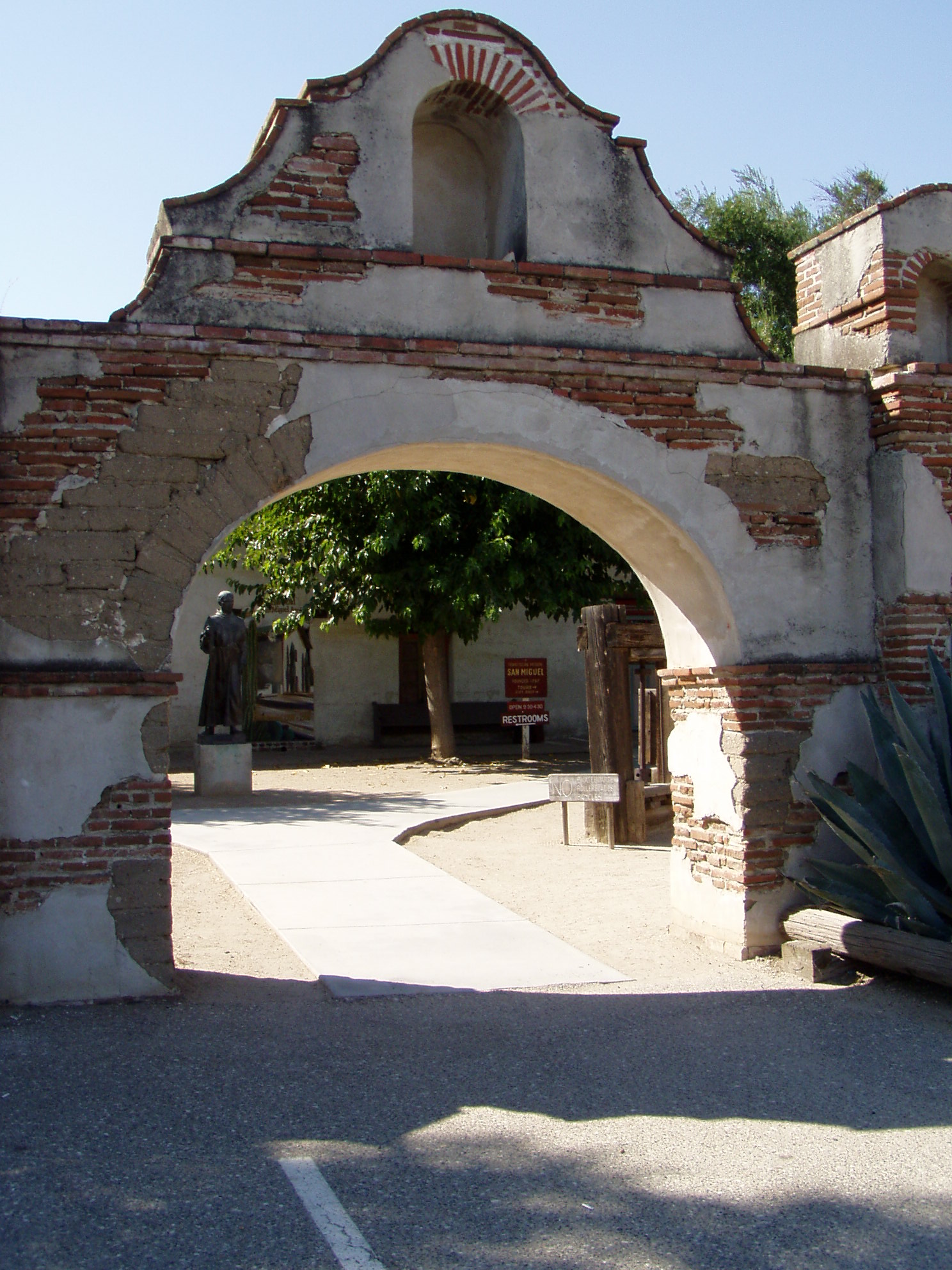 Mission San Miguel arch frames a statue of Fr. Junipero Serra, the Franciscan founder of California’s 21-mission chain.
Story & photo by
Cecil Scaglione
Mature Life Features
The real California, that land that’s a mixture of myth and movies, does exist.
All you have to do is follow the California mission trail down the 100-mile-long Salinas Valley, dubbed the Salad Bowl of the World, from Mission San Juan Bautista outside Salinas to San Luis Obispo mid-way between Los Angeles and San Francisco.
We took the scenic River Road that parallels the Salinas River and Highway 101 as far south as Mission Soledad. This quiet out-of-the-way mission is the 13th established by the Franciscan friars in the chain that forms the spine of the Golden State. It sits on a site that was served by native-built redwood aqueducts from hot springs eight miles away on the flanks of the Coastal Range.
Within a couple of hours’ drive time north from ‘Obispo are several other missions – Santa Cruz, San Carlos Borromeo del Rio Carmelo at Carmel, La Soledad, San Juan Bautista, San Antonio, and San Miguel. They’re all worth a look-see but we saved a few for a return trip.
We drove onto the Hunter Ligget Military Reservation to get to Mission San Antonio, the next one down the road from Soledad. It was established third after the missions at San Diego and Carmel and is the only such sanctuary still on a military base. Besides serving as centers for settlement, the 21 California missions were built as military complexes roughly a day’s horse-ride apart.
It’s southern neighbor, San Miguel, was established in 1797 as the 16th mission on El Camino Real (The King’s Highway). Window panes are still made of stretched sheepskin, similar to those the padres substituted for glass.
Before heading on down to 240-year-old Mission San Luis Obispo de Tolos, we ducked into Paso Robles, one of the best-kept secrets on this out-of-the-mainstream tourist trail. It anchors a rolling Tuscan-lookalike landscape that supports some 70 wineries. It’s still a land where cowboys and charros share a glass of locally made wine after a hard day corralling cattle, manhandling trucks and tractors laden with produce of all kinds, or working the vineyards that quilt the undulating countryside.
Vintners here are even known to down a cold beer after a hot day tending vines.
Mature Life Features, Copyright 2004
Hyundai’s Santa Fe Crossover Hauls With Verve

Story & Photo
By James Gaffney
Mature Life Features
From the second you hear the welcome jingle that plays when you shut the door, you feel something is different about the new Hyundai Santa Fe. Step down on the gas pedal and feel the zesty acceleration of this five-passenger, compact crossover’s new power plant: a 2.0-liter, four banger, mated to a six-speed automatic transmission, that pushes out 264 horses and 269 pound-feet of torque.
What the Korean automaker seems to understand is that driving a bantam-sized crossover designed to pull double duty as a family hauler doesn’t have to be boring.
The third-generation transporter, which began rolling off the assembly line at Hyundai’s North American factory in Alabama in 2012, is anything but boring thanks to the near-complete overhaul the car maker has given its entire fleet.
The new Santa Fe’s base model 2.0-liter, four-cylinder tranny, for example, replaces the outgoing V-6 for overall improved fuel economy (20/27 city/highway miles per gallon, respectively), while offering better acceleration thanks to a turbocharged direct-injection system.
An optional all-wheel-drive transmission makes the vehicle better equipped for handling inclement weather and occasional off-road treks (though the Santa Fe is by no means a 4×4 rock eater). On highways the AWD can be turned off to deliver maximum power to the front.
Cabin materials also received an upgrade. Quality hard plastics and soft-touch surfaces are in abundance. Premium leather upholstery is available for consumers wishing to fork out the extra cash for this upgrade. A refreshed interior offers a more eye-pleasing and user-friendly design as seen in the center console, center stack and driver’s-side instrument cluster. Well-designed nooks and cubbies offer ample storage space for smart phones, maps and notepads. A smart, duo-tone color palette is accented by faux polished-wood flourishes, all of which add a surprising touch of elegance to a car that doesn’t boast a luxury badge.
One design flaw I found in the cup holders was that they are not designed to conform or accommodate containers of varying size.
With ample leg room and headroom in front and back, the new Santa Fe seems better designed for long hauls and road trips without the driver getting an earful of complaints from cramped backseat passengers. A pull-up panel in back creates additional rear cargo storage, though segmenting this under-surface space into quadrants seems at cross-purposes with the goal of a free-flowing storage design. Coming to the rescue are 40/20/40 split-folding back seats which, when folded forward, create a cargo zone that puts the Santa Fe on par with other vehicles in its class and segment.
If the Santa Fe can finally stake a claim as a serious competitor against chief rivals that include the Ford Escape, Honda CR-V, Chevy Equinox and Mazda CX-5, chalk it up in part to the long list of standards that come with the entry-level model: 17-inch wheels, front fog lamps, rear spoiler, cruise control, tilt-telescoping steering wheel, 40/20/40 split-folding rear seats, satellite radio, and Bluetooth and USB-iPod integration.
Starting MSRP for the base model is around $24,450. My top-trim 2.0T AWD test car cost $35,925. The Santa Fe Sport may not be the best of all possible worlds, but it deserves to be on the crossover test-drive checklist for car buyers looking for decent fuel economy, a spirited drive, and good cargo capacity.
(James Gaffney is automotive editor-at-large for Seven magazine and the former automotive columnist at The Times-Picayune in New Orleans.)
Mature Life Features, Copyright 2013
Free Lunch
By Cecil Scaglione
Mature Life Features
After a lifetime of being told there’s no such thing as a free lunch, I got one this week.
Well, sorta.
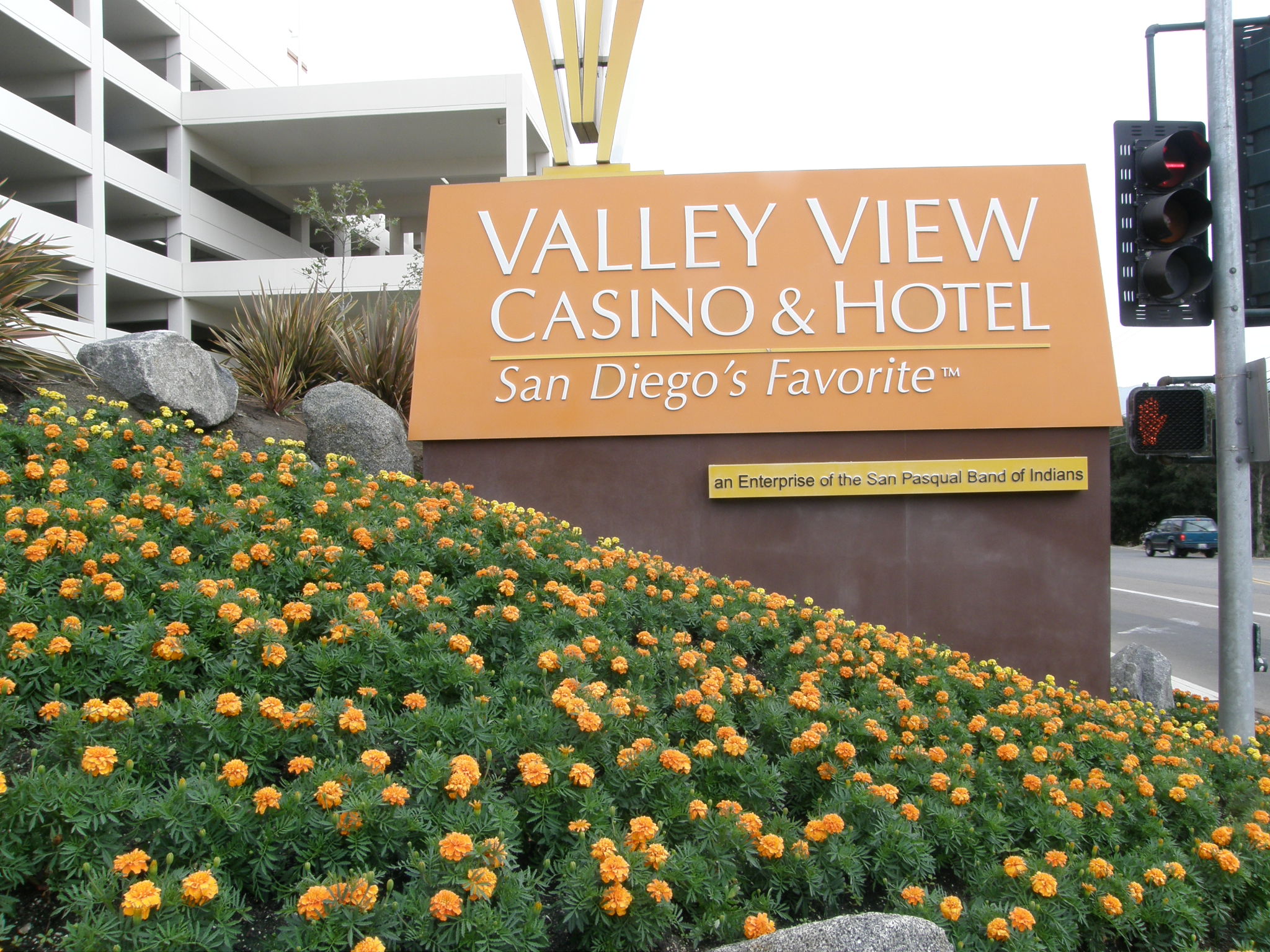
It was during a date made by my wife, Bev, to meet a long-time friend at the Valley View Casino in north San Diego County. The casino-restaurant-hotel complex calls itself “San Diego’s Favorite” and boasts about featuring lobster under a portion of its glass-covered buffet counters.
The event dictated that we not worry about what didn’t get done around the house after the kids and grandkids returned to Phoenix Tuesday, wrapping up a weekend visit. We got most things re-arranged and cleaned up but the rest was left until after Bev’s auld-lang-syne appointment because she didn’t want to be so weary she couldn’t enjoy re-gossiping about the old days and catching up on the new days with her former neighbor, who had moved to Hawaii for several years before returning to Southern California after her husband died.
It took us about an hour to drive up to the casino, one of a dozen or so in the county. As the name suggests, it’s perched on a high hill overlooking the countryside that’s made up mostly of a deep valley surrounded by scrubby-looking hills peppered with scrubby looking rocks, shrubs and trees.
As the ladies dived into reminiscing while feeding a couple of slot machines, I went to a nearby counter and registered for a Player’s Cub card so the San Pascual Indian tribe could track how much money I lose. And I was told I get a free buffet, either lunch or dinner, with my new card.
I rushed back to tell Bev and she decided to get herself a free lunch — er, Players Club card — too.
As it turned out, the ladies quit feeding the machines and decided to feed themselves about the time I was ready to build my fortune. Bev’s wins and losses had bounced up and down and she wound up around $20 down. Since the buffet costs $19.95, she broke even. And, since I never got the opportunity to test my luck, I got a free lunch.
The operators have every right to boast about the buffet. It was extensive and fresh, with plenty of variety. But no lobster at lunch, only at dinner.
Bay-Area Attractions Blend in Monterey
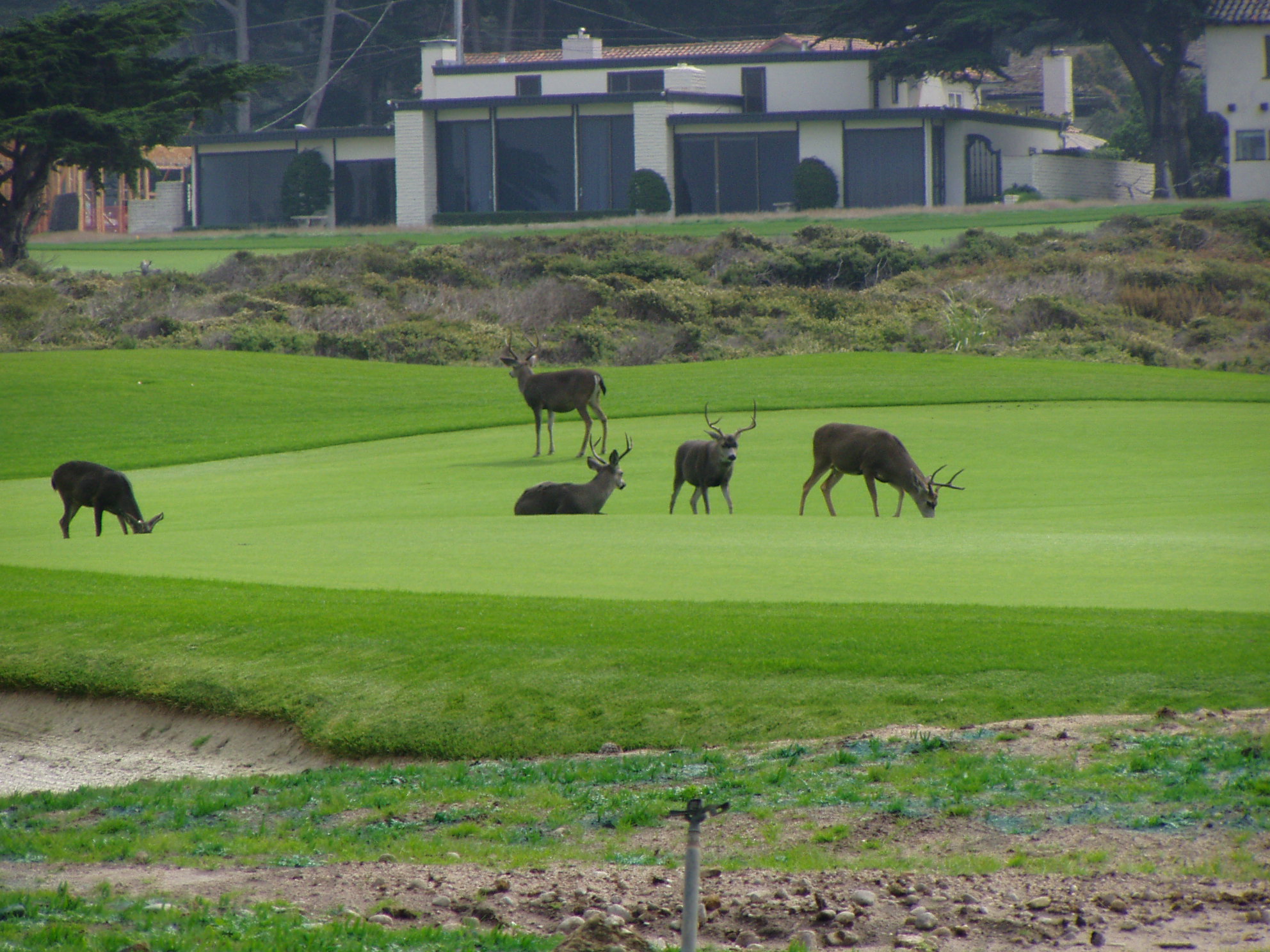 Deer manicure a Monterey Peninsula golf course.
By Cecil Scaglione
Mature Life Features
MONTEREY —- The cops warned us about the raid.
The man in the police uniform announced a few decibles above Rosine restaurant’s late-lunchtime chatter: “You have 17 minutes to move your cars.”
We either had to finish eating in that time or rush out and move our vehicles from their
downtown parking spots before a fleet of tow trucks swooped down Alvarado Street to move
them for us.
Right behind them was an army of vans and pickups that swarm into the commercial core of this
city of 29,000 to set up a weekly farmers’ market and craft fair that has been pleasing penchants ranging
from popcorn to porcelain, and puppets to pumpkin bread since 1991.
The rush is repeated every Tuesday throughout the year. Most of the produce on sale springs out of the neighboring salubrious Salinas Valley. It has been dubbed the Valley of the World by Salinas’ native son, Pulitzer- and Nobel-prizewinner John Steinbeck. It is also the model for “East of Eden,” one of his many renowned novels.
Cradled between the Coastal Range on the west and Pinnacles on the east, this funnel of fertility
stretches some 100 miles south to the Paso Robles-San Luis Obispo-Morro Bay region.
Earlier in the day, we covered the Presidio and Fisherman’s Wharf, smaller but more comfortable
versions of their similarly-named counterparts several miles north in San Francisco. They’re
much more accessible in this City by the Bay – Monterey Bay.
Within strolling distance are Cannery Row, also made famous by Steinbeck, and its world-
renowned aquarium. The carnival atmosphere of the Wharf, with its cotton candy and pull taffy, is so permeating you
begin to look for fire eaters and bearded ladies. Spielers shout enticements and offer cuisine
samples to lure you into whatever restaurant they happen to be standing in front of.
Dining is not to be pooh-poohed here. Menus at eatery entrances feature dishes ranging from
abalone to zucchini. If there isn’t enough there for the gourmand, you’re still here, just minutes away in Cannery Row with its eclectic array of boutiques, saloons, and dining dens. It also serves as a megaphone proclaiming the
dozens of wineries and their products in the Monterey Peninsula as well as reminding visitors
this is Steinbeck country.
The late author’s home town is 30 minutes east of Monterey’s neighbor, Marina, with its spume-
sprayed sand-dune beaches. There’s a Steinbeck Center in Salinas that fleshes out the author’s
course from farm laborer to literary lion with such memorable titles as “Tortilla Flats,” “The
Grapes of Wrath,” “Sweet Thursday,” and, of course, “Cannery Row.”
This agricultural hub feels longitudes away from the scenic and storied 17-mile drive, Pebble
Beach and Big Sur. Aiming your auto west for just half an hour gets you right back to the
brisk Pacific breezes that constantly massage these shores.
Our first approach was made by taking the winding 100 mile coastal Highway 1 from Carmel to Cambria.
If you plan to make this drive, take plenty of time and film. There are vistas at every curve of the
road, and there are hundreds of curves. You can also take time to visit the fabled Hearst Castle at
San Simeon or stop for a respite at the Arthur Miller Library tucked into a rock-and-tree-walled
nook alongside the road.
A pleasant surprise at the northern tip of the Monterey Peninsula are the vistas from Ocean View
Boulevard, which borders the coastal edge of Pacific Grove, Monterey’s western neighbor. And
you don’t have to pay the $9.75-per-vehicle required to take the 17-mile drive. It was
worth the price because we got to see the famed California mission at Carmel, Monterey’s
southern neighbor, before we began the scenic drive from that city’s entrance.
We also got to see deer pottering about on the golf greens overlooking Spanish Bay. This was
reprised the following morning when a doe and fawn traipsed below our balcony at the Asilomar
Conference Center, a rustic retreat on the Pacific dedicated to the simple life. It was a culture-shock away from our previous night’s stay in a luxurious Marina Dunes suite on the opposite side of Monterey Bay.
Mature Life Features, Copyright 2004
YOUR STUFF …
 … may be what dreams are made of,

but it can become a nightmare
when you have to throw it out
…or have a garage sale.
— Cecil Scaglione
Mature Life Features
Spokane Bets Generosity Trumps Glitz ‘n’ Glamor
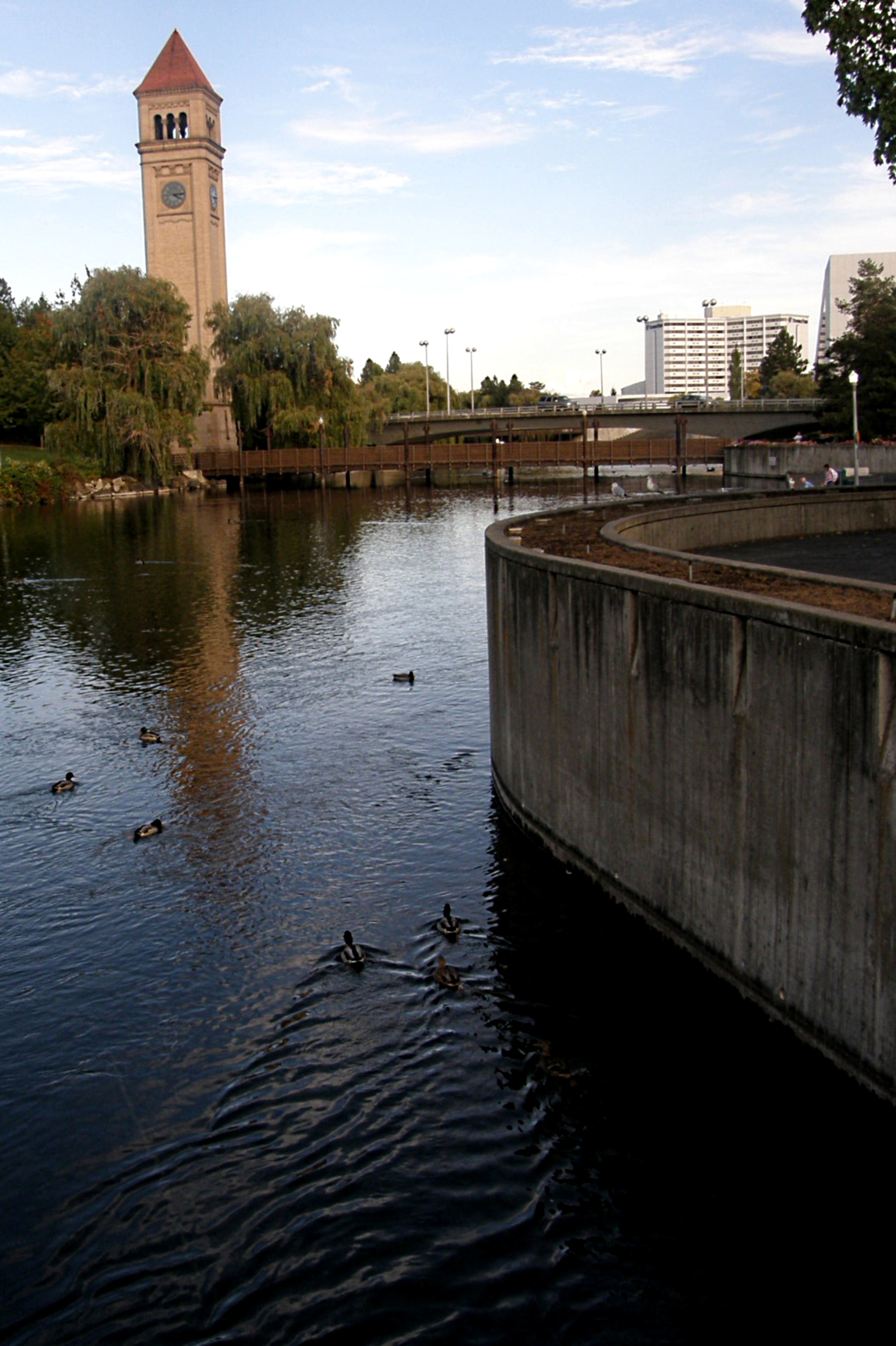 110-year-old clock tower alongside Spokane’s river
is all that remains of the Great Northern Rail Depot
Story & photo by
Cecil Scaglione
Mature Life Features
SPOKANE, Wash. – As Nevada’s Glitter Gulch kicks the “H” out of hospitality in its dedicated drive for dollars, a gaming group here is tucking it back in.
For example, players’ club members at the Northern Quest Resort and Casino about 15 minutes from downtown get a credit on their losses if they return to play. Diners at Masselow’s, the triple A Four Diamond main restaurant among the 14 eateries in the complex, receive a miniature bark-canoe-full of fry bread and huckleberry jam. Occupants of its 250 rooms, who can have a Fatburger delivered to their room at any time of night or day, get free airport shuttle service as well as to and from downtown Spokane. Women even get one-third off the price of a cigar on Ladies Night (Thursday) in the comfortable spirits club room.
It’s down-home service with a swagger. You can see it all around you on the 250-acre Quest complex that was awarded to the 400-member Kalispel tribe in trust because the contours and condition of their reservation an hour north make it unfeasible to build any commercial enterprises on that land.
Besides concerts and other on-site diversions associated with casinos, there’s plenty do when you leave a gaming table or slot machine and head for daylight. Everyone on staff is quick to tell you there are innumerable lakes and rivers and mountains within 40 minutes of the casino.
Hiking, biking, fishing, birding, skiing, snowshoeing: they’re all available. So is picking your own apples – there are more than 100 varieties to choose from – nectarines, peaches, strawberries, corn, carrots, grapes and several other types of fruit and vegetables in season. They’re tended by the dozens of farms and orchards clustered around Green Bluffs an hour north of town.
Several have mini playgrounds to keep youngsters entertained while you harvest. If you don’t have the time or energy to gather your own, you can buy just-picked picked produce, along with wedges of freshly made pies, jellies and jams, and an array of tongue-teasing homemade products.
If hunting is your hobby, “Deer are like rabbits around here,” according to one local resident.
While driving around the countryside, you can stop at any of the several wineries and sip samples. At Townshend Cellars, we were treated to a 2002 huckleberry port. An added attraction at the Arbor Crest tasting room, better known as The Cliff House, is the view. There’s the Spokane skyline over one shoulder and the mountains of Idaho over the other.
The east-west Spokane River flows below. It’s bordered by the Centennial Trial, a 39-mile paved strip open to hikers, bikers, skaters and horses that stretches from the neighboring state line to the east on through downtown Spokane’s Riverfront Park.
A major feature of the park, which was a hub of activity during the city’s 1974 World’s Fair, are the falls that pour water westward through the heart of the city.
After touring the city and countryside, your hunger can be assuaged by a 22-inch one-pound hot dog in The Q, the casino’s sports bar dominated by the largest plasma television screen produced by Panasonic. It’s 10 feet by 30 feet. You can add fries to that dog with local fry sauce, a mixture of ketchup and mayonnaise.
Mature Life Features, Copyright 2012
On a Mission in San Diego

By Cecil Scaglione
Mature Life Features
Played tourist at home this weekend and took the camera to visit Mission San Diego de Alcala.
It’s worth spending some time there, especially when you move from the busy front into the quieter and more spacious courtyard encapsulated by the Spanish-colonial structure housing a museum, priests’ quarters, chapel, and more (like public bathrooms). Happened upon a wedding in the parish that Franciscan Junipero Serra established in 1769 as the first of the 21 missions that form the spine of California.
The original Spanish settlement was where Old Town is now, below the Presidio tower on the hill that allowed settlers to get a strategic early view of any ships sailing into San Diego Bay.
The friars decided to move their neophyte native converts away from the lascivious soldiers so they moved the church and school about five miles up the San Diego River – the distance in which tolling bells could be heard.
Among the exhibits is a showcase of models of the missions stretching from here to north of San Francisco in the order in which they were founded. It’s a quick look at California’s early development.
While they were situated within a day’s march of each other – anywhere from about 30 to 50 miles – they weren’t founded in order from south to north. The next mission established after San Diego was in Carmel just south of San Francisco.
However, to follow El Camino Real (The King’s Highway) formed by the mission chain, drive up Highway 5 to the largest mission in the chain – Mission San Luis Rey in Oceanside. Next is San Juan Capistrano and then there’s…
Con Artists As Dangerous as Mugger with a Gun

By Cecil Scaglione
Mature Life Features
Con artists feed on the greedy and the careless. And also on the polite. Folks continue to give out numbers for their bank accounts, credit cards, and Social Security just because a caller has requested them.
The unseen solicitor poses as a fraud investigator looking into charges have been made against your credit card and offers to repair your account. He or she will ask to verify your numbers and address and other such information.
Ask for a phone number so you can call them back. Then hang up, whether they give you a number or not. Don’t be polite. They’re crooks trying to steal your money. Call the local Better Business Bureau and tell them about the call.
If you’re concerned about your credit-card account, call the phone number on the back of the card to discuss the
matter with a company representative.
The ubiquitous cell phone with a camera has become a weapon these thieves are using more and more. They use telephone camera to take photos of credit cards. That gives them your name,account number and expiration date — enough to run out and clean out your account. So don’t leave your card laying on a counter at the store or table at a restaurant.
Never let the card out of your sight. Crooked employees can swipe your card through a scanner to
copy the magnetic strip.
The expanding use of the Internet has widened the horizon for these crooks exponentially. Never
send any information over the ‘Net, unless you’ve initiated the contact with a reputable mail-order house you’ve dealt with regularly, such as Land’s End, or if you’re ordering something from an e-mail house, such as e-Bay or Amazon.
Don’t be fooled by an Internet website that looks official. Scammers can set up an official looking page and have your responses diverted to their own e-mailbox and merrily milk your funds. The Web also is a great marketplace for crooks selling bogus products described as healthful supplements and medical devices.
The old standby scams are still around, like the lottery and Nigerian schemes. The first involves a contact that says you’ve won money in a lottery and all you have to do to get your money is wire funds to cover tariffs and attorney fees because the money is originating from abroad. One Southern California resident was bilked out of more than $250,000 by these schemers not too long ago. The Nigerian plotters have a variety of stories that are all designed to break your bank. there for a bit and they’ll give you a handsome fee.
Then there’s this tried-and-true con. You receive a gaudy piece of mail or an “invitation” that says you’ve won a rather hefty gift or a tempting vacation trip, for example. All you have to do is send a few hundred dollars to expedite the paper work.
Chuck it in the paper shredder. If you don’t have one, get one. They’re inexpensive and can be used to shred all paper that carries sensitive and financial information: statements from your bank, credit-card companies, brokerage firm, and mortgage company.
Watch out for gift checks you receive in the mail. A neighbor cashed in small such check — it was for less than $10 — from a company she had dealt with and learned in her next statement that, by cashing the check, she signed on to pay a monthly fee for a travel service the company provided. She didn’t need any such service since she works for an airline but the firm said by cashing the check, she was automatically signed on, and that was that.
Remember the gilded rule: if something sounds too good to be true, it usually is.
Mature Life Features, Copyright 2004
The Old Gang that Grew Old
The R & R (relatives and reminisces) jaunt back to Canada included an all-too-brief gathering at the Kitchener home of Joe and Edith Brown that drew former newspaper colleagues Gene McCarthy and Ray Alviano and his wife, Lucille.

From left, are ex-Kitchener-Waterloo Record staffers McCarthy, Brown, Scaglione, and Alviano.
Before getting to the “before” pic, lemme offer some background. Gene was a two-way reporter/photog who covered everything from prostitutes to politicians (some might ask “What’s the difference?”) to princes and police and also wrote a book of a sensational case he covered. (I now have a treasured autographed copy perched in my bookshelves.) Joe was a photographer who got smart before the rest of us and left newspapering early to open his own extremely successful business. Me, you know from reading “About Us” in this blog. Ray joined the K-W Record sports department more than five decades ago and became sports editor for several years until he retired.

Now pick us out of the above foto taken in my basement recreation room during the 1960 Christmas season. Gene is at the extreme right. Joe is in front center with his feet (and white socks) extended over a chair. Ray is being hugged by Lucille in center rear. I’m the dark-haired guy with glasses and cigarette under the ceiling light.
We had a lot of fun recalling escapades of that time in our lives. Amazingly, we had few revisions of each other’s remembrances revived in Brown’s living room a few weeks ago.
Want Beer? Go to the Source.
What better way to get our Canadian-beer fix than to head to where it’s brewed. So we blew into the Steam Whistle facility in the Roundhouse at the foot of the CN Tower. Got a bottle and glass of fine pilsener (and a souvenir tasting glass) before heading out into the reconstructed station and pump house and locomotive roundhouse that was a loud and major working railway yard about a century ago. With appetites whetted, we headed west on the Queensway to Prego where Lou reviewed memories with owner (and chef) Angelo before we feasted on one of the house specialities — roasted rabbit. Sun’s out but wind off the lake still has teeth in it…
 Mature Life Features